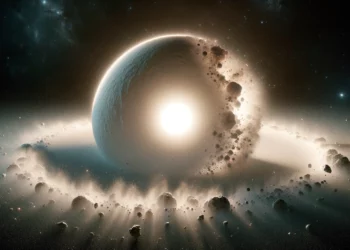
white dwarf

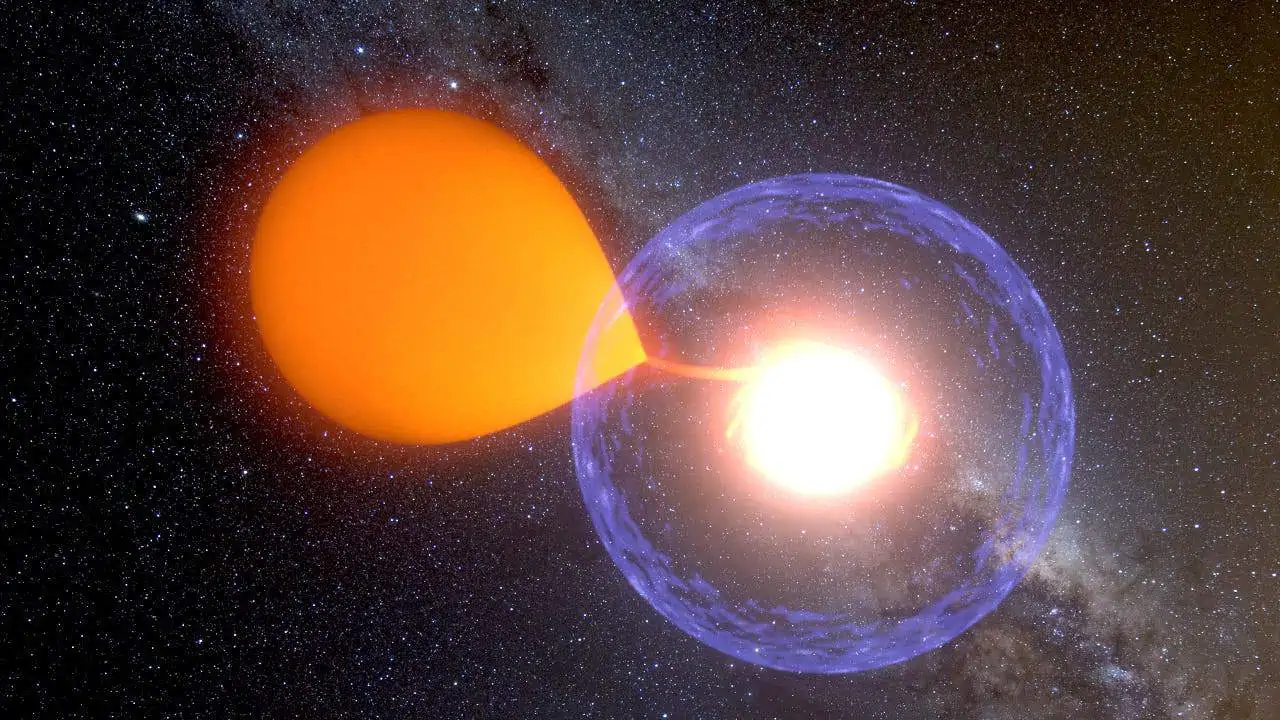
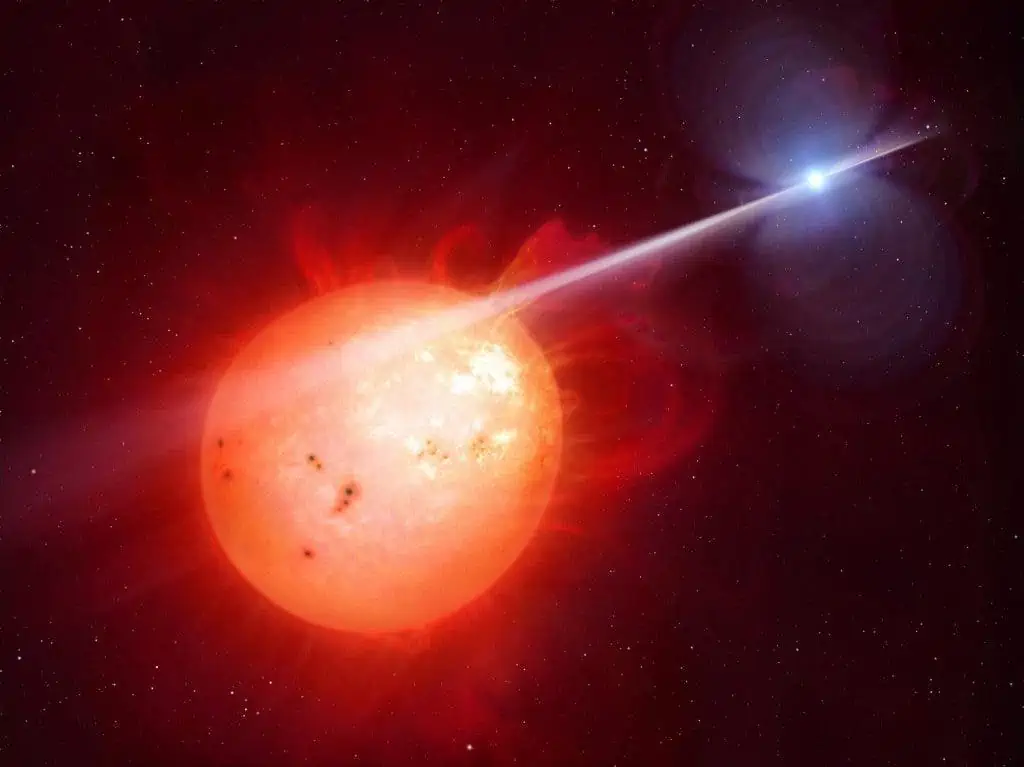
A white dwarf, also called a degenerate dwarf, is a stellar remnant composed mostly of electron-degenerate matter. They are very dense; a white dwarf's mass is comparable to that of the Sun, and its volume is comparable to that of the Earth. Its faint luminosity comes from the emission of stored thermal energy.[1] The nearest known white dwarf is Sirius B, 8.6 light years away, the smaller component of the Sirius binary star. There are currently thought to be eight white dwarfs among the hundred star systems nearest the Sun.[2] The unusual faintness of white dwarfs was first recognized in 1910 by Henry Norris Russell, Edward Charles Pickering, and Williamina Fleming;[3], p. 1 the name white dwarf was coined by Willem Luyten in 1922.[4]

For more information about white dwarf check the Wikipedia article here

ZME Science posts about white dwarf

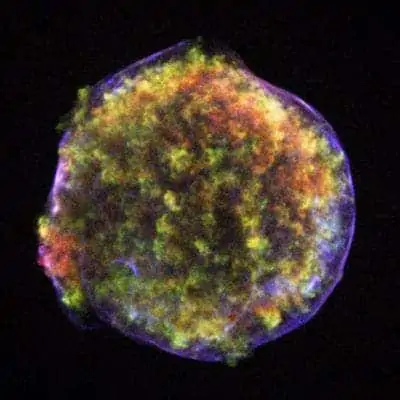
New type of supernova discovered. Hint: it’s tiny and faint

Wed, Mar 27, 2013

0 Comments

Supernovae are highly energetic events caused by the explosion of stars that are at times so bright they can outshine whole galaxies. These are thought to occur in two varieties, but a recently published paper has a described a third type of supernova, one that’s fainter than the other two and distinguishes itself by the [...]

Alien life hunters hold white dwarf stars as safest bet

Tue, Feb 26, 2013

0 Comments

Though hundreds of potentially life harboring exoplanets have been discovered thus far, until the James Webb Space Telescope becomes operational, sometime around 2018, scientists today lack the resources to peer into the guts of these planet and  determine a realistic chance of hosting life. Even when the JWT goes live, however, it will take hundreds [...]

Astronomers paint a clearer picture of how supernovae are born

Wed, Mar 21, 2012

0 Comments

Supernovae are one of the most energetic and brightest events in the cosmos, often so powerful they outshine whole galaxies. They’re considered  to play a major role in our understanding of the Universe, which is why scientists have invested so much time and effort into studying them. A recent study of X-ray and ultraviolet observations from [...]

Coldest star so far found – not hotter than a cup of coffee

Wed, Mar 23, 2011

0 Comments

Astronomers usually classify stellar objects by a spectra going from hotter to cooler, using the letters O, B, A, F, G, K, and M. As observational technology progressed and a myriad of new astronomical findings were made, in the last 15 years alone two new classes  L and T emerged designed to describe ultracool brown [...]

Physicists create a supernova in a jar

Sat, Dec 4, 2010

0 Comments

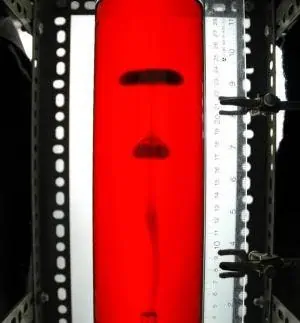
A supernova is a stellar explosion of cosmic proportions, that often can outshine the entire galaxy it is located in, before fading away in a matter of weeks or months. During this short period however, supernovae emit as much energy as the Sun emits during its entire life span – it’s the same kind of [...]

White dwarf considered the hottest ever discovered

Tue, Dec 16, 2008

0 Comments

Astronomy & Astrophysics has published spectroscopic observations of one of the hottest stars discovered so far – a white dwarf called KPD 0005+5106. The observations were made using the space-based Far-Ultraviolet Spectroscopic Explorer (FUSE), showing that the temperature can reach 200 000 K at the surface of the star. Temperatures can get so high that [...]

Astronomers Discover Stars With Carbon Atmospheres

Thu, Nov 22, 2007

0 Comments

We have another piece of evidence which goes to show that we fail to understand numerous things about our universe. Astronomers have discovered white dwarf stars with pure carbon atmospheres. It is something that probably nobody would have believed. The exact way these stars evolved is still pretty much a mystery for astrophysicists. They believe [...]

Subscribe for FREE!

Popular This Week

Drop us a line!

Tip us on news, scientific reports and studies, scientific advances, science art, interesting phenomena or any kind of science related material. Just write to andrei@zmescience.com.