

In an era of unprecedented exploration and discovery, there are still surprising creatures in the animal kingdom — hidden giants that defy our understanding of scale and proportion. From the humid rainforests to the shimmering depths of the oceans, these colossal creatures aren’t the typical titans that first come to mind. This isn’t a story of whales and elephants.
We’re diving into a lesser-known realm, exploring the largest of the small and the giants among the ordinary. Prepare to meet behemoth bugs, colossal crustaceans, and titanic mollusks. On this journey, we’ll defy scale, shatter expectations, and reveal the hidden grandeur of the natural world. Get ready to see Earth’s creatures in a whole new light. Let’s set out together and delve into the fascinating lives of the unassuming giants that share our world.
Welcome to the world of Earth’s unassuming giants, where the small become large and the familiar morphs into the extraordinary.
The Giant African snail
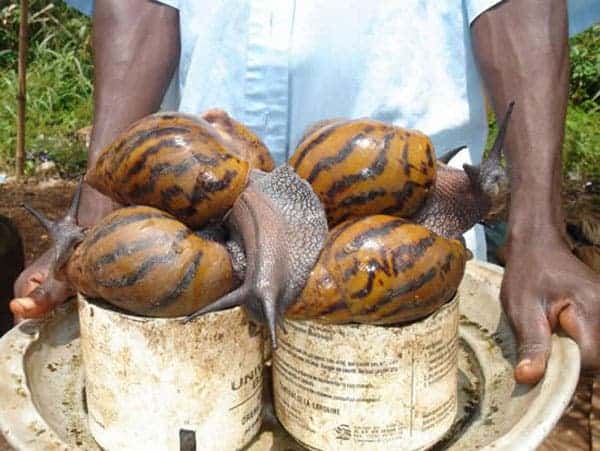
If you’re a snail in Africa, you either go big or go home. Okay, that probably doesn’t make sense at all but bear with me.
Remember your last encounter with a garden snail? Now, imagine that snail, but as big as your foot. Or a bit bigger That’s the Achatina fulica, the Giant African Snail.
The giant Ghana snail, as it’s also called sometimes, is a large, voracious mollusk, sometimes measuring over 30 cm in length.
Native to East Africa, this gastropod is no ordinary slowpoke. It’s the largest land snail species on Earth.
Its size is striking, but so is its appetite. These snails are not picky eaters, they’ll devour almost anything they come across. Consuming over 500 types of plants, these snails are capable of transforming lush landscapes into barren grounds at remarkable speed. Because they eat so much and creates lots of offspring, they’re considered to be one of the most invasive species in the world.
They originate from West Africa, but they’ve found homes all around the world, including areas such as Barbados or Florida — and they are often considered pests because of their invasive nature.
Giant African snails are also routinely confiscated in airports in the US, because they are sometimes kept as pets (something which is not very wise, as they can spread dangerous bacteria and pathogens). Like almost all land gastropods, these snails are hermaphrodites, which means they are both male and female at the same time.
Chinese Giant Salamander
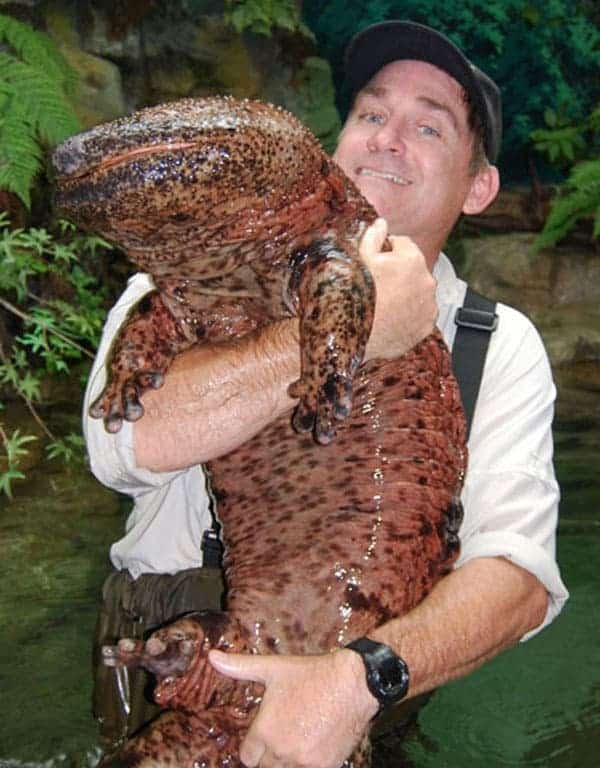
If you’d be strolling along some rocky mountain streams and lakes in the Yangtze River basin of central China and came across this salamander, you’d probably think you were looking at a prehistoric animal. These aquatic beasts are relics of a time long past. They’ve been around for millions of years, and they’ve remained largely unchanged. The Chinese Giant Salamander is indeed a living fossil — but that’s not even what’s most striking about it.
You wouldn’t really think of a salamander when it comes to giant animals, but maybe this will change your mind. The Chinese Giant Salamander (Andrias davidianus) is the largest amphibian in the world, sometimes reaching 1.80 cm. And while they’re not exactly lookers—with their blotchy skin and tiny, beady eyes—their extraordinary resilience and sheer size make them a sight to behold.
However, unlike the above-mentioned snails, the Chinese Giant Salamander isn’t really that adaptable. The species is critically endangered due to habitat loss, pollution, and overcollection, as it is considered a delicacy and used in traditional Chinese medicine. Unfortunately, it’s not that uncommon for Chinese medicine to send an animal to extinction.
The Fruit Bat
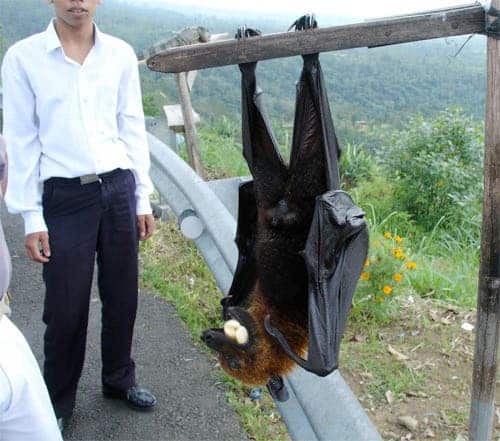
An echo in the twilight. A gentle flap of wings. A ghostly shape on the night sky — that’s what we’ve come to associate with bats. But with a wingspan comparable to human height and the face of a fox, the fruit bat stands out amongst its relatives.
Meet the Fruit Bat, nature’s enormous nocturnal navigator.
Megabats form a group that features the world’s largest bats. However, not all species are huge: the smallest species measures a mere 6 cm. However, the largest species, fruit bats (or Flying foxes as they are sometimes called) have a wingspan of up to 1.5 m (4 ft 11 in).
Though often associated with horror and superstition, fruit bats are vital pollinators and seed dispersers. Their impressive wingspans—reaching over 5 feet in some species—allow them to cover vast distances in search of ripe fruit. And when they find it, they perform a crucial service, spreading seeds far and wide.
Like their relatives, fruit bats have bad eyes. But unlike their relatives, most fruitbats don’t echocolate — they rely on sight and smell for navigation. Unfortunately, because of their strong immune systems, fruit bats also breed very strong pathogens. This makes them reservoirs of several viruses that can affect humans and cause disease.
Giant Freshwater Stingray

Not all Stingrays live in the ocean — in fact, the biggest ones don’t. You’d be more likely to find one of these giant animals in the Mekong river.
With widths of over 2.2 meters (over 7 feet), these underwater behemoths are among the largest fish in the world. But despite their massive size, they’re elusive creatures, their flat bodies allowing them to bury themselves in riverbeds and vanish from sight. To make matters even worse, giant freshwater stingrays are threatened by overfishing and habitat degradation resulting from deforestation, land development, and damming. Just like with the salamander, their numbers are dwindling.
But these giant animals are truly remarkable. The Giant Freshwater Stingray usually weighs 500–600 kg (1,100–1,300 lbs). Its long, whip-like tail is capable of piercing bone, but the species is relatively peaceful and is not aggressive toward humans at all. The giant freshwater stingray is viviparous and nourishes its embryos initially by yolk and later by histotroph (“uterine milk”) provided by the mother.
Giant Weta Cricket
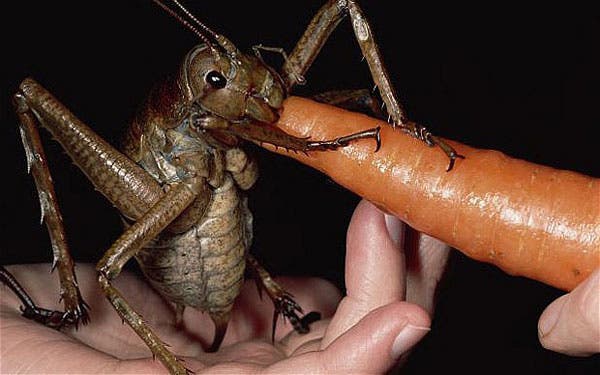
Picture a cricket. Now, supersize it. Now make it a bit bigger. That’s the Giant Weta Cricket, the heaviest insect on Earth, found in the nooks and crannies of New Zealand.
The 11 species of giant weta (Deinacrida spp.) are significantly larger than their relatives, which are themselves larger than most insects. They are found primarily on small islands off the coast of the main islands in New Zealand, and they represent a nice case of island gigantism. They sometimes measure over 10 cm.
Despite their somewhat intimidating appearance, these nocturnal critters are gentle vegetarians, feasting on a diet of leaves, flowers, and other plant material.
So if you ever come across a giant Weta, don’t shriek and run. Instead, take a moment to marvel at the wonder of nature’s scale.
The Nomura Jellyfish
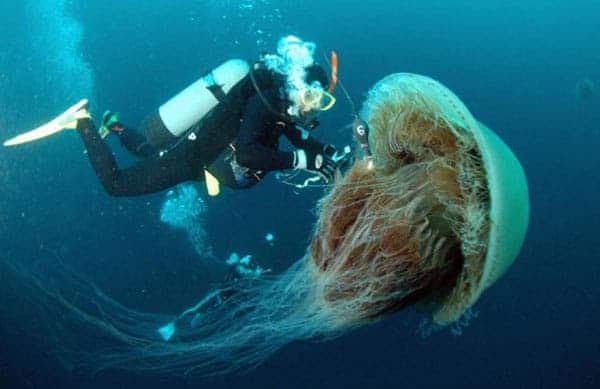
The diameter when fully grown is slightly greater than the height of an average man. They can weigh more than 200 kg and are endemic to Japanese waters. Nomura jellyfish are amazing creatures, but scientists are worried about the bloom in their population. They are so heavy that in 2009, a 10-tonne fishing trawler, the Diasan Shinsho-maru, capsized as its crew tried to haul in a net with dozens of them.
Their nearly transparent bodies are awe-inspiring yet intimidating, lending the ocean a sense of mystery and grandeur. Despite their imposing size, these marine titans are at the mercy of the sea currents, drifting aimlessly and showcasing their majestic forms to the fortunate few who encounter them.
We were so fascinated by these creatures we dedicated an entire article to them. But Japanese authorities are more interested in finding a use for them rather than marveling at their unique biology. Each year this species costs Japanese fisheries serious damage and so an economic solution may be found in converting this invasion into a resource. For instance, a Japanese company produces vanilla and jellyfish ice cream using Nomura’s jellyfish.
The Japanese Spider Crab
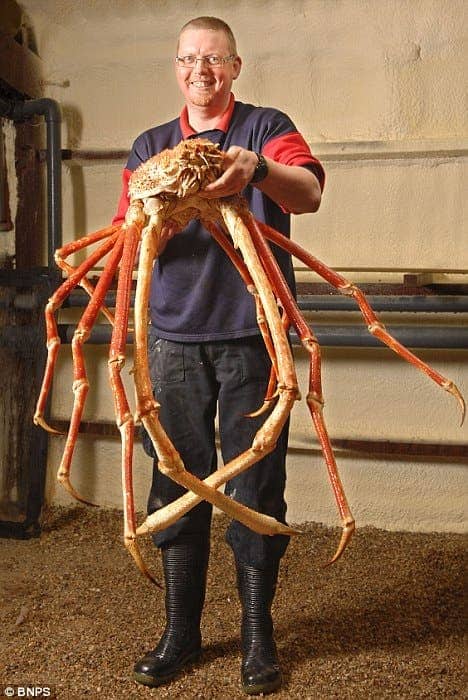
On a dive off the coast of Japan, you feel a tickle on your leg. Looking down, you see something startling. It almost looks alien-like. But fear not—it’s just a Japanese Spider Crab, the largest crustacean on Earth, and it’s harmless to humans.
With leg spans stretching up to 13 feet and bodies that weigh as much as a small dog, these crabs are the armored colossi of the deep sea. Despite their somewhat sinister appearance, they’re gentle creatures, slowly traversing the ocean floor in search of food.
Crabs are quite awesome animals, but there’s probably something in the waters in Japan. Weighing up to 19 kg, the giant Japanese spider crab has long been a Japanese fishing staple and can inflict serious injury with its powerful claws. However, they normally reserve their weapons for their prey They have the greatest leg span of any arthropod, reaching 3.8 meters from claw to claw. Despite its threatening appearance, the Japanese Spider Crab usually has a very gentle disposition.
Plenty of other giants
Life on Earth is truly spectacular. We’ve traversed jungles, plumbed the depths of rivers and oceans. We’ve marveled at creatures that are remarkable not just for their size — but also for their unique adaptations and survival strategies. We haven’t even scratched the surface of Earth’s giant animals.
These titanic creatures remind us of the sheer diversity of life on our planet and of the importance of conserving the many different habitats that support them. From the small garden snail to its massive African cousin, from the average pond-dwelling salamander to its gargantuan Chinese relative, nature presents us with a wondrous tableau of life at every scale.
Let’s remember these behemoths of the wild, not as curiosities, but as integral parts of Earth’s intricate web of life. As we move forward in our own human story, let’s ensure we don’t forget their tales of survival, growth, and sheer enormity. And as we encounter the small, the tiny, and the seemingly insignificant in our daily lives, let’s not forget to look a little closer. You never know—you might just find a giant in disguise.


