
ZME Science
No Result
View All Result
ZME Science
No Result
View All Result
ZME Science

Home → Science

Physical, encryption-like method could help the world finally get rid of nukes

"You can hack electronics, but you can't hack physics," says lead author Areg Danagoulian.

Alexandru MicubyAlexandru Micu
April 24, 2018
in News, Physics, Science, World Problems
A A
Share on FacebookShare on TwitterSubmit to Reddit

MIT researchers have devised a method that could allow states to prove they’re disposing of nuclear weapons without giving away any of their technical details — which are considered state secrets.
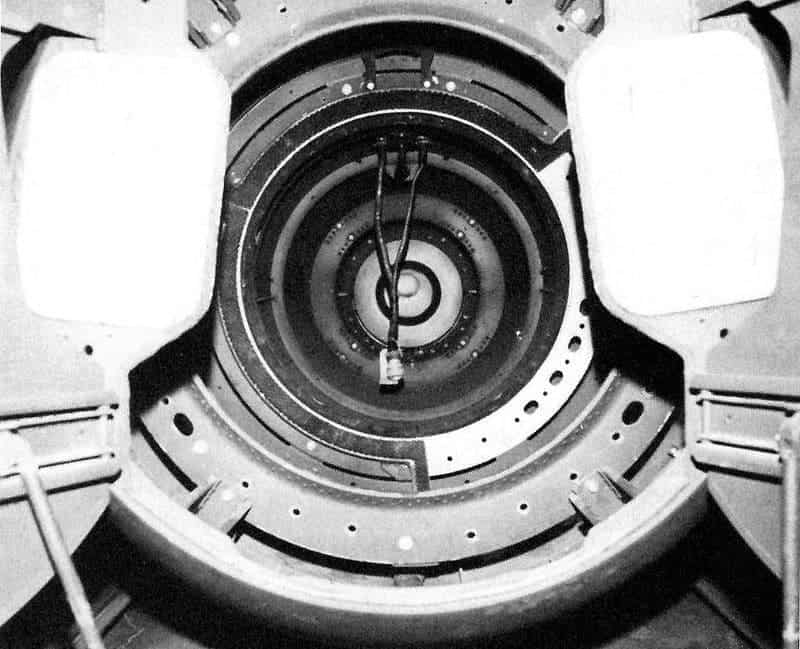
Mark 5.
Open nose cavity US Mark 5 nuclear bomb showing the ‘pit’.
Image credits Scott Carson / US Atomic Energy Commission.

Nuclear disarmament negotiations (particularly those between the U.S. and Russia) always hit a patch of rough ground when verification processes come up. The main point of these talks is to promote nuclear non-proliferation — the understanding that the fewer nukes there are in the world at any one time, and the fewer actors there are with access to them, the easier it will be for humanity not to blast itself back to an irradiated stone age. However, every reliable verification process that the two parties could agree on as trustworthy (i.e. visually identifying the warheads) would give away technical data pertaining to the weapons.

This would never fly. For starters, governments don’t like other people to know how their nukes work — especially the people they’re generally aiming said nukes at. Secondly, such measures would risk disseminating technical details to third-parties, thereby defeating the whole purpose of disarmament efforts. Visual confirmation, then, became a no-go.

To spot a warhead

Now, an MIT research team reports developing a novel method of confirmation that could help promote nuclear disarmament without disseminating any state secrets. The method, similar to a physics-based version of cryptographic encryption systems, can be applied in two different versions — just in case one is found to have drawbacks by any government. The findings were published in two different papers.

Lacking a reliable tool to identify nuclear weapons, and thus bereft of a way to enforce their destruction, past agreements have focused on decommissioning of delivery systems. It makes sense, as it’s far harder to ‘fake’ a plane or a ballistic missile, whereas nuclear bombs are basically spheres of plutonium. Such measures have worked reasonably well up to now, but lead author Areg Danagoulian believes that it only skirted the real issue: to avoid such weapons falling into the hands of terrorist or rogue states, we need to dispose of the actual warheads — which means we need a reliable way to identify them or spot fakes, one to which governments will agree.

“How do you verify what’s in a black box without looking inside? People have tried many different concepts,” Danagoulian says. “But these efforts tend to suffer from the same problem: If they reveal enough information to be effective, they reveal too much to be politically acceptable.”

Their solution draws inspiration from digital data encryption methods, which alter data using a set of large numbers, which form the key. Without this key, the encrypted data is a hodge-podge of characters. However, while it may be illegible, it is still possible to tell if it is identical to another set of encrypted data — if they use the same key, the datasets would be the same hodge-podge. Danagoulian and his team applied the same principle for their warhead verification system — “not through computation but through physics,” he explains. “You can hack electronics, but you can’t hack physics.”

The method analyzes both of a warhead’s essential parts: the sphere of radioactive elements that supply its nuclear ‘gunpowder’, and the dimension of the hollow sphere called a pit that serves as a ‘detonator’ — details pertaining to both elements are considered state secrets. Because of this, they couldn’t simply probe the weapons’ internal characteristics, and they couldn’t tell a fake apart just by measuring emitted radiation.

RelatedPosts

Huge stash of abused Iron Age weapons discovered in a German hill fort
A Rocket Carried Cannabis Seeds and 166 Human Remains into Space But Their Capsule Never Made It Back
Intense Gamma Ray blast indeed traced back to supermassive black hole
Sonic black hole confirms Hawking radiation theory

Negative filter

So what the team did was to introduce a physical key, created from a mix of the same isotopes used in the weapon, but in a ratio unknown to the inspection crew. Similarly to a filter applied to a photo, the key will scramble information about the weapon itself. In keeping with that analogy, the physical key is like a complementary color filter (a picture’s negative) that will cancel out all of the weapon’s emissions when lined up properly. If the investigated object has a different emission pattern (i.e. it’s a fake), it will bleed through the filter, alerting the investigation crew.
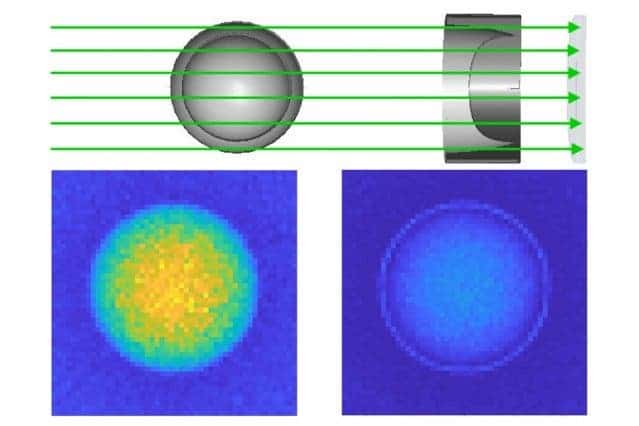
Nuclear verification.
(Top) diagram showing the configuration that could be used to verify that a nuclear warhead is real. (Bottom left) measurement without the reciprocal. (Bottom right) measurement with the reciprocal.
Image credits Areg Danagoulian.

This filter — called a cryptographic reciprocal or a cryptographic foil — will be produced by the same country that made the warheads, thereby keeping their secrets safe. The weapon can be hidden in a black box to prevent visual inspection, lined up with the foil, then get blasted with a beam of neutrons. A detector will then analyze the output and render it as a color image — if the warhead is genuine, the image will be blank. The second variant of this process substitutes a photon beam for the neutron one.

These tests are based on the requirements of a Zero Knowledge Proof — where the honest prover can demonstrate compliance, without revealing anything more. It also benefits from a built-in disincentive to lie. Because the template is the perfect complement of the weapon itself, when superimposed over a dummy it will actually reveal information about the warhead’s composition and configuration — the very things states don’t want others to know about.

It’s a neat concept; the only issue I have with it right now is that it only works if all parties involved are genuine, and do actually create the right reciprocals for their warheads. Still, if the system does someday get adopted and helps bring about significant reductions in the number of nuclear weapons in the world, Danagoulian says, “everyone will be better off.”

“There will be less of this waiting around, waiting to be stolen, accidentally dropped or smuggled somewhere. We hope this will make a dent in the problem.”

The papers “Experimental demonstration of an isotope-sensitive warhead verification technique using nuclear resonance fluorescence” has been published in the journal Proceedings of the National Academy of Sciences; “Nuclear disarmament verification via resonant phenomena” has been published in the journal Nature Communications.

Tags: IsotopesnuclearradiationWarheadsweapons

ShareTweetShare
Alexandru Micu

Alexandru Micu

Stunningly charming pun connoisseur, I have been fascinated by the world around me since I first laid eyes on it. Always curious, I'm just having a little fun with some very serious science.

Related Posts

Agriculture

A Rocket Carried Cannabis Seeds and 166 Human Remains into Space But Their Capsule Never Made It Back

byTudor Tarita
2 months ago
Biology

This Tiny Microbe Can Withstand Extreme Radiation That Would Obliterate Humans. Here’s How It Might Protect Astronauts on a Trip to Mars

byTibi Puiu
8 months ago
Animals

Scientists discover new Tardigrade species that may reveal the secret to their superpower-like radiation resistance

byTibi Puiu
10 months ago
News

AI’s thirst for energy is reopening an infamous nuclear plant in the US

byMihai Andrei
11 months ago

Recent news

The UK Government Says You Should Delete Emails to Save Water. That’s Dumb — and Hypocritical

August 16, 2025

In Denmark, a Vaccine Is Eliminating a Type of Cervical Cancer

August 16, 2025
This Picture of the Week shows a stunning spiral galaxy known as NGC 4945. This little corner of space, near the constellation of Centaurus and over 12 million light-years away, may seem peaceful at first — but NGC 4945 is locked in a violent struggle. At the very centre of nearly every galaxy is a supermassive black hole. Some, like the one at the centre of our own Milky Way, aren’t particularly hungry. But NGC 4945’s supermassive black hole is ravenous, consuming huge amounts of matter — and the MUSE instrument at ESO’s Very Large Telescope (VLT) has caught it playing with its food. This messy eater, contrary to a black hole’s typical all-consuming reputation, is blowing out powerful winds of material. This cone-shaped wind is shown in red in the inset, overlaid on a wider image captured with the MPG/ESO telescope at La Silla. In fact, this wind is moving so fast that it will end up escaping the galaxy altogether, lost to the void of intergalactic space. This is part of a new study that measured how winds move in several nearby galaxies. The MUSE observations show that these incredibly fast winds demonstrate a strange behaviour: they actually speed up far away from the central black hole, accelerating even more on their journey to the galactic outskirts. This process ejects potential star-forming material from a galaxy, suggesting that black holes control the fates of their host galaxies by dampening the stellar birth rate. It also shows that the more powerful black holes impede their own growth by removing the gas and dust they feed on, driving the whole system closer towards a sort of galactic equilibrium. Now, with these new results, we are one step closer to understanding the acceleration mechanism of the winds responsible for shaping the evolution of galaxies, and the history of the universe. Links  Research paper in Nature Astronomy by Marconcini et al. Close-up view of NGC 4945’s nucleus

Astronomers Find ‘Punctum,’ a Bizarre Space Object That Might be Unlike Anything in the Universe

August 15, 2025
  • About
  • Advertise
  • Editorial Policy
  • Privacy Policy and Terms of Use
  • How we review products
  • Contact

© 2007-2025 ZME Science - Not exactly rocket science. All Rights Reserved.

No Result
View All Result
  • Science News
  • Environment
  • Health
  • Space
  • Future
  • Features
    • Natural Sciences
    • Physics
      • Matter and Energy
      • Quantum Mechanics
      • Thermodynamics
    • Chemistry
      • Periodic Table
      • Applied Chemistry
      • Materials
      • Physical Chemistry
    • Biology
      • Anatomy
      • Biochemistry
      • Ecology
      • Genetics
      • Microbiology
      • Plants and Fungi
    • Geology and Paleontology
      • Planet Earth
      • Earth Dynamics
      • Rocks and Minerals
      • Volcanoes
      • Dinosaurs
      • Fossils
    • Animals
      • Mammals
      • Birds
      • Fish
      • Amphibians
      • Reptiles
      • Invertebrates
      • Pets
      • Conservation
      • Animal facts
    • Climate and Weather
      • Climate change
      • Weather and atmosphere
    • Health
      • Drugs
      • Diseases and Conditions
      • Human Body
      • Mind and Brain
      • Food and Nutrition
      • Wellness
    • History and Humanities
      • Anthropology
      • Archaeology
      • History
      • Economics
      • People
      • Sociology
    • Space & Astronomy
      • The Solar System
      • Sun
      • The Moon
      • Planets
      • Asteroids, meteors & comets
      • Astronomy
      • Astrophysics
      • Cosmology
      • Exoplanets & Alien Life
      • Spaceflight and Exploration
    • Technology
      • Computer Science & IT
      • Engineering
      • Inventions
      • Sustainability
      • Renewable Energy
      • Green Living
    • Culture
    • Resources
  • Videos
  • Reviews
  • About Us
    • About
    • The Team
    • Advertise
    • Contribute
    • Editorial policy
    • Privacy Policy
    • Contact

© 2007-2025 ZME Science - Not exactly rocket science. All Rights Reserved.