

ZME Science
No Result
View All Result
ZME Science
No Result
View All Result
ZME Science

Home → Space → Astrophysics

Turns out, another solar system has more planets than ours

Mihai AndreibyMihai Andrei
April 9, 2012
in Astrophysics, Space
A A
Share on FacebookShare on TwitterSubmit to Reddit

Our solar system is special for two reasons: the first one, obviously – is us. Our solar system is the only one we know of so far that hosts life. The second one is the number of planets – no other solar system that we’ve seen until now had as many planets as ours, but this has just changed.

The decade of exoplanets
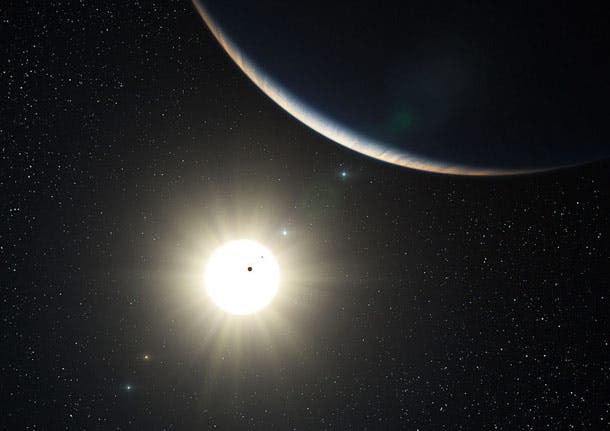
We keep making absolutely stunning exoplanet discoveries, mostly due to the Kepler telescopes, and the decade is just starting! HD 10180, located about 130 light-years away, was already known to have six planets, five roughly Neptune-sized and one the size of Saturn – nothing particularly interesting here, aside for the fact that pound for pound, this already made it a little more crowded than our own solar system.

But a new analysis using the HARPS camera in Chile has turned up a few new planets, enough to give HD 10180 more planets than our own Sun – and the fans of Pluto as a planet are absolutely not going to love this. Guessed it already? HD 10180 has (that’s right) nine planets, breaking the record by only one.

The three additional planets

These new planets have masses of 1.3, 1.9, and 5.1 times that of Earth, and orbit the star with periods (think of that as the planets’ years) of 1.2, 10, and 68 days, respectively. The first two out of three seem pretty well placed in the Earth mass range, and they are what astronomers like to call ‘super Earths‘. However, the first one is only 3 million km (less than 2 million miles) from HD 10180, and the second barely any cooler at about 14 million km (8 million miles) – which makes them closer to their sun than Mercury is to our sun, and the two stars are pretty similar.

Of course, it doesn’t look like they’ll win the ‘most likely to host life’ award, but the solar system snatched our prize! If there’s ever a reason to promote Pluto back to planet status, I say be it now and let us tie for the ‘solar system with most planets’.

For a full review of the findings, check out Bad Astronomy’s post.

RelatedPosts

TESS telescope discovers three intriguing close-by exoplanets
NASA finds 7 Earth-sized planets in a star nearby. Three are in the habitable zone
How many Earth-like planets are there in the Milky Way? Billions, according to astronomers
Not one, but two yet to be confirmed Earth-sized planets could orbit in the outer solar system
Tags: exoplanethd 10180KeplerKepler telescopesolar system

ShareTweetShare
Mihai Andrei

Mihai Andrei

Dr. Andrei Mihai is a geophysicist and founder of ZME Science. He has a Ph.D. in geophysics and archaeology and has completed courses from prestigious universities (with programs ranging from climate and astronomy to chemistry and geology). He is passionate about making research more accessible to everyone and communicating news and features to a broad audience.

Related Posts

News

Distant Exoplanet Triggers Stellar Flares and Triggers Its Own Destruction

byKimberly M. S. Cartier
1 week ago
This is HOPS-315, a baby star where astronomers have observed evidence for the earliest stages of planet formation. The image was taken with the Atacama Large Millimeter/submillimeter Array (ALMA), in which ESO is a partner. Together with data from the James Webb Space Telescope (JWST), these observations show that hot minerals are beginning to solidify. In orange we see the distribution of carbon monoxide, blowing away from the star in a butterfly-shaped wind. In blue we see a narrow jet of silicon monoxide, also beaming away from the star. These gaseous winds and jets are common around baby stars like HOPS-315. Together the ALMA and JWST observations indicate that, in addition to these features, there is also a disc of gaseous silicon monoxide around the star that is condensing into solid silicates –– the first stages of planetary formation.
News

For the First Time Ever We Can See Planets Starting to Form Around a Star

byJordan Strickler
4 weeks ago
Astronomy

The James Webb telescope just found a planet by actually ‘seeing’ it

byMihai Andrei
2 months ago
News

Jupiter Was Twice Its Size and Had a Magnetic Field 50 Times Stronger After the Solar System Formed

byTibi Puiu
3 months ago

Recent news

The UK Government Says You Should Delete Emails to Save Water. That’s Dumb — and Hypocritical

August 16, 2025

In Denmark, a Vaccine Is Eliminating a Type of Cervical Cancer

August 16, 2025
This Picture of the Week shows a stunning spiral galaxy known as NGC 4945. This little corner of space, near the constellation of Centaurus and over 12 million light-years away, may seem peaceful at first — but NGC 4945 is locked in a violent struggle. At the very centre of nearly every galaxy is a supermassive black hole. Some, like the one at the centre of our own Milky Way, aren’t particularly hungry. But NGC 4945’s supermassive black hole is ravenous, consuming huge amounts of matter — and the MUSE instrument at ESO’s Very Large Telescope (VLT) has caught it playing with its food. This messy eater, contrary to a black hole’s typical all-consuming reputation, is blowing out powerful winds of material. This cone-shaped wind is shown in red in the inset, overlaid on a wider image captured with the MPG/ESO telescope at La Silla. In fact, this wind is moving so fast that it will end up escaping the galaxy altogether, lost to the void of intergalactic space. This is part of a new study that measured how winds move in several nearby galaxies. The MUSE observations show that these incredibly fast winds demonstrate a strange behaviour: they actually speed up far away from the central black hole, accelerating even more on their journey to the galactic outskirts. This process ejects potential star-forming material from a galaxy, suggesting that black holes control the fates of their host galaxies by dampening the stellar birth rate. It also shows that the more powerful black holes impede their own growth by removing the gas and dust they feed on, driving the whole system closer towards a sort of galactic equilibrium. Now, with these new results, we are one step closer to understanding the acceleration mechanism of the winds responsible for shaping the evolution of galaxies, and the history of the universe. Links  Research paper in Nature Astronomy by Marconcini et al. Close-up view of NGC 4945’s nucleus

Astronomers Find ‘Punctum,’ a Bizarre Space Object That Might be Unlike Anything in the Universe

August 15, 2025
  • About
  • Advertise
  • Editorial Policy
  • Privacy Policy and Terms of Use
  • How we review products
  • Contact

© 2007-2025 ZME Science - Not exactly rocket science. All Rights Reserved.

No Result
View All Result
  • Science News
  • Environment
  • Health
  • Space
  • Future
  • Features
    • Natural Sciences
    • Physics
      • Matter and Energy
      • Quantum Mechanics
      • Thermodynamics
    • Chemistry
      • Periodic Table
      • Applied Chemistry
      • Materials
      • Physical Chemistry
    • Biology
      • Anatomy
      • Biochemistry
      • Ecology
      • Genetics
      • Microbiology
      • Plants and Fungi
    • Geology and Paleontology
      • Planet Earth
      • Earth Dynamics
      • Rocks and Minerals
      • Volcanoes
      • Dinosaurs
      • Fossils
    • Animals
      • Mammals
      • Birds
      • Fish
      • Amphibians
      • Reptiles
      • Invertebrates
      • Pets
      • Conservation
      • Animal facts
    • Climate and Weather
      • Climate change
      • Weather and atmosphere
    • Health
      • Drugs
      • Diseases and Conditions
      • Human Body
      • Mind and Brain
      • Food and Nutrition
      • Wellness
    • History and Humanities
      • Anthropology
      • Archaeology
      • History
      • Economics
      • People
      • Sociology
    • Space & Astronomy
      • The Solar System
      • Sun
      • The Moon
      • Planets
      • Asteroids, meteors & comets
      • Astronomy
      • Astrophysics
      • Cosmology
      • Exoplanets & Alien Life
      • Spaceflight and Exploration
    • Technology
      • Computer Science & IT
      • Engineering
      • Inventions
      • Sustainability
      • Renewable Energy
      • Green Living
    • Culture
    • Resources
  • Videos
  • Reviews
  • About Us
    • About
    • The Team
    • Advertise
    • Contribute
    • Editorial policy
    • Privacy Policy
    • Contact

© 2007-2025 ZME Science - Not exactly rocket science. All Rights Reserved.