

ZME Science
No Result
View All Result
ZME Science
No Result
View All Result
ZME Science

Home → Science

A lot of plant genes actually come from bacteria. And this may explain the success of early land plants

Even the genes that make us shed tears when cutting onions are bacterial in origin.

Tibi PuiubyTibi Puiu
March 1, 2022 - Updated on January 5, 2023
in Biology, News, Science
A A
Share on FacebookShare on TwitterSubmit to Reddit
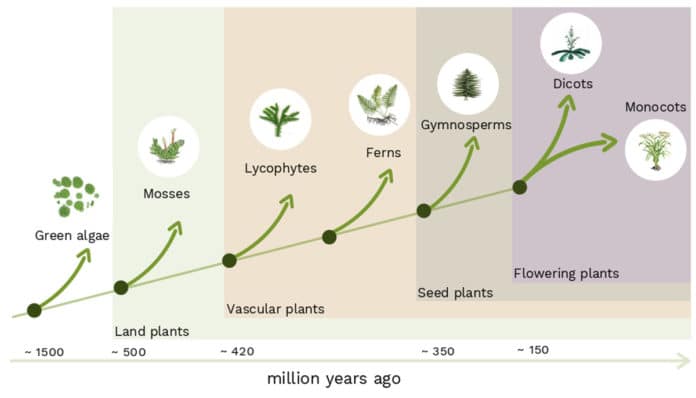
The evolution of land plants (simplified). Around 500 million years ago land plants started to spread from water to land. Credit: IST Austria.

When we think of gene transfer, the first thing that pops into our mind is inheritance. We tend to physically resemble our parents, be it in terms of height, skin tone, eye color, or facial traits, because we inherited genes from each parent, who in turn got their genes from their parents, and so on. Some organisms, however, find sexual reproduction counterproductive for their needs and opt for cloning, creating perfect genetic copies of themselves in perpetuity, apart from the occasional mutated offspring that refuses to be another chip off the old block. But that’s not all there is to it.

Sometimes DNA jumps between completely different species, and the results can be so unpredictable, they can dramatically alter the course of the evolution of life on Earth. Case in point, a new study makes the bold claim that genes jumping from microbes to green algae many hundreds of millions of years ago, shifted the tides and drove the evolution of land plants. Hundreds of genes found in plants thought to be essential to their development may have originally appeared in ancient bacteria, fungi, and viruses and became integrated into plants via horizontal gene transfer.

Speaking to ZME Science, Jinling Huang, a biologist at East Carolina University and corresponding author of the new study, said there could have been two major episodes of horizontal gene transfer (HGT) in the early evolution of land plants.

“Many or most of the genes acquired during these two major episodes have been retained in major land plant groups and affect numerous aspects of plant physiology and development,” the researcher said.

Sharing (genes) is caring

Genome-swapping events are rather common in bacteria. In fact, HGT is one of the main reasons why antibiotic resistance is spreading rapidly among microbes. This exchange of genetic material can turn otherwise harmless bacteria into drug-resistant ‘superbugs’.

Until not too long ago, HGT was thought to occur only among prokaryotes like bacteria, but recent evidence suggests that it can also happen in plants and even some animals. For instance, a 2021 study made the bold claim that herrings and smelts, two groups of fish that commonly roam the northernmost reaches of the Atlantic and Pacific Oceans, share a gene that couldn’t have been transferred through normal sexual channels — in effect, the researchers claim that HGT took place between two vertebrates.

“In genetics classes, we learn that genes are transmitted from parents to offspring (as such, kids look similar to their parents). This is called vertical transmission. In horizontal gene transfer, genes are transmitted from one species to another species. Although the importance of HGT has been widely accepted in bacteria now, there are a lot of debates on HGT in eukaryotes, particularly plants and animals. The findings of this study show that HGT not only occurred in plants, but also played an important role in the evolution of land plants,” Huang told ZME Science.

RelatedPosts

Scientists coax bacteria to assemble into a pressure sensor
Scientists make plastic self-cleaning surface that repels even the worst superbugs
Multicellular Life may have ‘cheated’ its way into Existence
Study proposes five new rules to prevent antibiotic resistance “disaster”

In order to investigate the role of HGT in early plant evolution, Huang and colleagues from China analyzed the genomes of 31 plants, including mosses, ferns, and trees, as well as green algae related to modern terrestrial plants. The researchers suspected quite a few genes transferred over from bacteria, but the results were totally surprising. They suggest that nearly 600 gene families — far more than researchers had expected — found in modern plants were transferred from totally foreign organisms like bacteria and fungi.

Many of these genes are thought to be involved in important biological functions. For instance, the late embryogenesis abundant genes, which help plants adapt to drier environments, are bacterial in origin. The same is true for the ammonium transporter gene that’s essential for a plant’s ability to soak up nitrogen from the soil to grow. And if you just despise cutting tear-jerking onions, you have HGT to blame too. The researchers found that the genes responsible for the biosynthesis of ricin toxin and sulfine (the irritating substance released when we cut onions) are also derived from bacteria.

“We were a little surprised to find those genes,” Dr. Huang told me, adding that his team was able to reconstruct the phylogenies (the history of the evolution of a species) for the genes using independent lines of evidence to determine whether a gene is derived from bacteria and the result of some inherited mutation.

“For instance, an ABC complex in plants consists of two subunits. Phylogenetic analyses show that both genes were acquired from bacteria. We also found that the two genes are positioned next to each other on the chromosomes of both bacteria and some plants, suggesting that the two genes might have been co-transferred from bacteria to plants,” the scientist added.

The establishment of plant life on land is one of the most significant evolutionary episodes in Earth history, with evidence gathered thus far indicating that land plants first appeared about 500 million years ago, during the Cambrian period, when the development of multicellular animal species took off.

This terrestrial colonization was made possible thanks to a series of major innovations in plant anatomy and biochemistry. If these findings are true, bacteria must have played a major role. Due to HGT, the earliest plants could have gained advantageous traits that make them more adapted to their novel terrestrial environment almost immediately, rather than having to wait for who knows how many thousands or even millions of years to develop similar genetic machinery.

The findings appeared today in the journal Molecular Plant.

Tags: bacteriaplants

ShareTweetShare
Tibi Puiu

Tibi Puiu

Tibi is a science journalist and co-founder of ZME Science. He writes mainly about emerging tech, physics, climate, and space. In his spare time, Tibi likes to make weird music on his computer and groom felines. He has a B.Sc in mechanical engineering and an M.Sc in renewable energy systems.

Related Posts

Biology

Scientists Taught Bacteria to Make Cheese Protein Without a Single Cow

byTudor Tarita
4 weeks ago
Chemistry

A Simple Heat Hack Could Revolutionize How We Produce Yogurt

byMihai Andrei
4 weeks ago
Health

There might be an anti-aging secret hiding in magic mushrooms

byTudor Tarita
1 month ago
Environment

This New Bioplastic Is Clear Flexible and Stronger Than Oil-Based Plastic. And It’s Made by Microbes

byTudor Tarita
1 month ago

Recent news

The UK Government Says You Should Delete Emails to Save Water. That’s Dumb — and Hypocritical

August 16, 2025

In Denmark, a Vaccine Is Eliminating a Type of Cervical Cancer

August 16, 2025
This Picture of the Week shows a stunning spiral galaxy known as NGC 4945. This little corner of space, near the constellation of Centaurus and over 12 million light-years away, may seem peaceful at first — but NGC 4945 is locked in a violent struggle. At the very centre of nearly every galaxy is a supermassive black hole. Some, like the one at the centre of our own Milky Way, aren’t particularly hungry. But NGC 4945’s supermassive black hole is ravenous, consuming huge amounts of matter — and the MUSE instrument at ESO’s Very Large Telescope (VLT) has caught it playing with its food. This messy eater, contrary to a black hole’s typical all-consuming reputation, is blowing out powerful winds of material. This cone-shaped wind is shown in red in the inset, overlaid on a wider image captured with the MPG/ESO telescope at La Silla. In fact, this wind is moving so fast that it will end up escaping the galaxy altogether, lost to the void of intergalactic space. This is part of a new study that measured how winds move in several nearby galaxies. The MUSE observations show that these incredibly fast winds demonstrate a strange behaviour: they actually speed up far away from the central black hole, accelerating even more on their journey to the galactic outskirts. This process ejects potential star-forming material from a galaxy, suggesting that black holes control the fates of their host galaxies by dampening the stellar birth rate. It also shows that the more powerful black holes impede their own growth by removing the gas and dust they feed on, driving the whole system closer towards a sort of galactic equilibrium. Now, with these new results, we are one step closer to understanding the acceleration mechanism of the winds responsible for shaping the evolution of galaxies, and the history of the universe. Links  Research paper in Nature Astronomy by Marconcini et al. Close-up view of NGC 4945’s nucleus

Astronomers Find ‘Punctum,’ a Bizarre Space Object That Might be Unlike Anything in the Universe

August 15, 2025
  • About
  • Advertise
  • Editorial Policy
  • Privacy Policy and Terms of Use
  • How we review products
  • Contact

© 2007-2025 ZME Science - Not exactly rocket science. All Rights Reserved.

No Result
View All Result
  • Science News
  • Environment
  • Health
  • Space
  • Future
  • Features
    • Natural Sciences
    • Physics
      • Matter and Energy
      • Quantum Mechanics
      • Thermodynamics
    • Chemistry
      • Periodic Table
      • Applied Chemistry
      • Materials
      • Physical Chemistry
    • Biology
      • Anatomy
      • Biochemistry
      • Ecology
      • Genetics
      • Microbiology
      • Plants and Fungi
    • Geology and Paleontology
      • Planet Earth
      • Earth Dynamics
      • Rocks and Minerals
      • Volcanoes
      • Dinosaurs
      • Fossils
    • Animals
      • Mammals
      • Birds
      • Fish
      • Amphibians
      • Reptiles
      • Invertebrates
      • Pets
      • Conservation
      • Animal facts
    • Climate and Weather
      • Climate change
      • Weather and atmosphere
    • Health
      • Drugs
      • Diseases and Conditions
      • Human Body
      • Mind and Brain
      • Food and Nutrition
      • Wellness
    • History and Humanities
      • Anthropology
      • Archaeology
      • History
      • Economics
      • People
      • Sociology
    • Space & Astronomy
      • The Solar System
      • Sun
      • The Moon
      • Planets
      • Asteroids, meteors & comets
      • Astronomy
      • Astrophysics
      • Cosmology
      • Exoplanets & Alien Life
      • Spaceflight and Exploration
    • Technology
      • Computer Science & IT
      • Engineering
      • Inventions
      • Sustainability
      • Renewable Energy
      • Green Living
    • Culture
    • Resources
  • Videos
  • Reviews
  • About Us
    • About
    • The Team
    • Advertise
    • Contribute
    • Editorial policy
    • Privacy Policy
    • Contact

© 2007-2025 ZME Science - Not exactly rocket science. All Rights Reserved.