
ZME Science
No Result
View All Result
ZME Science
No Result
View All Result
ZME Science

Home → Science → News

First edition of Newton’s Principia is on auction, poised to become most expensive copy of the book

One of the most important works in human history.

Alexandru MicubyAlexandru Micu
December 5, 2016
in News, Offbeat
A A
Share on FacebookShare on TwitterSubmit to Reddit

A first edition copy of Sir Isaac Newton’s Principia Mathematica, one of the most influential books in the world, is going to be held for auction in New York with an opening price of at least  US$1m (£790,000) this month.
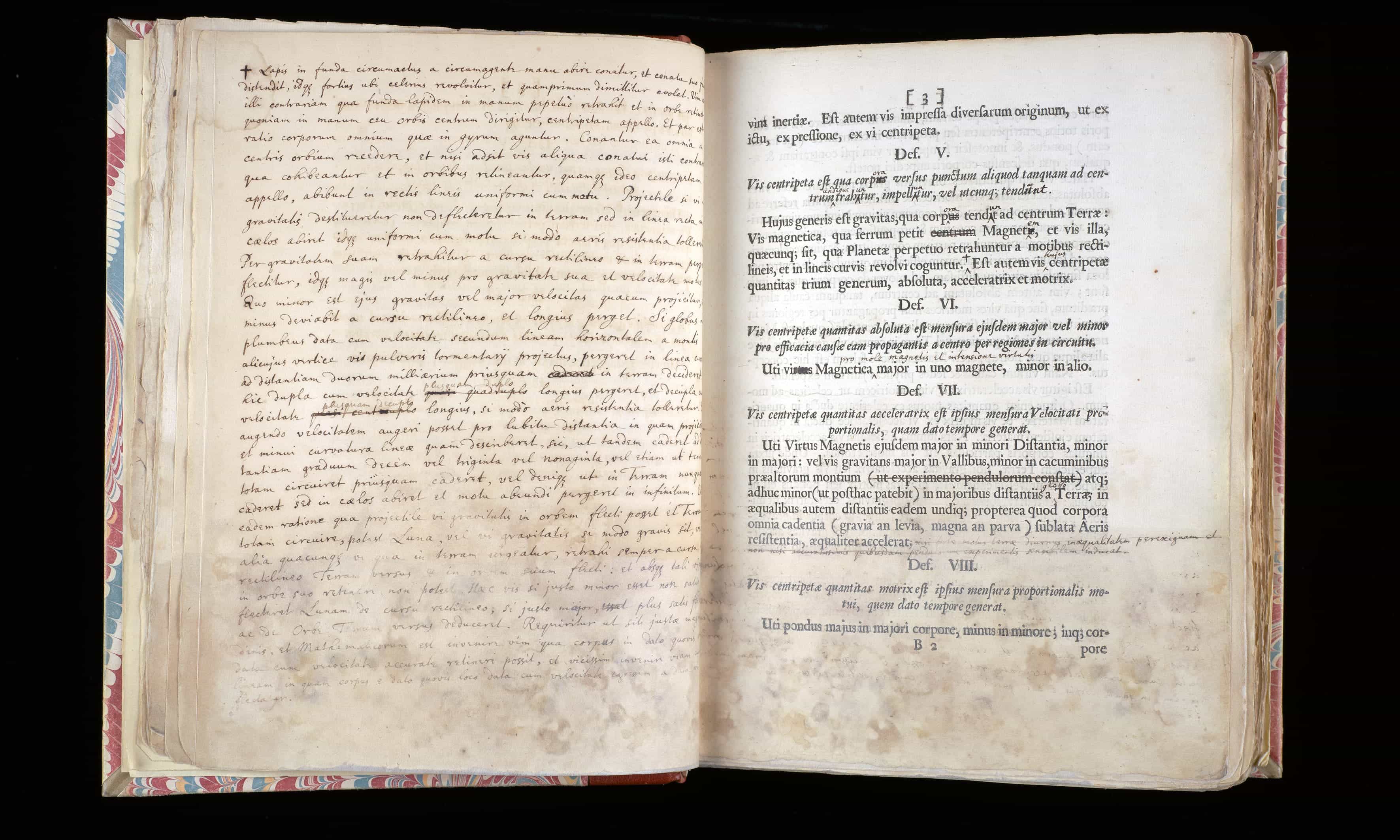
Principia
Principia Mathematica with Sir Isaac Newton’s notes.
Image credits Cambridge University Library.

Back in 2003, a red morocco leather-bound copy of the book said to have belonged to King James II sold at auction of more than US$2.5m; it’s list price was US$600,000. Now, New York auction house Christie’s is holding one of the first edition copies up for auction with a list price of between US$1-1.5m — which could easily become one of the most expensive copies of the text ever sold.

But what makes it so valuable? Well, the Philosophiæ Naturalis Principia Mathematica (Mathematical Principles of Natural Philosophy) is, hands down, one of the most important and influential books in modern science. It laid out the brunt of Newton’s theories on gravity and motion, while also being the first work of scope to apply a more rigorous mathematical system to physics. It became the benchmark for scientific method and thought. Just to put it into perspective, this book, published in 1687, was the physics treatise to read all up to the publication of Einstein’s theory of relativity in 1916. It was a fundamental text, setting the tone of physical research for almost 230 years.

“What Newton does in the 1680s is revolutionise the physical sciences. The fundamental laws of physics,” said Keith Moore, head of the Royal Society library.

It’s also one of the rarest printed versions of the book. Out of the roughly 400 first edition copies printed of the Principia, about 20% were “continental” copies designed for buyers in Europe, which had several minor differences from those sold in England at the time — and this copy is one of them.

Moore believes that the large guide price comes down to a growing appreciation of science in culture, as well as the huge fortunes amassed by luckier tech entrepreneurs.

“People who have big books these days maybe are the kinds of people who have made their money on the internet,” he said. “If you’ve made your money from a really cool algorithm, you will probably appreciate Newtonian physics. If you have a few million quid to spend, why wouldn’t you buy a copy of Principia Mathematica?”

“It’s not just the history and development of science; it’s one of the greatest books ever published,” Keith added. “It was hugely influential in terms of applying mathematics to basic physical problems.”

The society retains two copies of the book, including its “greatest treasure” — the original manuscript used to run the first print edition in 1687.


RelatedPosts

Book Review ‘Does it Fart?’
Critical version of ‘Mein Kampf’ a huge hit in Germany
Haven’t read a book lately? Blame Netflix, researchers say
Book Review: ‘The Five Horsemen of the Modern World: Climate, Food, Water, Disease, and Obesity’


Tags: booknewtonPrincipia Mathematica

ShareTweetShare
Alexandru Micu

Alexandru Micu

Stunningly charming pun connoisseur, I have been fascinated by the world around me since I first laid eyes on it. Always curious, I'm just having a little fun with some very serious science.

Related Posts

History

Did Isaac Newton Predict The End of the World in 2060?

byTibi Puiu
4 weeks ago
Does It Fart?: The Definitive Field Guide to Animal Flatulence
by Nick Caruso & Dani Rabaiotti
Publisher: Quercus // 145 pp // Buy on Amazon
Book Reviews

Book Review ‘Does it Fart?’

byMihai Andrei
7 years ago
News

Haven’t read a book lately? Blame Netflix, researchers say

byMihai Andrei
7 years ago
Image credits: Cambridge University.
History

Sir Isaac Newton’s groundbreaking papers to become UNESCO heritage

byMihai Andrei
7 years ago

Recent news

The UK Government Says You Should Delete Emails to Save Water. That’s Dumb — and Hypocritical

August 16, 2025

In Denmark, a Vaccine Is Eliminating a Type of Cervical Cancer

August 16, 2025
This Picture of the Week shows a stunning spiral galaxy known as NGC 4945. This little corner of space, near the constellation of Centaurus and over 12 million light-years away, may seem peaceful at first — but NGC 4945 is locked in a violent struggle. At the very centre of nearly every galaxy is a supermassive black hole. Some, like the one at the centre of our own Milky Way, aren’t particularly hungry. But NGC 4945’s supermassive black hole is ravenous, consuming huge amounts of matter — and the MUSE instrument at ESO’s Very Large Telescope (VLT) has caught it playing with its food. This messy eater, contrary to a black hole’s typical all-consuming reputation, is blowing out powerful winds of material. This cone-shaped wind is shown in red in the inset, overlaid on a wider image captured with the MPG/ESO telescope at La Silla. In fact, this wind is moving so fast that it will end up escaping the galaxy altogether, lost to the void of intergalactic space. This is part of a new study that measured how winds move in several nearby galaxies. The MUSE observations show that these incredibly fast winds demonstrate a strange behaviour: they actually speed up far away from the central black hole, accelerating even more on their journey to the galactic outskirts. This process ejects potential star-forming material from a galaxy, suggesting that black holes control the fates of their host galaxies by dampening the stellar birth rate. It also shows that the more powerful black holes impede their own growth by removing the gas and dust they feed on, driving the whole system closer towards a sort of galactic equilibrium. Now, with these new results, we are one step closer to understanding the acceleration mechanism of the winds responsible for shaping the evolution of galaxies, and the history of the universe. Links  Research paper in Nature Astronomy by Marconcini et al. Close-up view of NGC 4945’s nucleus

Astronomers Find ‘Punctum,’ a Bizarre Space Object That Might be Unlike Anything in the Universe

August 15, 2025
  • About
  • Advertise
  • Editorial Policy
  • Privacy Policy and Terms of Use
  • How we review products
  • Contact

© 2007-2025 ZME Science - Not exactly rocket science. All Rights Reserved.

No Result
View All Result
  • Science News
  • Environment
  • Health
  • Space
  • Future
  • Features
    • Natural Sciences
    • Physics
      • Matter and Energy
      • Quantum Mechanics
      • Thermodynamics
    • Chemistry
      • Periodic Table
      • Applied Chemistry
      • Materials
      • Physical Chemistry
    • Biology
      • Anatomy
      • Biochemistry
      • Ecology
      • Genetics
      • Microbiology
      • Plants and Fungi
    • Geology and Paleontology
      • Planet Earth
      • Earth Dynamics
      • Rocks and Minerals
      • Volcanoes
      • Dinosaurs
      • Fossils
    • Animals
      • Mammals
      • Birds
      • Fish
      • Amphibians
      • Reptiles
      • Invertebrates
      • Pets
      • Conservation
      • Animal facts
    • Climate and Weather
      • Climate change
      • Weather and atmosphere
    • Health
      • Drugs
      • Diseases and Conditions
      • Human Body
      • Mind and Brain
      • Food and Nutrition
      • Wellness
    • History and Humanities
      • Anthropology
      • Archaeology
      • History
      • Economics
      • People
      • Sociology
    • Space & Astronomy
      • The Solar System
      • Sun
      • The Moon
      • Planets
      • Asteroids, meteors & comets
      • Astronomy
      • Astrophysics
      • Cosmology
      • Exoplanets & Alien Life
      • Spaceflight and Exploration
    • Technology
      • Computer Science & IT
      • Engineering
      • Inventions
      • Sustainability
      • Renewable Energy
      • Green Living
    • Culture
    • Resources
  • Videos
  • Reviews
  • About Us
    • About
    • The Team
    • Advertise
    • Contribute
    • Editorial policy
    • Privacy Policy
    • Contact

© 2007-2025 ZME Science - Not exactly rocket science. All Rights Reserved.