

ZME Science
No Result
View All Result
ZME Science
No Result
View All Result
ZME Science

Home → Science → Geology

Little-known 2012 volcanic eruption was actually the largest in over a century, new data shows

It was huge, and we might have missed it completely!

Mihai AndreibyMihai Andrei
January 10, 2018
in Geology, News
A A
Share on FacebookShare on TwitterSubmit to Reddit

In July 2012, geologists noted the eruption of a previously little-known volcanic area called Havre Seamount, located off the coast of New Zealand. Now, after analyzing the data more thoroughly, they say it was one of the largest eruptions in modern history — we just didn’t realize it because it took place underwater.
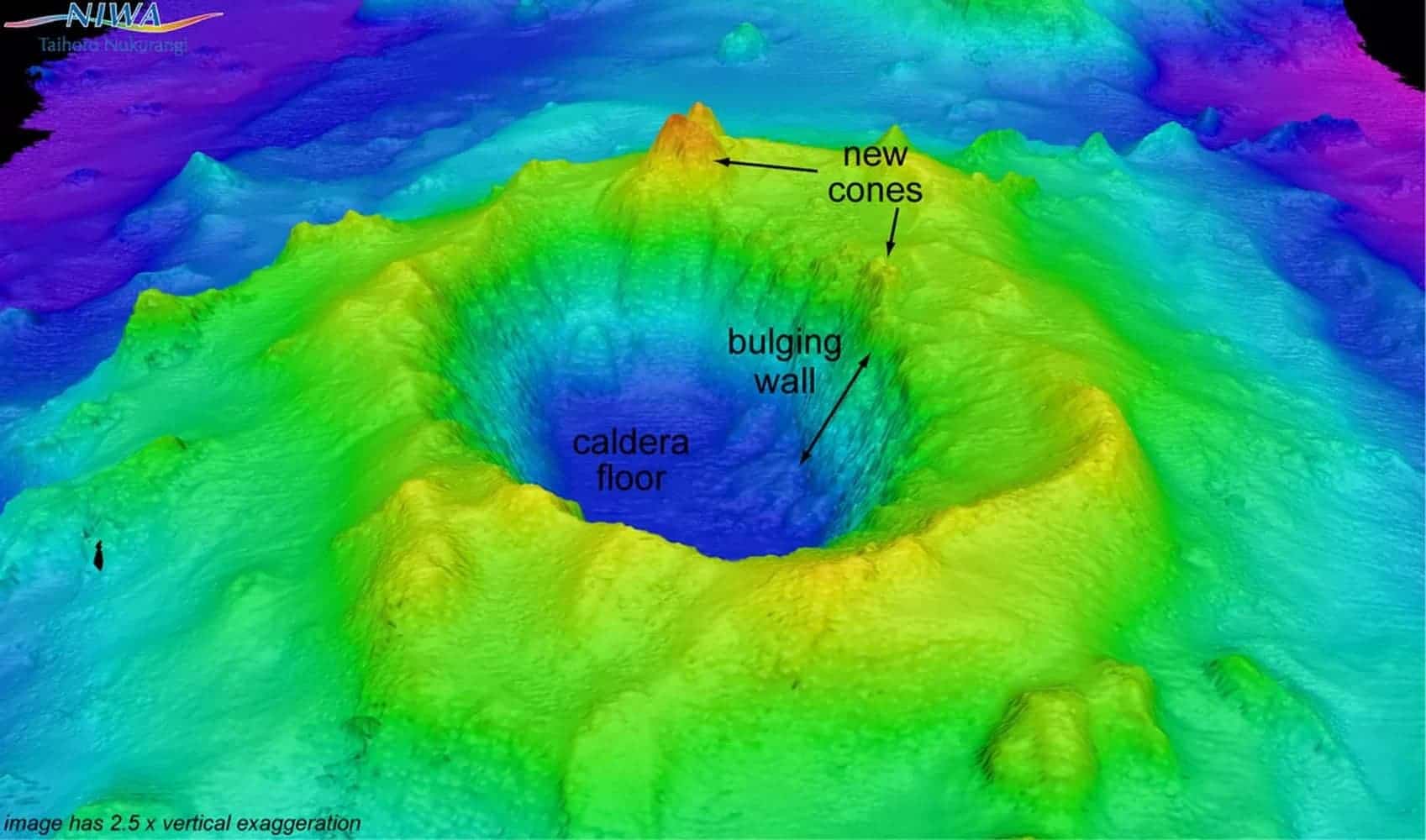
An echosounder image showing the undersea volcano called Havre Seamount, including a new cone that formed during the July 2012 eruption. Credit: NIWA/GNS Science.

The eruption of the Havre Seamount was not initially noticed by scientists. Havre Seamount was only discovered in 2002, and researchers weren’t even aware that the area was volcanic. But as it erupted, it offered passengers on an airline flight over the Southwest Pacific an unusual display: a raft of porous, floating rock (known as pumice), as big as 150 square miles — that’s 50% bigger than the surface of Paris.

Maggie de Grau was a passenger on that flight. Like many others on that plane, she took photos of the strange phenomenon, which she proceeded to email to Dr. Scott Bryan, a senior research fellow at Queensland University of Technology. The raft grew even more, and Bryan contacted some of his colleagues, ultimately discovering that a few military pilots had also witnessed the event days and weeks after the eruption. An officer in the Royal Australian Navy was quoted as saying that it was “the weirdest thing [he had] seen in 18 years at sea.” It was at that point that scientists knew they had something much bigger on their hands.

“We knew it was a large-scale eruption, approximately equivalent to the biggest eruption we’ve seen on land in the 20th Century,” said Rebecca Carey, a volcanologist at University of Tasmania and Co-Chief Scientist on the expedition.

NASA image of Havre Seamount eruption and initial formation of pumice raft.

After the pumice raft was detected, the gears started to turn. Seismologists quickly pinpointed and described a cluster of earthquakes consistent with magma rising into a magma chamber prior to eruption. Retrospective analysis of satellite imagery also revealed the pumice, and so, a mission to map the seafloor topography and monitor any changes was launched in 2015.

Using a pair of autonomous underwater vehicles, they were able to dive beneath the surface of the water and see what neither the earthquakes nor the satellite imagery could reveal: what the eruption looked like. Now, these results have finally been published.

“When we used the submersible vehicles to go down to the seafloor in 2015, we were able to see a vast array of new volcanic products, such as 14 different lava flows at depths of between 1,220 and 650 metres beneath sea level,” says Rebecca Carey, lead researcher on the study, which has been published in the journal Science Advances.

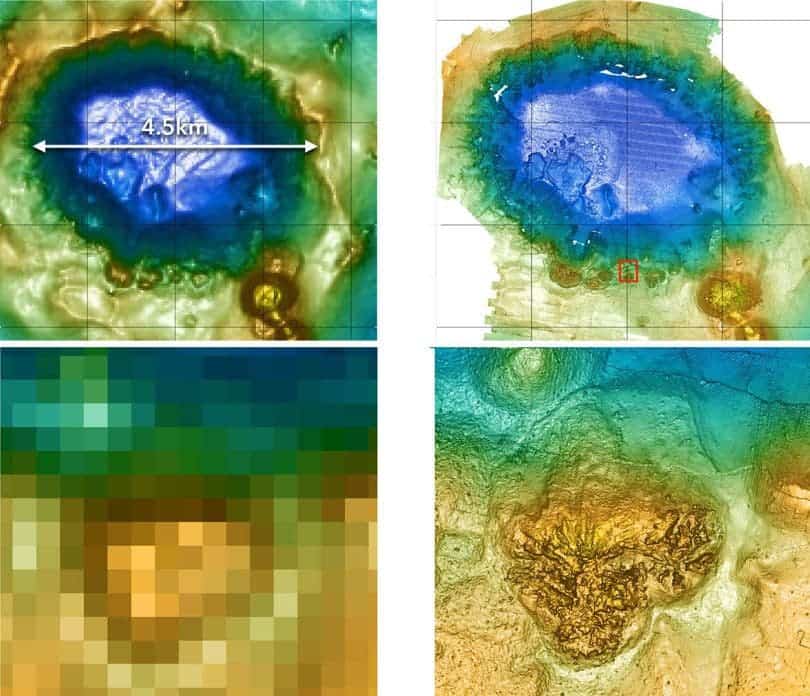
High-resolution seafloor topography of the Havre caldera mapped by the autonomous underwater vehicle (AUV) Sentry shows the lava that erupted in 2012 in red. The volcano is nearly a mile deep (1,519 meters). The top of the volcano is at 650 meters below sea level. Credit: Rebecca Carey, University of Tasmania, Adam Soule, WHOI/

As it turns out, the Havre eruption has some intriguing particularities. For starters, it’s the largest deep-ocean eruption in recorded history and one of very few recorded submarine eruptions involving rhyolite magma — a type of silica-rich magma. Eruptions involving this type of magma are violent and explosive, but most of what we know about them comes from rock records. Scientists have never before been able to analyze such an eruption shortly after it occurred.

The eruption was also more complex — it’s not just one volcano cone that erupted. It consisted of lava from 14 volcanic vent sites between 900 and 1220 meters (3000 and 4000 feet) below the surface. The sheer size of the eruption was also impressive: 1.5 times larger than the 1980 eruption of Mount St. Helens. But unlike that eruption, this one didn’t produce an explosive tower due to water pressure. The water pushing down on the lava suppressed most of the explosivity we would have seen if the eruption had taken place on land. However, rather interestingly, lava flows look exactly like how they would if they were on land; but unlike a land eruption, 75 percent of the lava floated to the surface and drifted away with the currents.
RelatedPosts

NASA researchers use unmanned planes to trace toxic vulcanic gas
Alaska volcano as seen from outer space
Vesuvius Eruption Turned This Roman Man’s Brain Into Glass 2,000 Years Ago and Scientists Just Figured Out How
Mount Doom from LOTR set to erupt – in real life


Images of ship-based mapping compared with autonomous vehicle mapping. Credits: University of Tasmania, Australia.

It’s not surprising at all that geologists didn’t grasp the full scale of this eruption at first. More than 70 percent of the planet’s volcanic activity happens underwater, but the details are often hidden to us. Getting the chance to explore this eruption hands on is a rare opportunity.

However, while for geologists this is a thrilling discovery, wildlife may have been greatly affected by the scale of the eruption. Carey says biologists are “very interested to learn more about how species recolonise, and where those new species are coming from”. All in all, they brought back a trove of data which will take years to analyze. It will take a long time before we finally grasp the ramifications of the 2012 Havre eruption.

“There is a decade worth of interdisciplinary science to do based on our 2015 voyage data and samples. It’s very exciting to marry the geosciences with other scientific disciplines addressing novel research questions,” concludes Carey

Journal Reference: Rebecca Carey et al. The largest deep-ocean silicic volcanic eruption of the past century.

Tags: underwater eruptionvolcanic eruption

ShareTweetShare
Mihai Andrei

Mihai Andrei

Dr. Andrei Mihai is a geophysicist and founder of ZME Science. He has a Ph.D. in geophysics and archaeology and has completed courses from prestigious universities (with programs ranging from climate and astronomy to chemistry and geology). He is passionate about making research more accessible to everyone and communicating news and features to a broad audience.

Related Posts

History

Vesuvius Eruption Turned This Roman Man’s Brain Into Glass 2,000 Years Ago and Scientists Just Figured Out How

byTibi Puiu
1 week ago
Geology

Most diamonds come from violent volcanic eruptions. Scientists have now finally figured out how

byTibi Puiu
2 years ago
Geology

The Bulge is back: Three Sister volcano in Oregon triggers swelling but is unlikely to erupt

byMihai Andrei
4 years ago
Credit: A colored map of mantle flow under the  North American tectonic plate. The warm colors indicate lower speed, implying that rock in those regions is less dense, likely warmer and rising toward the surface. Credit: Vadim Levin/Rutgers University-New Brunswick.
Geology

Warm rock beneath New England hints of upcoming volcanic eruption millions of years from now

byTibi Puiu
8 years ago

Recent news

The UK Government Says You Should Delete Emails to Save Water. That’s Dumb — and Hypocritical

August 16, 2025

In Denmark, a Vaccine Is Eliminating a Type of Cervical Cancer

August 16, 2025
This Picture of the Week shows a stunning spiral galaxy known as NGC 4945. This little corner of space, near the constellation of Centaurus and over 12 million light-years away, may seem peaceful at first — but NGC 4945 is locked in a violent struggle. At the very centre of nearly every galaxy is a supermassive black hole. Some, like the one at the centre of our own Milky Way, aren’t particularly hungry. But NGC 4945’s supermassive black hole is ravenous, consuming huge amounts of matter — and the MUSE instrument at ESO’s Very Large Telescope (VLT) has caught it playing with its food. This messy eater, contrary to a black hole’s typical all-consuming reputation, is blowing out powerful winds of material. This cone-shaped wind is shown in red in the inset, overlaid on a wider image captured with the MPG/ESO telescope at La Silla. In fact, this wind is moving so fast that it will end up escaping the galaxy altogether, lost to the void of intergalactic space. This is part of a new study that measured how winds move in several nearby galaxies. The MUSE observations show that these incredibly fast winds demonstrate a strange behaviour: they actually speed up far away from the central black hole, accelerating even more on their journey to the galactic outskirts. This process ejects potential star-forming material from a galaxy, suggesting that black holes control the fates of their host galaxies by dampening the stellar birth rate. It also shows that the more powerful black holes impede their own growth by removing the gas and dust they feed on, driving the whole system closer towards a sort of galactic equilibrium. Now, with these new results, we are one step closer to understanding the acceleration mechanism of the winds responsible for shaping the evolution of galaxies, and the history of the universe. Links  Research paper in Nature Astronomy by Marconcini et al. Close-up view of NGC 4945’s nucleus

Astronomers Find ‘Punctum,’ a Bizarre Space Object That Might be Unlike Anything in the Universe

August 15, 2025
  • About
  • Advertise
  • Editorial Policy
  • Privacy Policy and Terms of Use
  • How we review products
  • Contact

© 2007-2025 ZME Science - Not exactly rocket science. All Rights Reserved.

No Result
View All Result
  • Science News
  • Environment
  • Health
  • Space
  • Future
  • Features
    • Natural Sciences
    • Physics
      • Matter and Energy
      • Quantum Mechanics
      • Thermodynamics
    • Chemistry
      • Periodic Table
      • Applied Chemistry
      • Materials
      • Physical Chemistry
    • Biology
      • Anatomy
      • Biochemistry
      • Ecology
      • Genetics
      • Microbiology
      • Plants and Fungi
    • Geology and Paleontology
      • Planet Earth
      • Earth Dynamics
      • Rocks and Minerals
      • Volcanoes
      • Dinosaurs
      • Fossils
    • Animals
      • Mammals
      • Birds
      • Fish
      • Amphibians
      • Reptiles
      • Invertebrates
      • Pets
      • Conservation
      • Animal facts
    • Climate and Weather
      • Climate change
      • Weather and atmosphere
    • Health
      • Drugs
      • Diseases and Conditions
      • Human Body
      • Mind and Brain
      • Food and Nutrition
      • Wellness
    • History and Humanities
      • Anthropology
      • Archaeology
      • History
      • Economics
      • People
      • Sociology
    • Space & Astronomy
      • The Solar System
      • Sun
      • The Moon
      • Planets
      • Asteroids, meteors & comets
      • Astronomy
      • Astrophysics
      • Cosmology
      • Exoplanets & Alien Life
      • Spaceflight and Exploration
    • Technology
      • Computer Science & IT
      • Engineering
      • Inventions
      • Sustainability
      • Renewable Energy
      • Green Living
    • Culture
    • Resources
  • Videos
  • Reviews
  • About Us
    • About
    • The Team
    • Advertise
    • Contribute
    • Editorial policy
    • Privacy Policy
    • Contact

© 2007-2025 ZME Science - Not exactly rocket science. All Rights Reserved.