
ZME Science
No Result
View All Result
ZME Science
No Result
View All Result
ZME Science

Home → Science

New four-legged robots designed to work together to accomplish difficult tasks

Teamwork makes the dream work.

Alexandru MicubyAlexandru Micu
October 19, 2021
in News, Robotics, Science
A A
Share on FacebookShare on TwitterSubmit to Reddit

Quantity is a quality all of its own, and that seems to be true in robotics, as well. Researchers at the University of Notre Dame report having successfully designed and built multi-legged robots that can navigate difficult terrain and work together to perform various tasks.
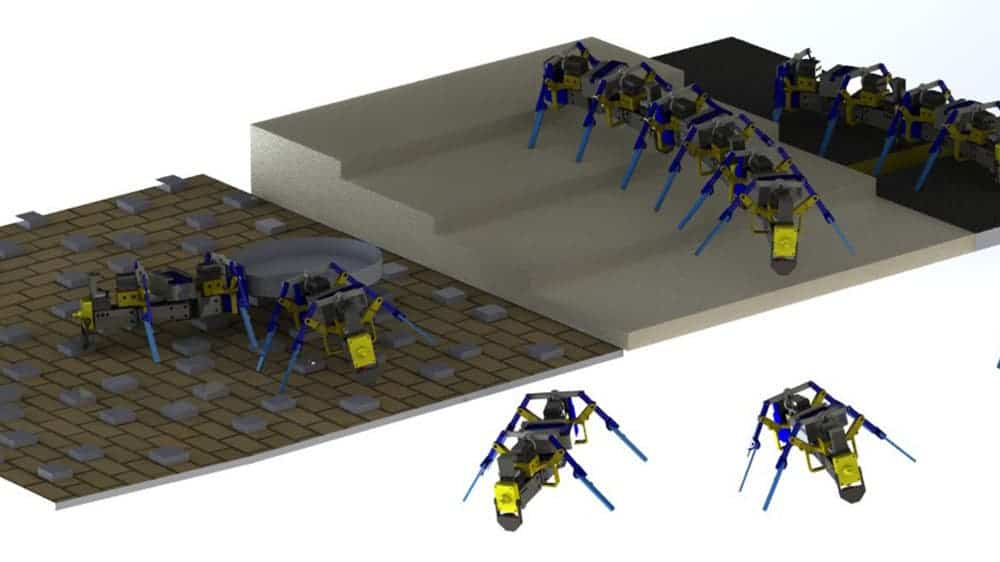
Image credits University of Notre Dame / Yasemin Ozkan-Aydin.

Nature is no stranger to the concept of cooperation. We ourselves are a great example of such cooperation at work, but insects such as ants and bees showcase what can be done when even tiny actors join hands. Roboticists have long been keen to mimic such abilities in their creations, and to instill them in small frames, especially.

New research places us squarely on the path towards such an objective.

Silicon swarm

“Legged robots can navigate challenging environments such as rough terrain and tight spaces, and the use of limbs offers effective body support, enables rapid maneuverability and facilitates obstacle crossing,” says Yasemin Ozkan-Aydin, an assistant professor of electrical engineering at the University of Notre Dame, who designed the robots.

“However, legged robots face unique mobility challenges in terrestrial environments, which results in reduced locomotor performance.”

The collective behavior of birds, ants, and other social insect species has been a great source of inspiration for Ozkan-Aydin. In particular, she was fascinated by their ability to work together to perform tasks that would be impossible for a single individual of the species to perform. She set out to try and instill the same capabilities in her own creations.

Although collective behaviors have been explored in flying and underwater robots, land-borne robots must contend with particular challenges that the other two do not. Traversing complex terrain, for example, is one such challenge.

Ozkan-Aydin started from the idea that a physical connection between individual bots could be used to enhance their overall mobility. The legged robots she designed will attempt to perform tasks such as moving a light object or navigating a smooth surface on their own but, if the task proves to be too great for them alone, several robots will physically connect to one another to form a larger, multi-legged system. Collectively, they will work to overcome the issue.

“When ants collect or transport objects, if one comes upon an obstacle, the group works collectively to overcome that obstacle. If there’s a gap in the path, for example, they will form a bridge so the other ants can travel across — and that is the inspiration for this study,” she said.

“Through robotics we’re able to gain a better understanding of the dynamics and collective behaviors of these biological systems and explore how we might be able to use this kind of technology in the future.”

Each individual bot measures around 15 to 20 centimeters (6 to 8 inches) in length, and they were built using a 3D printer. They carry their own lithium polymer battery, three sensors — a light sensor at the front and two magnetic touch sensors at the front and back, — and a microcontroller. The magnetic sensors allow them to connect to one another. They move around on four flexible legs, a setup that Ozkan-Aydin says reduces their need for sensors and their overall complexity.

RelatedPosts

These tiny birds’ hopping could teach robots how to navigate rough environments
Gecko-like robot climbs walls effortlessly
When robots are everywhere, what will humans be good for?
Rats trade with each other and are surprisingly fair, research finds

She designed and built the robots in early 2020 and, due to the pandemic, much of her experimentation was performed at home or in her yard. During that time, the robots’ abilities were tested over grass, mulch, leaves, and acorns. Their abilities to cross flat surfaces were tested over particle board, stairs made from insulation foam, over a shaggy carpet, or over a particle board with rectangular wooden blocks glued on to simulate rough terrain.

During this time, Ozkan-Aydin programmed the robots so that when one of them became stuck, they would send a signal to the others to come to link up with it and help it traverse the obstacles together.

“You don’t need additional sensors to detect obstacles because the flexibility in the legs helps the robot to move right past them,” said Ozkan-Aydin. “They can test for gaps in a path, building a bridge with their bodies; move objects individually; or connect to move objects collectively in different types of environments, not dissimilar to ants.”

There are still improvements that can be made to the design, she explains. However, the intention wasn’t to design the perfect robot; what she hopes for is that her findings will help spur further development of low-cost, cooperative robots that can perform real-world tasks such as search-and-rescue operations, collective transport of various objects, environmental monitoring, or even space exploration. In the future, she will be focusing on improving the control, sensing abilities, and power autonomy of the robots.

“For functional swarm systems, the battery technology needs to be improved,” she said. “We need small batteries that can provide more power, ideally lasting more than 10 hours. Otherwise, using this type of system in the real world isn’t sustainable.”

“You need to think about how the robots would function in the real world, so you need to think about how much power is required, the size of the battery you use. Everything is limited so you need to make decisions with every part of the machine.”

The paper “Self-reconfigurable multilegged robot swarms collectively accomplish challenging terradynamic tasks” has been published in the journal Science Robotics.

Tags: cooperationrobotssocial

ShareTweetShare
Alexandru Micu

Alexandru Micu

Stunningly charming pun connoisseur, I have been fascinated by the world around me since I first laid eyes on it. Always curious, I'm just having a little fun with some very serious science.

Related Posts

Animals

To Fight Invasive Pythons in the Everglades Scientists Turned to Robot Rabbits

byTudor Tarita
2 weeks ago
News

China released an open source kung-fu robot and we’re not really sure why

byMihai Andrei
5 months ago
Biology

Ants outperform humans at group puzzle-solving activity

byMihai Andrei
8 months ago
Future

Meet the smallest and fastest robot-insects ever developed

byMihai Andrei
1 year ago

Recent news

The UK Government Says You Should Delete Emails to Save Water. That’s Dumb — and Hypocritical

August 16, 2025

In Denmark, a Vaccine Is Eliminating a Type of Cervical Cancer

August 16, 2025
This Picture of the Week shows a stunning spiral galaxy known as NGC 4945. This little corner of space, near the constellation of Centaurus and over 12 million light-years away, may seem peaceful at first — but NGC 4945 is locked in a violent struggle. At the very centre of nearly every galaxy is a supermassive black hole. Some, like the one at the centre of our own Milky Way, aren’t particularly hungry. But NGC 4945’s supermassive black hole is ravenous, consuming huge amounts of matter — and the MUSE instrument at ESO’s Very Large Telescope (VLT) has caught it playing with its food. This messy eater, contrary to a black hole’s typical all-consuming reputation, is blowing out powerful winds of material. This cone-shaped wind is shown in red in the inset, overlaid on a wider image captured with the MPG/ESO telescope at La Silla. In fact, this wind is moving so fast that it will end up escaping the galaxy altogether, lost to the void of intergalactic space. This is part of a new study that measured how winds move in several nearby galaxies. The MUSE observations show that these incredibly fast winds demonstrate a strange behaviour: they actually speed up far away from the central black hole, accelerating even more on their journey to the galactic outskirts. This process ejects potential star-forming material from a galaxy, suggesting that black holes control the fates of their host galaxies by dampening the stellar birth rate. It also shows that the more powerful black holes impede their own growth by removing the gas and dust they feed on, driving the whole system closer towards a sort of galactic equilibrium. Now, with these new results, we are one step closer to understanding the acceleration mechanism of the winds responsible for shaping the evolution of galaxies, and the history of the universe. Links  Research paper in Nature Astronomy by Marconcini et al. Close-up view of NGC 4945’s nucleus

Astronomers Find ‘Punctum,’ a Bizarre Space Object That Might be Unlike Anything in the Universe

August 15, 2025
  • About
  • Advertise
  • Editorial Policy
  • Privacy Policy and Terms of Use
  • How we review products
  • Contact

© 2007-2025 ZME Science - Not exactly rocket science. All Rights Reserved.

No Result
View All Result
  • Science News
  • Environment
  • Health
  • Space
  • Future
  • Features
    • Natural Sciences
    • Physics
      • Matter and Energy
      • Quantum Mechanics
      • Thermodynamics
    • Chemistry
      • Periodic Table
      • Applied Chemistry
      • Materials
      • Physical Chemistry
    • Biology
      • Anatomy
      • Biochemistry
      • Ecology
      • Genetics
      • Microbiology
      • Plants and Fungi
    • Geology and Paleontology
      • Planet Earth
      • Earth Dynamics
      • Rocks and Minerals
      • Volcanoes
      • Dinosaurs
      • Fossils
    • Animals
      • Mammals
      • Birds
      • Fish
      • Amphibians
      • Reptiles
      • Invertebrates
      • Pets
      • Conservation
      • Animal facts
    • Climate and Weather
      • Climate change
      • Weather and atmosphere
    • Health
      • Drugs
      • Diseases and Conditions
      • Human Body
      • Mind and Brain
      • Food and Nutrition
      • Wellness
    • History and Humanities
      • Anthropology
      • Archaeology
      • History
      • Economics
      • People
      • Sociology
    • Space & Astronomy
      • The Solar System
      • Sun
      • The Moon
      • Planets
      • Asteroids, meteors & comets
      • Astronomy
      • Astrophysics
      • Cosmology
      • Exoplanets & Alien Life
      • Spaceflight and Exploration
    • Technology
      • Computer Science & IT
      • Engineering
      • Inventions
      • Sustainability
      • Renewable Energy
      • Green Living
    • Culture
    • Resources
  • Videos
  • Reviews
  • About Us
    • About
    • The Team
    • Advertise
    • Contribute
    • Editorial policy
    • Privacy Policy
    • Contact

© 2007-2025 ZME Science - Not exactly rocket science. All Rights Reserved.