


ZME Science
No Result
View All Result
ZME Science
No Result
View All Result
ZME Science

Home → Science → Anthropology

Stone tools evolved independent of ancient African cultures

Tibi PuiubyTibi Puiu
September 26, 2014
in Anthropology, Archaeology, News
A A
Share on FacebookShare on TwitterSubmit to Reddit

RelatedPosts

Artifacts hint that modern human culture may have emerged in Africa 20,000 years earlier
Early human ancestors may not have passed down knowledge but simply crafted tools on instinct
Neanderthal genes may explain our unique rounded skull shape
Neanderthal man suffered from earliest example of disease jumping from animal to human
Neanderthals were one of the early hominids who used  Levallois technique to make stone tools. Image: Prisma/UIG/Getty
Neanderthals were one of the early hominids who used Levallois technique to make stone tools. Image: Prisma/UIG/Getty

A breakthrough finding in Armenia where thousands of ancient cutting tools were found beautifully preserved casts doubt on a currently prevailing hypothesis that these were solely invented in Africa. The tools discovered are between 325,000 and 335,000 years old. The age suggests the ancient paleolithic cultures of the time that inhabited the region independently developed the sophisticated technique to produce them.

Independent thought and inventions across the ancient hominid world
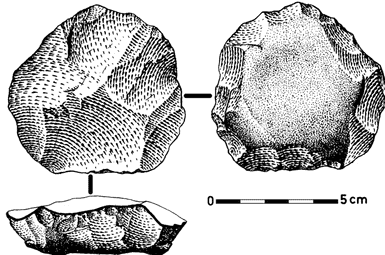
Levallois Core from the Douro Basin, Portugal.  José-Manuel Benito Alvarez
Levallois Core from the Douro Basin, Portugal. José-Manuel Benito Alvarez

Early Stone Age populations made their tools by chipping away a stone until it turned into a desired shape – a cutting tool, arrow or spear tip etc. In the so-called Levallois technology, named after the Levallois-Perret suburb of Paris where it was first described, the toolmaker first chisels a suitably shaped core from a stone and then slices off flakes from it.  Raw blocks of stone are prepared by striking pieces off the edges until it is shaped something like a turtle shell: flat on the bottom and humped on the top. That shape permits the knapper to control the results of using applied force: by striking the top edges of the prepared core, the knapper can pop off a series of similarly sized flattish, sharp stone flakes which can then be used as tools. The technique was reckoned a leap forward in stone technology and behavioral modernity: the production method is in stages, and requires forethought and planning.

“The discovery of thousands of stone artefacts preserved at this unique site provides a major new insight into how Stone Age tools developed during a period of profound human behavioral and biological change,” said Dr. Simon Blockley from the Department of Geography at Royal Holloway.

“The people who lived there 325,000 years ago were much more innovative than previously thought, using a combination of two different technologies to make tools that were extremely important for the mobile hunter-gatherers of the time.

Lavallois technology was discovered throughout Europe and Eurasia, but because such tools in African had been dated as being much older than those found in other regions, many researchers were led to believe the technique first developed there and was then introduced in other parts of the world following a great migration.
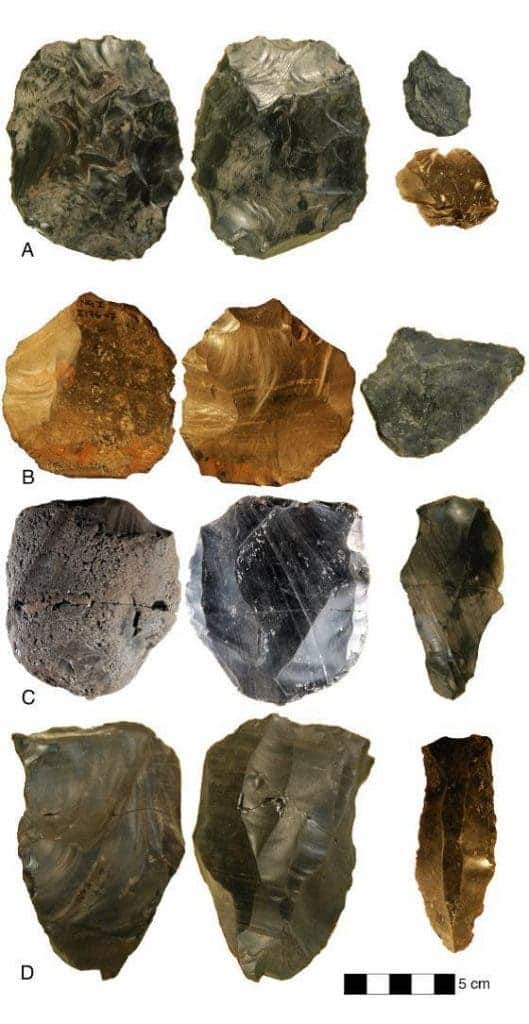
levalloise_tool
Levallois and biface tools. Credit: Royal Holloway, University of London

The Nor Geghi site in present day Armenia, discovered in 2008, shakes this theory which was already doubtful. For instance, it doesn’t explain  why some Levallois tools found in Eurasia are smaller, or otherwise different, from African ones and relies on a unvoked an unproven migration of unknown hominids out of Africa.

“Our findings challenge the theory held by many archaeologists that Levallois technology was invented in Africa and spread to Eurasia as the human population expanded. Due to our ability to accurately date the site in Armenia, we now have the first clear evidence that this significant development in human innovation occurred independently within different populations,”  Blockley said.

Researchers led by Daniel Adler at the University of Connecticut in Storrs discovered thousands of cutting tools of various shapes and size trapped inside a flood plain sediment with volcanic ash, and preserved by two lava flows dated to 200,000 and 400,000 years ago. Using chemical methods, the researchers found the tools came from local source, although some used material from as far as 120km away.

“We wouldn’t have found this mixture if the Levallois technology had simply replaced the old method,” says Adler. “The communities probably worked out for themselves how to make bifacial tools and then it was a short step to the Levallois method.” He argues that the Stone Age people used both approaches flexibly.

Findings were reported in the journal Science.

Tags: hominidNeanderthaltool use

ShareTweetShare
Tibi Puiu

Tibi Puiu

Tibi is a science journalist and co-founder of ZME Science. He writes mainly about emerging tech, physics, climate, and space. In his spare time, Tibi likes to make weird music on his computer and groom felines. He has a B.Sc in mechanical engineering and an M.Sc in renewable energy systems.

Related Posts

Anthropology

Not Just Hunters: Wooden Tools Unearth the Sophisticated, Plant-Eating World of Early Humans

byMihai Andrei
1 month ago
Archaeology

Neanderthals Turned Cave Lion Bone into a 130,000-Year-Old ‘Swiss Army Knife’

byTibi Puiu
1 month ago
Science

Wild Chimps Build Flexible Tools with Impressive Engineering Skills

byMihai Andrei
5 months ago
Egyptian Bow Drill
Archaeology

A 7,000-Year-Old Fire-Starting Kit Was Just Unearthed in China

byTibi Puiu
5 months ago

Recent news

The UK Government Says You Should Delete Emails to Save Water. That’s Dumb — and Hypocritical

August 16, 2025

In Denmark, a Vaccine Is Eliminating a Type of Cervical Cancer

August 16, 2025
This Picture of the Week shows a stunning spiral galaxy known as NGC 4945. This little corner of space, near the constellation of Centaurus and over 12 million light-years away, may seem peaceful at first — but NGC 4945 is locked in a violent struggle. At the very centre of nearly every galaxy is a supermassive black hole. Some, like the one at the centre of our own Milky Way, aren’t particularly hungry. But NGC 4945’s supermassive black hole is ravenous, consuming huge amounts of matter — and the MUSE instrument at ESO’s Very Large Telescope (VLT) has caught it playing with its food. This messy eater, contrary to a black hole’s typical all-consuming reputation, is blowing out powerful winds of material. This cone-shaped wind is shown in red in the inset, overlaid on a wider image captured with the MPG/ESO telescope at La Silla. In fact, this wind is moving so fast that it will end up escaping the galaxy altogether, lost to the void of intergalactic space. This is part of a new study that measured how winds move in several nearby galaxies. The MUSE observations show that these incredibly fast winds demonstrate a strange behaviour: they actually speed up far away from the central black hole, accelerating even more on their journey to the galactic outskirts. This process ejects potential star-forming material from a galaxy, suggesting that black holes control the fates of their host galaxies by dampening the stellar birth rate. It also shows that the more powerful black holes impede their own growth by removing the gas and dust they feed on, driving the whole system closer towards a sort of galactic equilibrium. Now, with these new results, we are one step closer to understanding the acceleration mechanism of the winds responsible for shaping the evolution of galaxies, and the history of the universe. Links  Research paper in Nature Astronomy by Marconcini et al. Close-up view of NGC 4945’s nucleus

Astronomers Find ‘Punctum,’ a Bizarre Space Object That Might be Unlike Anything in the Universe

August 15, 2025
  • About
  • Advertise
  • Editorial Policy
  • Privacy Policy and Terms of Use
  • How we review products
  • Contact

© 2007-2025 ZME Science - Not exactly rocket science. All Rights Reserved.

No Result
View All Result
  • Science News
  • Environment
  • Health
  • Space
  • Future
  • Features
    • Natural Sciences
    • Physics
      • Matter and Energy
      • Quantum Mechanics
      • Thermodynamics
    • Chemistry
      • Periodic Table
      • Applied Chemistry
      • Materials
      • Physical Chemistry
    • Biology
      • Anatomy
      • Biochemistry
      • Ecology
      • Genetics
      • Microbiology
      • Plants and Fungi
    • Geology and Paleontology
      • Planet Earth
      • Earth Dynamics
      • Rocks and Minerals
      • Volcanoes
      • Dinosaurs
      • Fossils
    • Animals
      • Mammals
      • Birds
      • Fish
      • Amphibians
      • Reptiles
      • Invertebrates
      • Pets
      • Conservation
      • Animal facts
    • Climate and Weather
      • Climate change
      • Weather and atmosphere
    • Health
      • Drugs
      • Diseases and Conditions
      • Human Body
      • Mind and Brain
      • Food and Nutrition
      • Wellness
    • History and Humanities
      • Anthropology
      • Archaeology
      • History
      • Economics
      • People
      • Sociology
    • Space & Astronomy
      • The Solar System
      • Sun
      • The Moon
      • Planets
      • Asteroids, meteors & comets
      • Astronomy
      • Astrophysics
      • Cosmology
      • Exoplanets & Alien Life
      • Spaceflight and Exploration
    • Technology
      • Computer Science & IT
      • Engineering
      • Inventions
      • Sustainability
      • Renewable Energy
      • Green Living
    • Culture
    • Resources
  • Videos
  • Reviews
  • About Us
    • About
    • The Team
    • Advertise
    • Contribute
    • Editorial policy
    • Privacy Policy
    • Contact

© 2007-2025 ZME Science - Not exactly rocket science. All Rights Reserved.