

ZME Science
No Result
View All Result
ZME Science
No Result
View All Result
ZME Science

Home → Environment → Climate

In the US, climate change will disproportionately hurt the poor

Don't believe in climate change? Don't worry, you'll suffer just as well.

Mihai AndreibyMihai Andrei
July 7, 2017
in Climate, News
A A
Share on FacebookShare on TwitterSubmit to Reddit

A new study from Berkeley researchers found that the lower class in the US will suffer the effects of global warming much more than the upper class. It’s somewhat ironic, since these are also traditionally the areas with the highest rate of climate change denial.
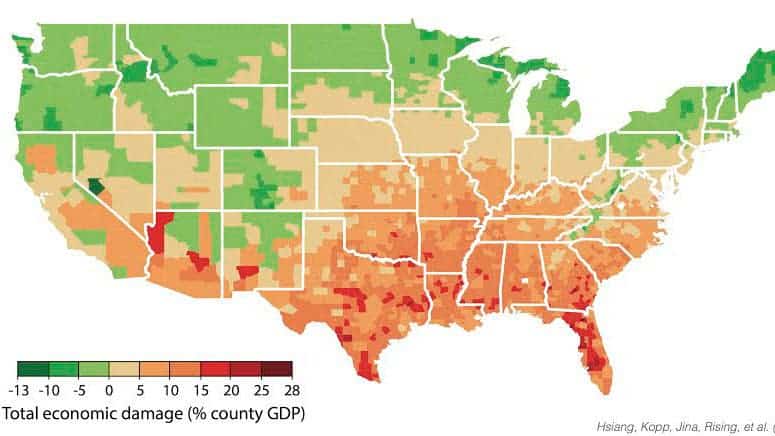
The map reflects the uneven distribution of economic impacts of unmitigated climate change based on county-level research. Image credits: Solomon Hsiang and co-authors of “Estimating economic damage from climate change in the United States” in the journal Science.

The poorest third of all US counties will lose up to 20 percent of their incomes, in an event that will bear similarities to the Great Recession. Meanwhile, regions such as the Pacific Northwest and New England will gain economically over the Gulf and Southern states. Basically, the gap between the rich and the poor will widen more than ever, and the country itself stands to lose 0.7 percent of its Gross Domestic Product for temperatures rising even just one degree Fahrenheit. If you think that’s not much, it’s about $126 billion. These are the conclusions of a new study carried out by two researchers from UC Berkeley: Solomon Hsiang,  and James Rising.

“Climate change is going to be like a huge transfer of wealth from some people to others,” said Hsiang. “This is kind of analogous to a tech boom in one region of the country and industry collapsing in another region. It’s going to make the current economic cleavages in this country even bigger.”

 They analyzed 116 climate change forecasts and numerous economic analyses developed by researchers from all around the world, assessing the effects of climate change on crime, agriculture, energy, labor, coastal communities and mortality. Their main findings are:
  • rising sea levels will cause more frequent tropical cyclones, worsening problems for low-lying coastal cities. South Carolina, Louisiana, and Florida will be the most affected.
  • rising temperatures will drastically reduce agricultural productivity in the Midwest.
  • annual national mortality rates will rise by roughly five deaths per 100,000 people for each degree Celsius increase in temperature.
  • electricity demands, especially related to air conditioning, will increase in all parts of the country except the Rockies and Pacific Northwest.
  • the number of hours worked will “decline about 0.11 percent for each additional degree in rising global mean surface temperature for workers who are not generally exposed to outdoor temperatures, and by 0.53 percent for high-risk, outside workers”.
  • violent crime rates in the country will increase by about 0.9 percent per each additional degree Celsius in global mean surface temperature.

It’s important to once again highlight that these effects won’t be spread equally across the country. The south, which is already very hot, will generally experience the most problems. The Midwest, long considered the country’s breadbasket due to its intensive farming, will dry out and be unable to reach the usual quotas.

Research also considered that rising temperatures might convince some people to relocate, but they think this is unlikely to play a big part in the overall numbers.

Things are looking pretty grim in the US, and things are clearer than ever: global warming will affect you, whether or not you realize it, and whether or not you believe in it. Hopefully, serious action is taken before it’s too late — though we might have already burned an important bridge.

Now, researchers say they want to build a similar model at a global scale.

“There are thousands of people around the world working on this problem,” said Hsiang. “What we are trying to do is to build a system, stitching together all the different models and building ‘the machine in the middle’ to bring it all together. This is how we should be doing policy, as a society.”


RelatedPosts

West Antarctic Ice Sheet collapse is irreversible; to cause 10 feet sea level rise
Venezuela has become the first country to lose all its glaciers
More than one billion people face displacement by 2050
How cycling races could help scientists study the effects of climate change
Tags: climate changeglobal warmingunited states

ShareTweetShare
Mihai Andrei

Mihai Andrei

Dr. Andrei Mihai is a geophysicist and founder of ZME Science. He has a Ph.D. in geophysics and archaeology and has completed courses from prestigious universities (with programs ranging from climate and astronomy to chemistry and geology). He is passionate about making research more accessible to everyone and communicating news and features to a broad audience.

Related Posts

Climate

White House Wants to Destroy NASA Satellites Tracking Climate Change and Plant Health

byMihai Andrei
6 days ago
Climate

This Is the Oldest Ice on the Planet and It’s About to Be Slowly Melted to Unlock 1.5 Million Years of Climate History

byTibi Puiu
3 weeks ago
Climate

Deadly Heatwave Killed 2,300 in Europe, and 1,500 of those were due to climate change

byMihai Andrei
1 month ago
Climate

Climate Change Unleashed a Hidden Wave That Triggered a Planetary Tremor

byMihai Andrei
2 months ago

Recent news

The UK Government Says You Should Delete Emails to Save Water. That’s Dumb — and Hypocritical

August 16, 2025

In Denmark, a Vaccine Is Eliminating a Type of Cervical Cancer

August 16, 2025
This Picture of the Week shows a stunning spiral galaxy known as NGC 4945. This little corner of space, near the constellation of Centaurus and over 12 million light-years away, may seem peaceful at first — but NGC 4945 is locked in a violent struggle. At the very centre of nearly every galaxy is a supermassive black hole. Some, like the one at the centre of our own Milky Way, aren’t particularly hungry. But NGC 4945’s supermassive black hole is ravenous, consuming huge amounts of matter — and the MUSE instrument at ESO’s Very Large Telescope (VLT) has caught it playing with its food. This messy eater, contrary to a black hole’s typical all-consuming reputation, is blowing out powerful winds of material. This cone-shaped wind is shown in red in the inset, overlaid on a wider image captured with the MPG/ESO telescope at La Silla. In fact, this wind is moving so fast that it will end up escaping the galaxy altogether, lost to the void of intergalactic space. This is part of a new study that measured how winds move in several nearby galaxies. The MUSE observations show that these incredibly fast winds demonstrate a strange behaviour: they actually speed up far away from the central black hole, accelerating even more on their journey to the galactic outskirts. This process ejects potential star-forming material from a galaxy, suggesting that black holes control the fates of their host galaxies by dampening the stellar birth rate. It also shows that the more powerful black holes impede their own growth by removing the gas and dust they feed on, driving the whole system closer towards a sort of galactic equilibrium. Now, with these new results, we are one step closer to understanding the acceleration mechanism of the winds responsible for shaping the evolution of galaxies, and the history of the universe. Links  Research paper in Nature Astronomy by Marconcini et al. Close-up view of NGC 4945’s nucleus

Astronomers Find ‘Punctum,’ a Bizarre Space Object That Might be Unlike Anything in the Universe

August 15, 2025
  • About
  • Advertise
  • Editorial Policy
  • Privacy Policy and Terms of Use
  • How we review products
  • Contact

© 2007-2025 ZME Science - Not exactly rocket science. All Rights Reserved.

No Result
View All Result
  • Science News
  • Environment
  • Health
  • Space
  • Future
  • Features
    • Natural Sciences
    • Physics
      • Matter and Energy
      • Quantum Mechanics
      • Thermodynamics
    • Chemistry
      • Periodic Table
      • Applied Chemistry
      • Materials
      • Physical Chemistry
    • Biology
      • Anatomy
      • Biochemistry
      • Ecology
      • Genetics
      • Microbiology
      • Plants and Fungi
    • Geology and Paleontology
      • Planet Earth
      • Earth Dynamics
      • Rocks and Minerals
      • Volcanoes
      • Dinosaurs
      • Fossils
    • Animals
      • Mammals
      • Birds
      • Fish
      • Amphibians
      • Reptiles
      • Invertebrates
      • Pets
      • Conservation
      • Animal facts
    • Climate and Weather
      • Climate change
      • Weather and atmosphere
    • Health
      • Drugs
      • Diseases and Conditions
      • Human Body
      • Mind and Brain
      • Food and Nutrition
      • Wellness
    • History and Humanities
      • Anthropology
      • Archaeology
      • History
      • Economics
      • People
      • Sociology
    • Space & Astronomy
      • The Solar System
      • Sun
      • The Moon
      • Planets
      • Asteroids, meteors & comets
      • Astronomy
      • Astrophysics
      • Cosmology
      • Exoplanets & Alien Life
      • Spaceflight and Exploration
    • Technology
      • Computer Science & IT
      • Engineering
      • Inventions
      • Sustainability
      • Renewable Energy
      • Green Living
    • Culture
    • Resources
  • Videos
  • Reviews
  • About Us
    • About
    • The Team
    • Advertise
    • Contribute
    • Editorial policy
    • Privacy Policy
    • Contact

© 2007-2025 ZME Science - Not exactly rocket science. All Rights Reserved.