

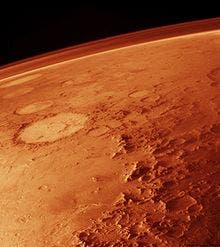
Despite previous research claimed Mars may have had a warmer and wetter period in its early history, billions of years ago, and the presence of ice at its arctic poles, the evidence provided by satellite imaging and microscopic 3D sample imaging from the planet’s surface itself seems to indicate that the surface of Mars has been arid for hundreds of millions of years. Since further study of other regions shows that Mars’ surface is uniform across the whole planet, it’s safe to say that the findings apply to all of Mars.
“We found that even though there is an abundance of ice, Mars has been experiencing a super-drought that may well have lasted hundreds of millions of years,” Pike explained.
“We think the Mars we know today contrasts sharply with its earlier history, which had warmer and wetter periods and which may have been more suited to life. Future NASA and ESA missions that are planned for Mars will have to dig deeper to search for evidence of life, which may still be taking refuge underground.”
Once the NASA Phoenix spacecraft landed on the Martian surface, one of the 24 teams based at mission control in the University of Arizona, operated parts of the spacecraft’s onboard laboratories. Soil samples dug up by a robotic arm were analyzed, and its instruments created 3D images of the surface of particles as small as 100 microns, which were transmitted back to the mission control on Earth.
The presence of clay is the best indicator for determining the former presence of liquid water. Thus, scientists began looking for clay particles in the samples, formed when rock is broken down by water. What the researchers found was that even if the few particles they saw in this size range were clay, they made up less than 0.1 percent of the total proportion of the soil in the sample. In contrast, the Earth’s soil is made up of 50 percent or more of clay.
This has lead the scientists involved in the study that the Martian surface has been arid for an extremely long time by comparing soil data from Mars, Earth and the Moon. They concluded that the soil was being formed in a similar way on Mars and the Moon because they were able to match the distribution of soil particle sizes. Moreover, it seems that Mars surface, at least according to the limited amount of “on-hands” samples they could analyze, has been exposed to liquid water only for 5,000 years, after scientists compared their data with the slowest rate that clays could form on Earth. This means no alien martian civilization could have ever evolve past a bacterial level.
What about the recently launched Curiosity rover on route to Mars, whose main mission, according to NASA, is that of determining whether Mars is, or ever was, capable of hosting life? Well, the $2.5 billion Mars Science Laboratory will hopefully be the final decision maker, and its more advanced instruments will be able to tell once and for all what’s the deal with life on Mars – on the surface, at least. Also, it will have a critical role in aiding scientists learn more about Mars’ surface and atmosphere, and steadily unravel its mysterious geological history. Let’s not forget there’s always Mars’ underground, too.
The study was published in the journal Geophysical Research Letters.
Was this helpful?