

ZME Science
No Result
View All Result
ZME Science
No Result
View All Result
ZME Science

Home → Research → Studies

Bacteria clogging of medical devices is more serious than previously thought

Tibi PuiubyTibi Puiu
March 4, 2013
in Health, Studies
A A
Share on FacebookShare on TwitterSubmit to Reddit

RelatedPosts

Scientists develop Cello, a programming language for bacteria
Study hints at a form of bacterial collective memory
New non-antibiotic treatment hijacks tuberculosis bacterium
ISS bacteria is almost the same as in your home, and that’s a good thing

A team of researchers at Princeton University have devised an experimental set-up that closely mimics the flow of bacteria through working medical devices. Their findings show that bacteria clog medical devices extremely fast – much faster than previously thought – and warrant new strategies and designs in order to counter machine failure.

The researchers used time lapse cameras to monitor fluid flow in narrow tubes or pores sim­i­lar to those used in water fil­ters and med­ical devices. What’s important to note is that the scientists used pressure driven fluid and rough tube surface, instead of stationary liquid and smooth surface, in order to mirror as closely as possible natural occurring conditions.
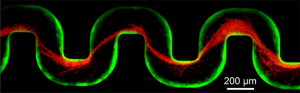
The microbes join to cre­ate slimy rib­bons that tan­gle and trap other pass­ing bac­te­ria, cre­at­ing a full block­age in a star­tlingly short period of time. (c) Princeton University

A number of bacteria commonly found in clogged devices were introduced in the experiment, and were observed over a period of 40 hours. The researchers dyed the microbes green in order to better monitor them. What they found, however, took them by surprise. The microbes steadily attached themselves to the walls of the narrow tube and began to multiply, eventually forming a slimy layer of coating called a biofilm.

Additional microbes, this time dyed red, were introduced and, naturally, these too adhered to the walls surface, where they stuck to the biofilm. During this time, however, fluid flow wasn’t considerably disrupted. Some 55 hours in the experiment,  the biofilm stream­ers tan­gled with each other and formed a sort of net-like structure that progressively trapped more and more bacteria as the snare became larger. Within an hour, the entire tube became blocked and the fluid flow stopped.

“For me the sur­prise was how quickly the biofilm stream­ers caused com­plete clog­ging,” said  Howard Stone, Princeton’s Don­ald R. Dixon ’69 and Eliz­a­beth W. Dixon Pro­fes­sor of Mechan­i­cal and Aero­space Engineering.. “There was no warn­ing that some­thing bad was about to happen.”

So in less than 60 hours of operation, their set-up had become clogged, much sooner and more devastating then anyone would have ever thought. The Princeton scientists’ work, published in the journal  Pro­ceed­ings of the National Acad­emy of Sci­ences, shows how easily susceptible water and soil filter or, most importantly, medical devices are to clogging in the face of flowing bacteria.


Tags: bacteriamedical technology

ShareTweetShare
Tibi Puiu

Tibi Puiu

Tibi is a science journalist and co-founder of ZME Science. He writes mainly about emerging tech, physics, climate, and space. In his spare time, Tibi likes to make weird music on his computer and groom felines. He has a B.Sc in mechanical engineering and an M.Sc in renewable energy systems.

Related Posts

Biology

Scientists Taught Bacteria to Make Cheese Protein Without a Single Cow

byTudor Tarita
4 weeks ago
Chemistry

A Simple Heat Hack Could Revolutionize How We Produce Yogurt

byMihai Andrei
4 weeks ago
Health

There might be an anti-aging secret hiding in magic mushrooms

byTudor Tarita
4 weeks ago
Environment

This New Bioplastic Is Clear Flexible and Stronger Than Oil-Based Plastic. And It’s Made by Microbes

byTudor Tarita
1 month ago

Recent news

The UK Government Says You Should Delete Emails to Save Water. That’s Dumb — and Hypocritical

August 16, 2025

In Denmark, a Vaccine Is Eliminating a Type of Cervical Cancer

August 16, 2025
This Picture of the Week shows a stunning spiral galaxy known as NGC 4945. This little corner of space, near the constellation of Centaurus and over 12 million light-years away, may seem peaceful at first — but NGC 4945 is locked in a violent struggle. At the very centre of nearly every galaxy is a supermassive black hole. Some, like the one at the centre of our own Milky Way, aren’t particularly hungry. But NGC 4945’s supermassive black hole is ravenous, consuming huge amounts of matter — and the MUSE instrument at ESO’s Very Large Telescope (VLT) has caught it playing with its food. This messy eater, contrary to a black hole’s typical all-consuming reputation, is blowing out powerful winds of material. This cone-shaped wind is shown in red in the inset, overlaid on a wider image captured with the MPG/ESO telescope at La Silla. In fact, this wind is moving so fast that it will end up escaping the galaxy altogether, lost to the void of intergalactic space. This is part of a new study that measured how winds move in several nearby galaxies. The MUSE observations show that these incredibly fast winds demonstrate a strange behaviour: they actually speed up far away from the central black hole, accelerating even more on their journey to the galactic outskirts. This process ejects potential star-forming material from a galaxy, suggesting that black holes control the fates of their host galaxies by dampening the stellar birth rate. It also shows that the more powerful black holes impede their own growth by removing the gas and dust they feed on, driving the whole system closer towards a sort of galactic equilibrium. Now, with these new results, we are one step closer to understanding the acceleration mechanism of the winds responsible for shaping the evolution of galaxies, and the history of the universe. Links  Research paper in Nature Astronomy by Marconcini et al. Close-up view of NGC 4945’s nucleus

Astronomers Find ‘Punctum,’ a Bizarre Space Object That Might be Unlike Anything in the Universe

August 15, 2025
  • About
  • Advertise
  • Editorial Policy
  • Privacy Policy and Terms of Use
  • How we review products
  • Contact

© 2007-2025 ZME Science - Not exactly rocket science. All Rights Reserved.

No Result
View All Result
  • Science News
  • Environment
  • Health
  • Space
  • Future
  • Features
    • Natural Sciences
    • Physics
      • Matter and Energy
      • Quantum Mechanics
      • Thermodynamics
    • Chemistry
      • Periodic Table
      • Applied Chemistry
      • Materials
      • Physical Chemistry
    • Biology
      • Anatomy
      • Biochemistry
      • Ecology
      • Genetics
      • Microbiology
      • Plants and Fungi
    • Geology and Paleontology
      • Planet Earth
      • Earth Dynamics
      • Rocks and Minerals
      • Volcanoes
      • Dinosaurs
      • Fossils
    • Animals
      • Mammals
      • Birds
      • Fish
      • Amphibians
      • Reptiles
      • Invertebrates
      • Pets
      • Conservation
      • Animal facts
    • Climate and Weather
      • Climate change
      • Weather and atmosphere
    • Health
      • Drugs
      • Diseases and Conditions
      • Human Body
      • Mind and Brain
      • Food and Nutrition
      • Wellness
    • History and Humanities
      • Anthropology
      • Archaeology
      • History
      • Economics
      • People
      • Sociology
    • Space & Astronomy
      • The Solar System
      • Sun
      • The Moon
      • Planets
      • Asteroids, meteors & comets
      • Astronomy
      • Astrophysics
      • Cosmology
      • Exoplanets & Alien Life
      • Spaceflight and Exploration
    • Technology
      • Computer Science & IT
      • Engineering
      • Inventions
      • Sustainability
      • Renewable Energy
      • Green Living
    • Culture
    • Resources
  • Videos
  • Reviews
  • About Us
    • About
    • The Team
    • Advertise
    • Contribute
    • Editorial policy
    • Privacy Policy
    • Contact

© 2007-2025 ZME Science - Not exactly rocket science. All Rights Reserved.