

A A
RSS

Peru meteorite forces scientists to rewrite books

Wed, Mar 12, 2008

Post filled in: Geology, Space

meteorite

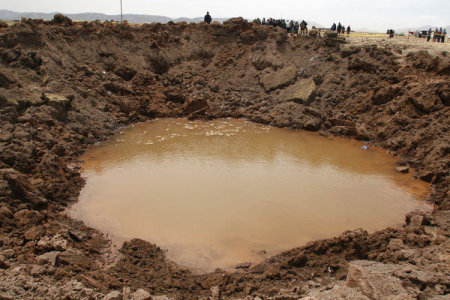
Back in September, a meteorite crashed somewhere in Peru, scaring locals and digging a hole in the ground, but pleased scientists which had the opportunity of studying it. But it behaved so strangely that in fact it forces scientists to rethink the way alien objects behave when entering Earth’s atmosphere and when they hit out planet.

The meteorite was believed to disintegrate before it reached the ground, but that is very far away from the truth, as the object left a 15 metre crater, reaching a speed which was 40-50 times faster than expected. Peter Shultz, professor of geological sciences at Brown University says it should have already melted before hitting the ground, but instead, the meteorite hit the ground with a speed of 24,000 kilometres per hour.

“They come into the atmosphere, they slow down, and they plop,” Schultz says. “It would make a hole in the ground, like a pit, but not a crater. But this meteorite kept on going at a speed about 40-50 times faster than it should have been going. We have to go back to the drawing board and think again,” he says.

The meteorite landed in what locals call an arroyo, or dry stream, so the crater was quickly filled by water from underneath the surface. The findings definetly made scientists go back to the drawing board, but hopefully this time they’ll get things right and understand more about alien objects that hit planets.


16 Comments For Peru meteorite forces scientists to rewrite books

  1. Me Says:

    This did not “definitely makes scientists go back to the drawing board”. You asked one person, a geology professor, what they thought of an incident they did not themselves study in depth. Your demeanor in writing this post is alarmist, hardly informational, and the content could have been conveyed completely in a 2×5 table.

  2. antonio Says:

    you don’t mention the intoxication like symptoms some people experienced near the impact site. there was a lot of especulation around that and then it cooled off.

  3. anon Says:

    AND you can’t spell.

  4. Sam Says:

    What if the meteorite DID vaporize when it came into the atmosphere. Gas has mass. Therefore, a pocket of gas moving fast enough COULD create a crater like that.

    For example, you know those little vortex gun toys? You pull back on an elastic that is attached to a plastic seal, which draws air into a cylindrical chamber. When you let go, it acts like a piston and forces the gas out of the cylinder. You can actually aim and fire this gun from 15-20 feet away and you can see and hear a puff of air impact the person or object you aimed it at.

    Same thing with the meteorite. What if it exploded in the atmosphere, and the shape of it was just perfect enough to create a vortex of air that blasted the crater?

  5. David Says:

    Why are you hopeful that scientists will understand what happens when meteorites enter the Earth’s atmosphere? Your condescending or alarmist tone ruined this article for me. That, and you simply aren’t a good writer.

  6. midnight skuller Says:

    Yeah,and your breath stinks and your balls hang way down.

  7. An Adult Says:

    Wow. Go to your rooms all of you, until you can learn to behave like mature humans rather than pompous web trolls.

  8. Digital Says:

    lulz tehy gotz it all wrong!

    I can’t blame him for writing it like this though… people only read it if the 2 second bite sized title gets them, and then you have to live up to that.

    Crappy writing, but standard of people trying to draw in the lower 50% of people.

  9. Barnegat Blummis IV Says:

    It is more proof that Darwin was wrong! The Earth was created 4300 years ago by the Twistoflex people who crashed into the place in space where the Earth would be and then smooshed together into a planet. Then Jesus came and said there should be no abortion (except Jerry Falwell who was an abortion) and then Dick Cheney shot his friend. Whew, I forgot to mention the Cretaceous, so you fill it in. Thank you.

  10. rprebel Says:

    Somewhere in Peru? Somewhere? Thanks for narrowing it down. I realize most people don’t know Lima from Ica from Cusco, but I do, and I would have liked to have at least been told where the thing landed. Somewhere in Peru…wow. How about next time, you can write an article about something falling to Earth, ’somewhere in Texas.’ That makes about as much sense. Even if it landed far away from the nearest city, you could at least give us some coordinates or something. Now I’m gonna have to google it myself, which equals a thumbs down from this stumbler.

    Oh, and I’m not even going to get started on the factual errors, let alone the grammar/spelling.

  11. laughcatcher Says:

    The comments on the article are much more factual and entertaining than the article itself. Do we all assume that Digital is in the lower 50% of people and the rest of us who read this article are as well? Do you mind telling us what 2 second bit sized title attracts the upper 50% of people? I need to be on the look out! It would be nice if we were all built in with automatic lie and ignorance detectors which would eliminate our obsession for media altogether.

  12. Paul Says:

    •A rock in space = “meteoroid”
    •Same rock enters Earth’s atmosphere = “meteor”
    •Any debris which survives the
    heat of passage through atmosphere = “meteorite”

  13. Barnegat Blummis Says:

    In case folks haven’t noticed, a huge meteorite nicknames “a landslide”, fell on the Republican Party and their chief liar and demonizer, John “Tell a Lie” McCain, lost the election. It was because he was selling fear when the people were fearful enough, thank you. Barack “Tell it like it IS” Obama, was and is selling HOPE, which is exactly what the people wanted and needed. And Palin, the good looking but stupid and incredibly mean liar, lost, too. Ah, America, God shed His Grace on thee!

  14. Colin Wilson Says:

    There was an article on the russian website Pravda that suggested this was not a meteorite, but a nuclear powered US spy satellite. Radiation sickness anyone ?

  15. Gordon Gesner Says:

    Yes, the writer cannot spell and should have given us the precise location, but instead of encouragement, shame on all who trash him. Why not offer positive suggestions such as researching the information better before writing and utilizing “spell-check?” Are these same mean people the ones who call me “donkey and stupid” when they lose a poker pot? How about joining the “human race” instead of always trying to trip those participating.

  16. KenyaKockroach Says:

    Hey Barnegot, Dud dat big rock outen the ski smack Y’all on the haid ? Hope y’all reee cover ‘fore it’s time to vote agin.

1 Trackbacks For This Post

  1. Huge Meteorite Impact Found In UK — Britain’s Largest » ZME Science Says:

    [...] the “crash site” in Peru, meteorites keep the headlines again! This time, scientists from the University of Oxford and the [...]

Leave a Reply

Subscribe

RSS

Subscribe via RSS or e-mail just by entering your address bellow. Learn more about subscribing here.

For a good cause