

ZME Science
No Result
View All Result
ZME Science
No Result
View All Result
ZME Science

Home → Space → Astronomy

All Red Dwarf stars have planets orbiting them

Mihai AndreibyMihai Andrei
March 7, 2014
in Astronomy, Space
A A
Share on FacebookShare on TwitterSubmit to Reddit

RelatedPosts

Astronomers Just Found Stars That Mimic Pulsars — And This May Explain Mysterious Radio Pulses in Space
Astronomers discover intriguing exoplanet with possible water vapor atmosphere
The reason why we haven’t found alien life yet might be because we’re searching too soon
Astronomers may have found a twin solar system thousands of light-years away

A new study has concluded that virtually all red dwarfs, the stars which make up at least three quarters out of all the stars in the Universe, have planets orbiting them.

The study suggested that habitable-zone super-Earth planets (where liquid water, and therefore life as we know it can exist) orbit around at least a quarter of the red dwarfs in the Sun’s own neighborhood. Among the planets which astronomers described there were also three planets classified as habitable-zone super-Earth.
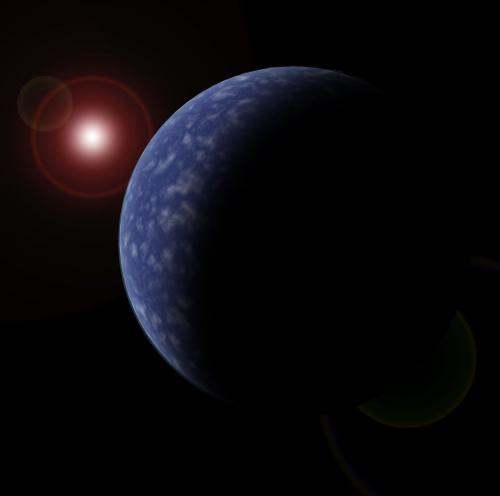
Artist’s impression. Credit: Neil Cook, University of Hertfordshire.

Dr Mikko Tuomi, from the University of Hertfordshire’s Centre for Astrophysics Research and lead author of the study, said:

“We were looking at the data from UVES alone, and noticed some variability that could not be explained by random noise. By combining those with data from HARPS, we managed to spot this spectacular haul of planet candidates. We are clearly probing a highly abundant population of low-mass planets, and can readily expect to find many more in the near future – even around the very closest stars to the Sun.”

This research is highly important not only for its own discoveries, but also for the promise it holds for the future. Basically, the team figured out a new method that enables new discoveries with existing data. What they did was they measured how much a star “wobbles” in space as it is affected by a planet’s gravity. A planet’s gravity, while extremely small compared to the star, still has a noticeable effect on it. Basically, since planets have no light, researchers detect them based on the wobble of these planets. This periodic wobble is detected in the star’s light.

Professor Hugh Jones, also from the University of Hertfordshire, commented:

“This result is somewhat expected in the sense that studies of distant red dwarfs with the Kepler mission indicate a significant population of small radius planets. So it is pleasing to be able to confirm this result with a sample of stars that are among the brightest in their class.”

This researchers adds another 8 to the 17 previously known planets orbiting red dwarfs – and that number can only go up as time passes on.

Tags: habirable planetred dwarf

ShareTweetShare
Mihai Andrei

Mihai Andrei

Dr. Andrei Mihai is a geophysicist and founder of ZME Science. He has a Ph.D. in geophysics and archaeology and has completed courses from prestigious universities (with programs ranging from climate and astronomy to chemistry and geology). He is passionate about making research more accessible to everyone and communicating news and features to a broad audience.

Related Posts

Artist's impression of an evolving white dwarf (foreground) and millisecond pulsar (background) binary system. Using the 4.1-meter SOAR Telescope on Cerro Pachón in Chile, part of Cerro Tololo Inter-American Observatory, a Program of NSF's NOIRLab, astronomers have discovered the first example of a binary system consisting of an evolving white dwarf orbiting a millisecond pulsar, in which the millisecond pulsar is in the final phase of the spin-up process. The source, originally detected by the Fermi Space Telescope, is a “missing link” in the evolution of such binary systems.
News

Astronomers Just Found Stars That Mimic Pulsars — And This May Explain Mysterious Radio Pulses in Space

byJordan Strickler
8 months ago
News

Astronomers discover intriguing exoplanet with possible water vapor atmosphere

byJordan Strickler
2 years ago
Gallery of stellar winds around cool ageing stars, showing a variety of morphologies, including disks, cones, and spirals. The blue colour represents material that is coming towards you, red is material that is moving away from you. (L. Decin, ESO/ALMA)
Astronomy

How Stellar Winds of Dying Stars Are Shaped

byRob Lea
5 years ago
Science

Astronomers may have found a twin solar system thousands of light-years away

byTibi Puiu
5 years ago

Recent news

This Picture of the Week shows a stunning spiral galaxy known as NGC 4945. This little corner of space, near the constellation of Centaurus and over 12 million light-years away, may seem peaceful at first — but NGC 4945 is locked in a violent struggle. At the very centre of nearly every galaxy is a supermassive black hole. Some, like the one at the centre of our own Milky Way, aren’t particularly hungry. But NGC 4945’s supermassive black hole is ravenous, consuming huge amounts of matter — and the MUSE instrument at ESO’s Very Large Telescope (VLT) has caught it playing with its food. This messy eater, contrary to a black hole’s typical all-consuming reputation, is blowing out powerful winds of material. This cone-shaped wind is shown in red in the inset, overlaid on a wider image captured with the MPG/ESO telescope at La Silla. In fact, this wind is moving so fast that it will end up escaping the galaxy altogether, lost to the void of intergalactic space. This is part of a new study that measured how winds move in several nearby galaxies. The MUSE observations show that these incredibly fast winds demonstrate a strange behaviour: they actually speed up far away from the central black hole, accelerating even more on their journey to the galactic outskirts. This process ejects potential star-forming material from a galaxy, suggesting that black holes control the fates of their host galaxies by dampening the stellar birth rate. It also shows that the more powerful black holes impede their own growth by removing the gas and dust they feed on, driving the whole system closer towards a sort of galactic equilibrium. Now, with these new results, we are one step closer to understanding the acceleration mechanism of the winds responsible for shaping the evolution of galaxies, and the history of the universe. Links  Research paper in Nature Astronomy by Marconcini et al. Close-up view of NGC 4945’s nucleus

Astronomers Find ‘Punctum,’ a Bizarre Space Object That Might be Unlike Anything in the Universe

August 15, 2025

Drone fishing is already a thing. It’s also already a problem

August 15, 2025

Some People Are Immune to All Viruses. Scientists Now Want To Replicate This Ability for a Universal Antiviral

August 15, 2025
  • About
  • Advertise
  • Editorial Policy
  • Privacy Policy and Terms of Use
  • How we review products
  • Contact

© 2007-2025 ZME Science - Not exactly rocket science. All Rights Reserved.

No Result
View All Result
  • Science News
  • Environment
  • Health
  • Space
  • Future
  • Features
    • Natural Sciences
    • Physics
      • Matter and Energy
      • Quantum Mechanics
      • Thermodynamics
    • Chemistry
      • Periodic Table
      • Applied Chemistry
      • Materials
      • Physical Chemistry
    • Biology
      • Anatomy
      • Biochemistry
      • Ecology
      • Genetics
      • Microbiology
      • Plants and Fungi
    • Geology and Paleontology
      • Planet Earth
      • Earth Dynamics
      • Rocks and Minerals
      • Volcanoes
      • Dinosaurs
      • Fossils
    • Animals
      • Mammals
      • Birds
      • Fish
      • Amphibians
      • Reptiles
      • Invertebrates
      • Pets
      • Conservation
      • Animal facts
    • Climate and Weather
      • Climate change
      • Weather and atmosphere
    • Health
      • Drugs
      • Diseases and Conditions
      • Human Body
      • Mind and Brain
      • Food and Nutrition
      • Wellness
    • History and Humanities
      • Anthropology
      • Archaeology
      • History
      • Economics
      • People
      • Sociology
    • Space & Astronomy
      • The Solar System
      • Sun
      • The Moon
      • Planets
      • Asteroids, meteors & comets
      • Astronomy
      • Astrophysics
      • Cosmology
      • Exoplanets & Alien Life
      • Spaceflight and Exploration
    • Technology
      • Computer Science & IT
      • Engineering
      • Inventions
      • Sustainability
      • Renewable Energy
      • Green Living
    • Culture
    • Resources
  • Videos
  • Reviews
  • About Us
    • About
    • The Team
    • Advertise
    • Contribute
    • Editorial policy
    • Privacy Policy
    • Contact

© 2007-2025 ZME Science - Not exactly rocket science. All Rights Reserved.