
ZME Science
No Result
View All Result
ZME Science
No Result
View All Result
ZME Science

Home → Science

A woman receives the first-ever successful transplant of a living, 3D-printed ear

Replacement body parts may be much closer to reality than we dare believe.

Alexandru MicubyAlexandru Micu
January 17, 2023
in Biology, News, Science
A A
Share on FacebookShare on TwitterSubmit to Reddit

A collaboration between doctors and US-based regenerative medicine company 3DBio Therapeutics has seen the first successful implant of a 3D-printed ear made from human cells into a living patient.
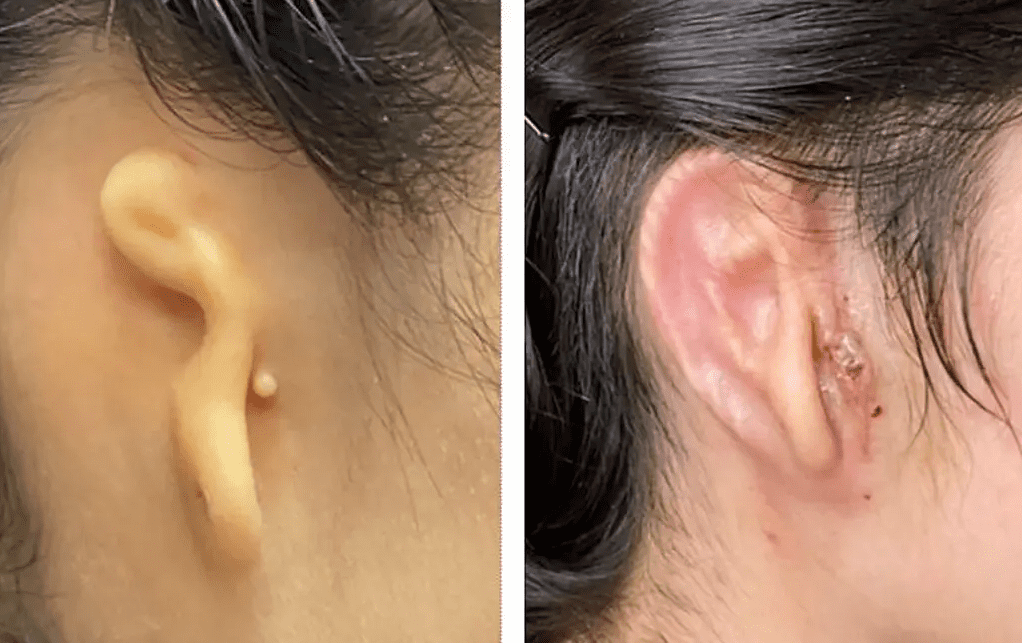
The patient, before the surgery, left, and 30 days after the surgery, right. Image credits Dr. Arturo Bonilla, Microtia-Congenital Ear Institute.

This transplant was one part of a larger cutting-edge effort: the first clinical trial of human-cell-3D-printed grafts. This event marks a major step toward widespread artificial tissue implants and tissue engineering. So far, the results are encouraging and, if everything continues along this path, we’re bound to see other types of tissue being trialed in a similar fashion.

Earmarked

“If everything goes as planned, this will revolutionize the way this is done,” said Arturo Bonilla, the lead surgeon on the ear reconstruction procedure, told The New York Times.

The condition this ear was meant to address is known as microtia, which involves the underdevelopment or entire absence of one or both ears. Around 1,500 people are born with the condition each year in the U.S. alone, and there are currently precious few options for treatment. Patients can opt for grafts made either from synthetic materials, or ones sculpted from tissue harvested from their ribcage.

This study is aiming to try and solve that issue by paving the way toward personalized tissue implants that can replace the ears of such patients. It involves taking samples from the patient’s existing ear tissue, from which cartilage cells are harvested. These are then multiplied in cultures and used as bioink to 3D-print into the shape of a new ear. This is then grafted onto the patient.

Such 3D printed ears keep regenerating cartilage over the patient’s lifetimes and are less likely to be rejected as they are made from their own cells.

The results of the woman’s surgery were made public in a news release. Although the company has not made the technical details of the process to the public, citing proprietary concerns, 3DBio says that federal regulations have already reviewed the trial and the data would be published in a peer-reviewed medical journal upon its completion.

RelatedPosts

Making insects taste like buttery popcorn
The LeverAxe uses physics to finally bring splitting wood to the 21st century
Crop improvements are just not keeping up with climate change
Lightning discharges help clean the air of some greenhouse gases

So far, the trial is still ongoing with 11 patients. It is still possible that the transplants will fail or lead to unforeseen health complications, even if these outcomes are very unlikely.

In the future, the company aims to explore how other replacement body parts can be created via 3D printing, including spinal discs, noses, knee menisci, rotator cuffs, or replacement breast tissue. In the long term, they hope this approach can even create far more complex organs like livers, kidneys, or pancreases, for life-saving transplants.

ShareTweetShare
Alexandru Micu

Alexandru Micu

Stunningly charming pun connoisseur, I have been fascinated by the world around me since I first laid eyes on it. Always curious, I'm just having a little fun with some very serious science.

Related Posts

Environment

The UK Government Says You Should Delete Emails to Save Water. That’s Dumb — and Hypocritical

byMihai Andrei
5 hours ago
Health

In Denmark, a Vaccine Is Eliminating a Type of Cervical Cancer

byMihai Andrei
6 hours ago
This Picture of the Week shows a stunning spiral galaxy known as NGC 4945. This little corner of space, near the constellation of Centaurus and over 12 million light-years away, may seem peaceful at first — but NGC 4945 is locked in a violent struggle. At the very centre of nearly every galaxy is a supermassive black hole. Some, like the one at the centre of our own Milky Way, aren’t particularly hungry. But NGC 4945’s supermassive black hole is ravenous, consuming huge amounts of matter — and the MUSE instrument at ESO’s Very Large Telescope (VLT) has caught it playing with its food. This messy eater, contrary to a black hole’s typical all-consuming reputation, is blowing out powerful winds of material. This cone-shaped wind is shown in red in the inset, overlaid on a wider image captured with the MPG/ESO telescope at La Silla. In fact, this wind is moving so fast that it will end up escaping the galaxy altogether, lost to the void of intergalactic space. This is part of a new study that measured how winds move in several nearby galaxies. The MUSE observations show that these incredibly fast winds demonstrate a strange behaviour: they actually speed up far away from the central black hole, accelerating even more on their journey to the galactic outskirts. This process ejects potential star-forming material from a galaxy, suggesting that black holes control the fates of their host galaxies by dampening the stellar birth rate. It also shows that the more powerful black holes impede their own growth by removing the gas and dust they feed on, driving the whole system closer towards a sort of galactic equilibrium. Now, with these new results, we are one step closer to understanding the acceleration mechanism of the winds responsible for shaping the evolution of galaxies, and the history of the universe. Links  Research paper in Nature Astronomy by Marconcini et al. Close-up view of NGC 4945’s nucleus
News

Astronomers Find ‘Punctum,’ a Bizarre Space Object That Might be Unlike Anything in the Universe

byTibi Puiu
11 hours ago
News

Drone fishing is already a thing. It’s also already a problem

byMihai Andrei
12 hours ago

Recent news

The UK Government Says You Should Delete Emails to Save Water. That’s Dumb — and Hypocritical

August 16, 2025

In Denmark, a Vaccine Is Eliminating a Type of Cervical Cancer

August 16, 2025
This Picture of the Week shows a stunning spiral galaxy known as NGC 4945. This little corner of space, near the constellation of Centaurus and over 12 million light-years away, may seem peaceful at first — but NGC 4945 is locked in a violent struggle. At the very centre of nearly every galaxy is a supermassive black hole. Some, like the one at the centre of our own Milky Way, aren’t particularly hungry. But NGC 4945’s supermassive black hole is ravenous, consuming huge amounts of matter — and the MUSE instrument at ESO’s Very Large Telescope (VLT) has caught it playing with its food. This messy eater, contrary to a black hole’s typical all-consuming reputation, is blowing out powerful winds of material. This cone-shaped wind is shown in red in the inset, overlaid on a wider image captured with the MPG/ESO telescope at La Silla. In fact, this wind is moving so fast that it will end up escaping the galaxy altogether, lost to the void of intergalactic space. This is part of a new study that measured how winds move in several nearby galaxies. The MUSE observations show that these incredibly fast winds demonstrate a strange behaviour: they actually speed up far away from the central black hole, accelerating even more on their journey to the galactic outskirts. This process ejects potential star-forming material from a galaxy, suggesting that black holes control the fates of their host galaxies by dampening the stellar birth rate. It also shows that the more powerful black holes impede their own growth by removing the gas and dust they feed on, driving the whole system closer towards a sort of galactic equilibrium. Now, with these new results, we are one step closer to understanding the acceleration mechanism of the winds responsible for shaping the evolution of galaxies, and the history of the universe. Links  Research paper in Nature Astronomy by Marconcini et al. Close-up view of NGC 4945’s nucleus

Astronomers Find ‘Punctum,’ a Bizarre Space Object That Might be Unlike Anything in the Universe

August 15, 2025
  • About
  • Advertise
  • Editorial Policy
  • Privacy Policy and Terms of Use
  • How we review products
  • Contact

© 2007-2025 ZME Science - Not exactly rocket science. All Rights Reserved.

No Result
View All Result
  • Science News
  • Environment
  • Health
  • Space
  • Future
  • Features
    • Natural Sciences
    • Physics
      • Matter and Energy
      • Quantum Mechanics
      • Thermodynamics
    • Chemistry
      • Periodic Table
      • Applied Chemistry
      • Materials
      • Physical Chemistry
    • Biology
      • Anatomy
      • Biochemistry
      • Ecology
      • Genetics
      • Microbiology
      • Plants and Fungi
    • Geology and Paleontology
      • Planet Earth
      • Earth Dynamics
      • Rocks and Minerals
      • Volcanoes
      • Dinosaurs
      • Fossils
    • Animals
      • Mammals
      • Birds
      • Fish
      • Amphibians
      • Reptiles
      • Invertebrates
      • Pets
      • Conservation
      • Animal facts
    • Climate and Weather
      • Climate change
      • Weather and atmosphere
    • Health
      • Drugs
      • Diseases and Conditions
      • Human Body
      • Mind and Brain
      • Food and Nutrition
      • Wellness
    • History and Humanities
      • Anthropology
      • Archaeology
      • History
      • Economics
      • People
      • Sociology
    • Space & Astronomy
      • The Solar System
      • Sun
      • The Moon
      • Planets
      • Asteroids, meteors & comets
      • Astronomy
      • Astrophysics
      • Cosmology
      • Exoplanets & Alien Life
      • Spaceflight and Exploration
    • Technology
      • Computer Science & IT
      • Engineering
      • Inventions
      • Sustainability
      • Renewable Energy
      • Green Living
    • Culture
    • Resources
  • Videos
  • Reviews
  • About Us
    • About
    • The Team
    • Advertise
    • Contribute
    • Editorial policy
    • Privacy Policy
    • Contact

© 2007-2025 ZME Science - Not exactly rocket science. All Rights Reserved.