ZME Science
No Result
View All Result
ZME Science
No Result
View All Result
ZME Science

Home → Science

Novel cell-in-a-shell is a like a body armor for tiny living things

It's like cells wearing power-armor!

Alexandru MicubyAlexandru Micu
March 14, 2018
in Biology, Health, News, Science
A A
Share on FacebookShare on TwitterSubmit to Reddit

Researchers from the Imperial College London (ICL) have fused living and non-living cells for the first time; the new entities should allow us to cash in on the abilities of living organisms in harsh applications traditionally relegated to machines.
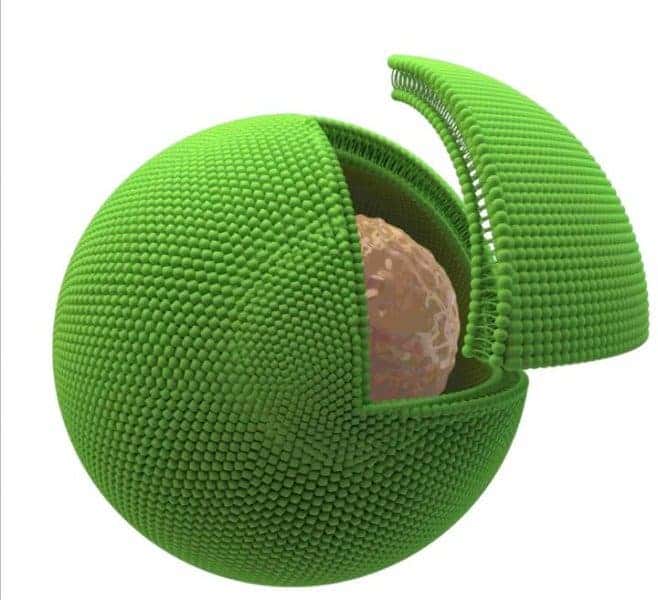
Cell in shell
An impression of a biological cell (brown) inside the artificial cell (green).
Image credits Imperial College London.

The system encapsulates biological cells within an artificial cell-like casing that allows the two to work together. The system should allow researchers to draw on the natural abilities of biological cells while keeping them safe from environmental threats. For example, the cyborg cells could be used as photosynthesis ‘batteries’, as in-vivo drug factories swimming around your bloodstream, or as biological sensors that can operate in harsh environments.

Rise of the cellborgs

The idea of mixing biological and mechanical systems isn’t new. However, previous work focused on taking part of a cell’s systems, such as certain enzymes or chemical processes, and grafting them into artificial casings. The work at ICL stands out by being the first to take an entire cell and put it in a mechanical shell.

A shell it may be, but it’s far from being just a shell: the artificial component also contains enzymes that work together with those inside the cell to produce new compounds. In the proof-of-concept experiment, the artificial shell produced a fluorescent chemical that allowed the researchers to confirm all was working as expected.

Biological cells can perform extremely complex functions, but can be difficult to control when trying to harness one aspect, says lead researcher Professor Oscar Ces, from the Department of Chemistry at ICL. “Artificial cells can be programmed more easily but we cannot yet build in much complexity.”

“Our new system bridges the gap between these two approaches by fusing whole biological cells with artificial ones, so that the machinery of both works in concert to produce what we need. This is a paradigm shift in thinking about the way we design artificial cells, which will help accelerate research on applications in healthcare and beyond.”

The team called on a field of knowledge known as microfluidics — which details the behavior of fluids through small channels — to put the two together. They used water and oil (which don’t mix) to make droplets of a defined size that contained both the cells and enzymes. Then, they applied a protective coating on the droplets, creating the artificial shell.

These cellborgs (not an official term, sadly) were then placed in a concentrated copper solution, since copper is usually toxic to biological cells. The team was able to detect the fluorescent chemicals in most of them after immersion, meaning the biological cells were safe inside their shells, still alive and functioning. This ability suggests the bio-artificial cells would be useful in the human body, where foreign biological cells have to contend with attacks by the body’s immune system.

The team went on to explain that their system is “controllable and customizable,” and that they can create different sizes of artificial cells. Furthermore, the casings can be applied to a wide range of cellular machinery “such as chloroplasts for performing photosynthesis or engineered microbes that act as sensors.”

RelatedPosts

Masks made of ostrich cells make COVID-19 glow in the dark
Discovery of new “don’t eat me protein” points the way to effective cancer therapy
Artificial intelligence can write classical music like a human composer. It’s the first non-human artist whose music is now copyrighted
Artificial cell can move on its own

Next on the list is improving the cellborgs’ functionality by improving the artificial shell, in order to make it act more like a biological membrane with extra functions. For example, if it could be designed to open and release the chemicals produced within only in response to certain signals, the cells could be used to deliver drugs to specific areas of the body. This would allow for greater drug efficiency with fewer side-effects — particularly useful for diseases such as cancer.

There’s still have a lot of work to do to get there, but the team says they’ve made a few promising steps in the right directions.

The paper “Constructing vesicle-based artificial cells with embedded living cells as organelle-like modules” has been published in the journal Scientific Reports.

Tags: Artificialcell

Share1TweetShare
Alexandru Micu

Alexandru Micu

Stunningly charming pun connoisseur, I have been fascinated by the world around me since I first laid eyes on it. Always curious, I'm just having a little fun with some very serious science.

Related Posts

Biology

Your Cells Can Hear You — And It Could Be Important for Fat Cells

byAlexandra Gerea
4 months ago
Anatomy

What is osmosis: a critical principle in biology

byTibi Puiu
3 years ago
Biology

One mutated protein can be used to make our immune system attack and destroy cancer cells

byAlexandru Micu
3 years ago
featured image for Scientists craft living human skin for robots
Future

Researchers develop ‘living skin’ and graft it onto a robotic finger

byMichelle Petersen
3 years ago

Recent news

The UK Government Says You Should Delete Emails to Save Water. That’s Dumb — and Hypocritical

August 16, 2025

In Denmark, a Vaccine Is Eliminating a Type of Cervical Cancer

August 16, 2025
This Picture of the Week shows a stunning spiral galaxy known as NGC 4945. This little corner of space, near the constellation of Centaurus and over 12 million light-years away, may seem peaceful at first — but NGC 4945 is locked in a violent struggle. At the very centre of nearly every galaxy is a supermassive black hole. Some, like the one at the centre of our own Milky Way, aren’t particularly hungry. But NGC 4945’s supermassive black hole is ravenous, consuming huge amounts of matter — and the MUSE instrument at ESO’s Very Large Telescope (VLT) has caught it playing with its food. This messy eater, contrary to a black hole’s typical all-consuming reputation, is blowing out powerful winds of material. This cone-shaped wind is shown in red in the inset, overlaid on a wider image captured with the MPG/ESO telescope at La Silla. In fact, this wind is moving so fast that it will end up escaping the galaxy altogether, lost to the void of intergalactic space. This is part of a new study that measured how winds move in several nearby galaxies. The MUSE observations show that these incredibly fast winds demonstrate a strange behaviour: they actually speed up far away from the central black hole, accelerating even more on their journey to the galactic outskirts. This process ejects potential star-forming material from a galaxy, suggesting that black holes control the fates of their host galaxies by dampening the stellar birth rate. It also shows that the more powerful black holes impede their own growth by removing the gas and dust they feed on, driving the whole system closer towards a sort of galactic equilibrium. Now, with these new results, we are one step closer to understanding the acceleration mechanism of the winds responsible for shaping the evolution of galaxies, and the history of the universe. Links  Research paper in Nature Astronomy by Marconcini et al. Close-up view of NGC 4945’s nucleus

Astronomers Find ‘Punctum,’ a Bizarre Space Object That Might be Unlike Anything in the Universe

August 15, 2025
  • About
  • Advertise
  • Editorial Policy
  • Privacy Policy and Terms of Use
  • How we review products
  • Contact

© 2007-2025 ZME Science - Not exactly rocket science. All Rights Reserved.

No Result
View All Result
  • Science News
  • Environment
  • Health
  • Space
  • Future
  • Features
    • Natural Sciences
    • Physics
      • Matter and Energy
      • Quantum Mechanics
      • Thermodynamics
    • Chemistry
      • Periodic Table
      • Applied Chemistry
      • Materials
      • Physical Chemistry
    • Biology
      • Anatomy
      • Biochemistry
      • Ecology
      • Genetics
      • Microbiology
      • Plants and Fungi
    • Geology and Paleontology
      • Planet Earth
      • Earth Dynamics
      • Rocks and Minerals
      • Volcanoes
      • Dinosaurs
      • Fossils
    • Animals
      • Mammals
      • Birds
      • Fish
      • Amphibians
      • Reptiles
      • Invertebrates
      • Pets
      • Conservation
      • Animal facts
    • Climate and Weather
      • Climate change
      • Weather and atmosphere
    • Health
      • Drugs
      • Diseases and Conditions
      • Human Body
      • Mind and Brain
      • Food and Nutrition
      • Wellness
    • History and Humanities
      • Anthropology
      • Archaeology
      • History
      • Economics
      • People
      • Sociology
    • Space & Astronomy
      • The Solar System
      • Sun
      • The Moon
      • Planets
      • Asteroids, meteors & comets
      • Astronomy
      • Astrophysics
      • Cosmology
      • Exoplanets & Alien Life
      • Spaceflight and Exploration
    • Technology
      • Computer Science & IT
      • Engineering
      • Inventions
      • Sustainability
      • Renewable Energy
      • Green Living
    • Culture
    • Resources
  • Videos
  • Reviews
  • About Us
    • About
    • The Team
    • Advertise
    • Contribute
    • Editorial policy
    • Privacy Policy
    • Contact

© 2007-2025 ZME Science - Not exactly rocket science. All Rights Reserved.