

ZME Science
No Result
View All Result
ZME Science
No Result
View All Result
ZME Science

Home → Science → Archaeology

Stonehenge rocks were brought in from 180 miles away

As if Stonehenge wasn't impressive enough, its rocks were quarried from a very, very long distance away.

Mihai AndreibyMihai Andrei
February 19, 2019
in Archaeology, Geology, News, Science
A A
Share on FacebookShare on TwitterSubmit to Reddit

As if Stonehenge wasn’t impressive enough, its rocks were quarried from a very, very long distance away. Now, researchers have zoomed in on the source of the rocks, identifying it at an outcrop in Wales, 180 miles away from the site.
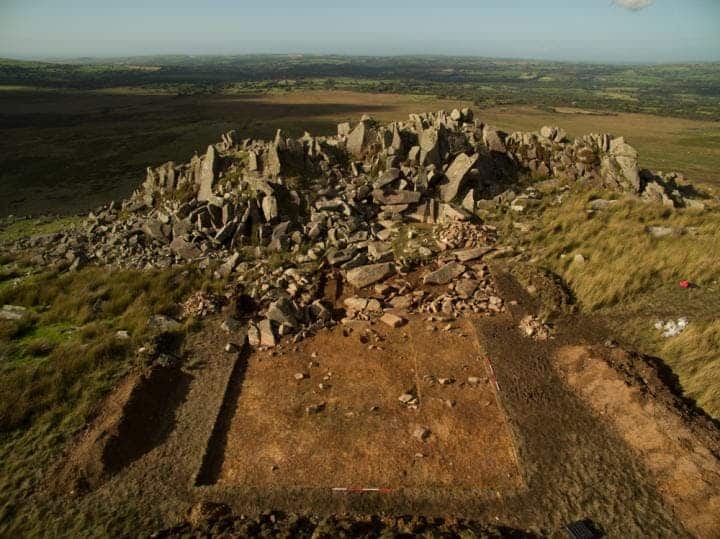
The Welsh quarry where the rocks were brought from. Image credits: UCL.

Stonehenge, which lies firmly in England, used rocks quarried from Wales. Geologists have long known that at least 42 of Stonehenge’s smaller stones, known as ‘bluestones’, came from the Preseli hills in Pembrokeshire, west Wales. The new study shows exactly where these rocks were quarried from.

“This was the dominant source of Stonehenge’s spotted dolerite, so-called because it has white spots in the igneous blue rock. At least five of Stonehenge’s bluestones, and probably more, came from Carn Goedog,” said geologist Dr. Richard Bevins from the National Museum of Wales.

This is rather unusual, as most megaliths of the time are built with rocks from no more than 10 miles away — which is very reasonable, considering how difficult it would have been to carry these big rocks over miles and miles. Especially in Europe, Neolithic megaliths were built with local rocks, says Professor Mike Pearson. Scientists have been trying to understand what makes Stonehenge such a remarkable outlier.

“We’re now looking to find out just what was so special about the Preseli hills 5,000 years ago, and whether there were any important stone circles here, built before the bluestones were moved to Stonehenge.”

According to the study, the bluestone outcrops consist of natural, vertical pillars. It wouldn’t have been all that difficult to extract from the outcrop, particularly compared to the stone quarries in ancient Egypt, which often consisted of much more solid rocks like basalt or granite. The tools they had, however, were woefully unfit for this type of job.

The Stonehenge workers actually left some traces of their work behind. Archaeologists have discovered tools such as hammer stones and stone wedges, but these wedges were much softer than the rocks.

“The stone wedges are made of imported mudstone, much softer than the hard dolerite pillars. An engineering colleague has suggested that hammering in a hard wedge could have created stress fractures, causing the thin pillars to crack. Using a soft wedge means that, if anything were to break, it would be the wedge and not the pillar,” said Professor Parker Pearson.

Transportation, however, would have been even more difficult. Excavations around the outcrop have uncovered the remains of man-made platforms of stone and Earth. Archaeologists also suspect that the builders used perishable ropes and levers.

“Bluestone pillars could be eased down onto this platform, which acted as a loading bay for lowering them onto wooden sledges before dragging them away,” said Professor Colin Richards (University of the Highlands and Islands), who has excavated Britain’s only other identified megalith quarry in the Orkney islands, off the north coast of Scotland.

The new discovery also works against a popular theory, which claimed that the rocks were carried on water, using rafts.

RelatedPosts

The pasta row: a Nobel laureate and a Michelin star chef debate making pasta — and there’s a lot to process
These researchers want to innovate dough-making — with physics
A record 53.6 million tons of e-waste was produced last year, says UN
That study about larvae eating plastic is full of holes

“Some people think that the bluestones were taken southwards to Milford Haven and placed on rafts or slung between boats and then paddled up the Bristol Channel and along the Bristol Avon towards Salisbury Plain. But these quarries are on the north side of the Preseli hills so the megaliths could have simply gone overland all the way to Salisbury Plain,” said Professor Kate Welham (Bournemouth University).

So some of the Stonehenge rocks were quarried with soft tools and carried using rudimentary platforms over 180 miles, an absolutely grueling journey — and we’re really not sure why.

The team now believes that Stonehenge was initially a circle of rough, unworked bluestones set in shallow pits (called the Aubrey holes). Over time, more rocks were added, finessed, and re-arranged.

The findings have been published in the journal Antiquity.

ShareTweetShare
Mihai Andrei

Mihai Andrei

Dr. Andrei Mihai is a geophysicist and founder of ZME Science. He has a Ph.D. in geophysics and archaeology and has completed courses from prestigious universities (with programs ranging from climate and astronomy to chemistry and geology). He is passionate about making research more accessible to everyone and communicating news and features to a broad audience.

Related Posts

Environment

The UK Government Says You Should Delete Emails to Save Water. That’s Dumb — and Hypocritical

byMihai Andrei
1 day ago
Health

In Denmark, a Vaccine Is Eliminating a Type of Cervical Cancer

byMihai Andrei
2 days ago
This Picture of the Week shows a stunning spiral galaxy known as NGC 4945. This little corner of space, near the constellation of Centaurus and over 12 million light-years away, may seem peaceful at first — but NGC 4945 is locked in a violent struggle. At the very centre of nearly every galaxy is a supermassive black hole. Some, like the one at the centre of our own Milky Way, aren’t particularly hungry. But NGC 4945’s supermassive black hole is ravenous, consuming huge amounts of matter — and the MUSE instrument at ESO’s Very Large Telescope (VLT) has caught it playing with its food. This messy eater, contrary to a black hole’s typical all-consuming reputation, is blowing out powerful winds of material. This cone-shaped wind is shown in red in the inset, overlaid on a wider image captured with the MPG/ESO telescope at La Silla. In fact, this wind is moving so fast that it will end up escaping the galaxy altogether, lost to the void of intergalactic space. This is part of a new study that measured how winds move in several nearby galaxies. The MUSE observations show that these incredibly fast winds demonstrate a strange behaviour: they actually speed up far away from the central black hole, accelerating even more on their journey to the galactic outskirts. This process ejects potential star-forming material from a galaxy, suggesting that black holes control the fates of their host galaxies by dampening the stellar birth rate. It also shows that the more powerful black holes impede their own growth by removing the gas and dust they feed on, driving the whole system closer towards a sort of galactic equilibrium. Now, with these new results, we are one step closer to understanding the acceleration mechanism of the winds responsible for shaping the evolution of galaxies, and the history of the universe. Links  Research paper in Nature Astronomy by Marconcini et al. Close-up view of NGC 4945’s nucleus
News

Astronomers Find ‘Punctum,’ a Bizarre Space Object That Might be Unlike Anything in the Universe

byTibi Puiu
2 days ago
News

Drone fishing is already a thing. It’s also already a problem

byMihai Andrei
2 days ago

Recent news

The UK Government Says You Should Delete Emails to Save Water. That’s Dumb — and Hypocritical

August 16, 2025

In Denmark, a Vaccine Is Eliminating a Type of Cervical Cancer

August 16, 2025
This Picture of the Week shows a stunning spiral galaxy known as NGC 4945. This little corner of space, near the constellation of Centaurus and over 12 million light-years away, may seem peaceful at first — but NGC 4945 is locked in a violent struggle. At the very centre of nearly every galaxy is a supermassive black hole. Some, like the one at the centre of our own Milky Way, aren’t particularly hungry. But NGC 4945’s supermassive black hole is ravenous, consuming huge amounts of matter — and the MUSE instrument at ESO’s Very Large Telescope (VLT) has caught it playing with its food. This messy eater, contrary to a black hole’s typical all-consuming reputation, is blowing out powerful winds of material. This cone-shaped wind is shown in red in the inset, overlaid on a wider image captured with the MPG/ESO telescope at La Silla. In fact, this wind is moving so fast that it will end up escaping the galaxy altogether, lost to the void of intergalactic space. This is part of a new study that measured how winds move in several nearby galaxies. The MUSE observations show that these incredibly fast winds demonstrate a strange behaviour: they actually speed up far away from the central black hole, accelerating even more on their journey to the galactic outskirts. This process ejects potential star-forming material from a galaxy, suggesting that black holes control the fates of their host galaxies by dampening the stellar birth rate. It also shows that the more powerful black holes impede their own growth by removing the gas and dust they feed on, driving the whole system closer towards a sort of galactic equilibrium. Now, with these new results, we are one step closer to understanding the acceleration mechanism of the winds responsible for shaping the evolution of galaxies, and the history of the universe. Links  Research paper in Nature Astronomy by Marconcini et al. Close-up view of NGC 4945’s nucleus

Astronomers Find ‘Punctum,’ a Bizarre Space Object That Might be Unlike Anything in the Universe

August 15, 2025
  • About
  • Advertise
  • Editorial Policy
  • Privacy Policy and Terms of Use
  • How we review products
  • Contact

© 2007-2025 ZME Science - Not exactly rocket science. All Rights Reserved.

No Result
View All Result
  • Science News
  • Environment
  • Health
  • Space
  • Future
  • Features
    • Natural Sciences
    • Physics
      • Matter and Energy
      • Quantum Mechanics
      • Thermodynamics
    • Chemistry
      • Periodic Table
      • Applied Chemistry
      • Materials
      • Physical Chemistry
    • Biology
      • Anatomy
      • Biochemistry
      • Ecology
      • Genetics
      • Microbiology
      • Plants and Fungi
    • Geology and Paleontology
      • Planet Earth
      • Earth Dynamics
      • Rocks and Minerals
      • Volcanoes
      • Dinosaurs
      • Fossils
    • Animals
      • Mammals
      • Birds
      • Fish
      • Amphibians
      • Reptiles
      • Invertebrates
      • Pets
      • Conservation
      • Animal facts
    • Climate and Weather
      • Climate change
      • Weather and atmosphere
    • Health
      • Drugs
      • Diseases and Conditions
      • Human Body
      • Mind and Brain
      • Food and Nutrition
      • Wellness
    • History and Humanities
      • Anthropology
      • Archaeology
      • History
      • Economics
      • People
      • Sociology
    • Space & Astronomy
      • The Solar System
      • Sun
      • The Moon
      • Planets
      • Asteroids, meteors & comets
      • Astronomy
      • Astrophysics
      • Cosmology
      • Exoplanets & Alien Life
      • Spaceflight and Exploration
    • Technology
      • Computer Science & IT
      • Engineering
      • Inventions
      • Sustainability
      • Renewable Energy
      • Green Living
    • Culture
    • Resources
  • Videos
  • Reviews
  • About Us
    • About
    • The Team
    • Advertise
    • Contribute
    • Editorial policy
    • Privacy Policy
    • Contact

© 2007-2025 ZME Science - Not exactly rocket science. All Rights Reserved.