

ZME Science
No Result
View All Result
ZME Science
No Result
View All Result
ZME Science

Home → Science

Chinese archaeologists discover evidence of skull surgery in ancient, sophisticated hospital

It's an important finding, from one of China's richest archaeological sites.

Mihai AndreibyMihai Andrei
November 15, 2018
in Archaeology, News, Science
A A
Share on FacebookShare on TwitterSubmit to Reddit

Researchers working in China’s oldest archaeological site have discovered two human skulls featuring traces of trepanation.
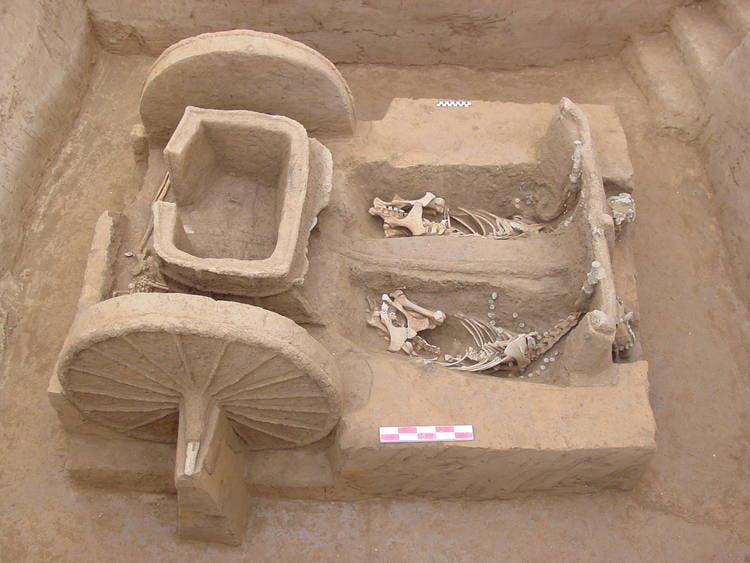
The archaeological site of Yin Xu, close to Anyang City, some 500 km south of Beijing, is an ancient capital city of the late Shang Dynasty. Image credits: UNESCO.

Trepanation, the practice of drilling hole in the skull for medical purposes, was remarkably widespread across ancient cultures. We have found evidence of trepanation from the Inca people in South America to Ancient Greece; humans were also practicing it on animals more than 5,000 years ago. However, for the longest time, China seemed devoid of trepanation. A 2017 study attributes this to “the lack of publications on this topic in the English language,” and a recent finding seems to add to that idea.

Archaeologists have just uncovered two skulls, including one belonging to a 10-year-old boy, that show clear signs of trepanation.

“The skull surface is smooth and even, indicating the traces of artificial drilling. And the cranium shows that it still grew after the perforation, which suggests the surgery was successful,” said Yue Hongbin, researcher with the Institute of Archaeology under the Chinese Academy of Social Sciences (CASS), according to Xinhua.

The skulls date back to the Shang Dynasty (about 1600 BC-1046 BC), a period known for many cultural and social advancements. During the Shang Dynasty, people would treat diseases with drugs, surgeries, acupuncture, and massages, said Yue.

The findings were made at a long-known site: Yin, the last capital of the Shang Dynasty, which is in the current day city of Anyang. Yin has been excavated for some 90 years, yielding numerous remarkable findings — and this one is no exception. Archaeologists have discovered a hospital or a similar medical site, it seems, which is surprisingly sophisticated for its time. They’ve uncovered inscriptions on tortoise bones, detailing the names, symptoms, and treatments of 50 kinds of diseases, says Song Zhenhao, one of the research leaders at CASS.

In a nearby tomb, archaeologists also discovered a large number of plant leaves, including some of ‘oriental bittersweet’ (Celastrus orbiculatus) — a plant that’s still used in Chinese traditional medicine to clear away toxins such as snake venom.

Archaeologists also report identifying bone needles which they believed were used for medical purposes.

RelatedPosts

Beijing just closed its last coal station — What does this mean for the world’s climate
Nearly Three-Quarters of New Solar and Wind Projects Are Being Built in China
China’s changing diet is increasing air pollution – and leading to more premature deaths
UK Archaeologists find 5 long-lost Roman roads

“They were not needles for sewing, since they are sharp at both ends and do not have pinholes. We believe they were for medical use,” said Yue. “Archaeological findings in the ruins have continued to provide more and more evidence to help recast ancient medical history.”

It’s not clear how common trepanation was in ancient China, though it was definitely practiced at times. A recent study suggests that the practice dates back at least 3,500 years, and these new findings seem to support that timeline.

Tags: archaeologychinatrepanation

ShareTweetShare
Mihai Andrei

Mihai Andrei

Dr. Andrei Mihai is a geophysicist and founder of ZME Science. He has a Ph.D. in geophysics and archaeology and has completed courses from prestigious universities (with programs ranging from climate and astronomy to chemistry and geology). He is passionate about making research more accessible to everyone and communicating news and features to a broad audience.

Related Posts

Archaeology

Venice’s Iconic Lion Is Actually a Repurposed Chinese Monster, Scientists Say

byMihai Andrei
1 week ago
News

The World’s Largest Solar Plant is Rising in Tibet. It’s So Vast It’s the Size of Chicago

byTibi Puiu
2 weeks ago
pompeii roman columns
News

The Romans Actually Returned to Pompeii After the Eruption for a Few Chaotic Centuries

byMihai Andrei
3 weeks ago
Archaeology

Archaeologists Discover 6,000 Year Old “Victory Pits” That Featured Mass Graves, Severed Limbs, and Torture

byMihai Andrei
3 weeks ago

Recent news

How Bees Use the Sun for Navigation Even on Cloudy Days

September 12, 2025

Scientists Quietly Developed a 6G Chip Capable of 100 Gbps Speeds

September 12, 2025

When Ice Gets Bent, It Sparks: A Surprising Source of Electricity in Nature’s Coldest Corners

September 12, 2025
  • About
  • Advertise
  • Editorial Policy
  • Privacy Policy and Terms of Use
  • How we review products
  • Contact

© 2007-2025 ZME Science - Not exactly rocket science. All Rights Reserved.

No Result
View All Result
  • Science News
  • Environment
  • Health
  • Space
  • Future
  • Features
    • Natural Sciences
    • Physics
      • Matter and Energy
      • Quantum Mechanics
      • Thermodynamics
    • Chemistry
      • Periodic Table
      • Applied Chemistry
      • Materials
      • Physical Chemistry
    • Biology
      • Anatomy
      • Biochemistry
      • Ecology
      • Genetics
      • Microbiology
      • Plants and Fungi
    • Geology and Paleontology
      • Planet Earth
      • Earth Dynamics
      • Rocks and Minerals
      • Volcanoes
      • Dinosaurs
      • Fossils
    • Animals
      • Mammals
      • Birds
      • Fish
      • Amphibians
      • Reptiles
      • Invertebrates
      • Pets
      • Conservation
      • Animal facts
    • Climate and Weather
      • Climate change
      • Weather and atmosphere
    • Health
      • Drugs
      • Diseases and Conditions
      • Human Body
      • Mind and Brain
      • Food and Nutrition
      • Wellness
    • History and Humanities
      • Anthropology
      • Archaeology
      • History
      • Economics
      • People
      • Sociology
    • Space & Astronomy
      • The Solar System
      • Sun
      • The Moon
      • Planets
      • Asteroids, meteors & comets
      • Astronomy
      • Astrophysics
      • Cosmology
      • Exoplanets & Alien Life
      • Spaceflight and Exploration
    • Technology
      • Computer Science & IT
      • Engineering
      • Inventions
      • Sustainability
      • Renewable Energy
      • Green Living
    • Culture
    • Resources
  • Videos
  • Reviews
  • About Us
    • About
    • The Team
    • Advertise
    • Contribute
    • Editorial policy
    • Privacy Policy
    • Contact

© 2007-2025 ZME Science - Not exactly rocket science. All Rights Reserved.