
ZME Science
No Result
View All Result
ZME Science
No Result
View All Result
ZME Science

Home → Science

2023 was the hottest year on record — by a huge margin

Since June, every month has been the world's hottest on record.

Fermin KoopbyFermin Koop
January 14, 2024
in Climate, Environment, News, Science
A A
Edited and reviewed by Zoe Gordon
Share on FacebookShare on TwitterSubmit to Reddit

Unprecedented global temperatures led 2023 to become the warmest year on record, overtaking 2016 by a large margin, the European Union’s Copernicus Climate Change Service (C3S) said. Last year was about 1.48 °C warmer than the period from 1850-1900, before the extensive burning of fossil fuels.
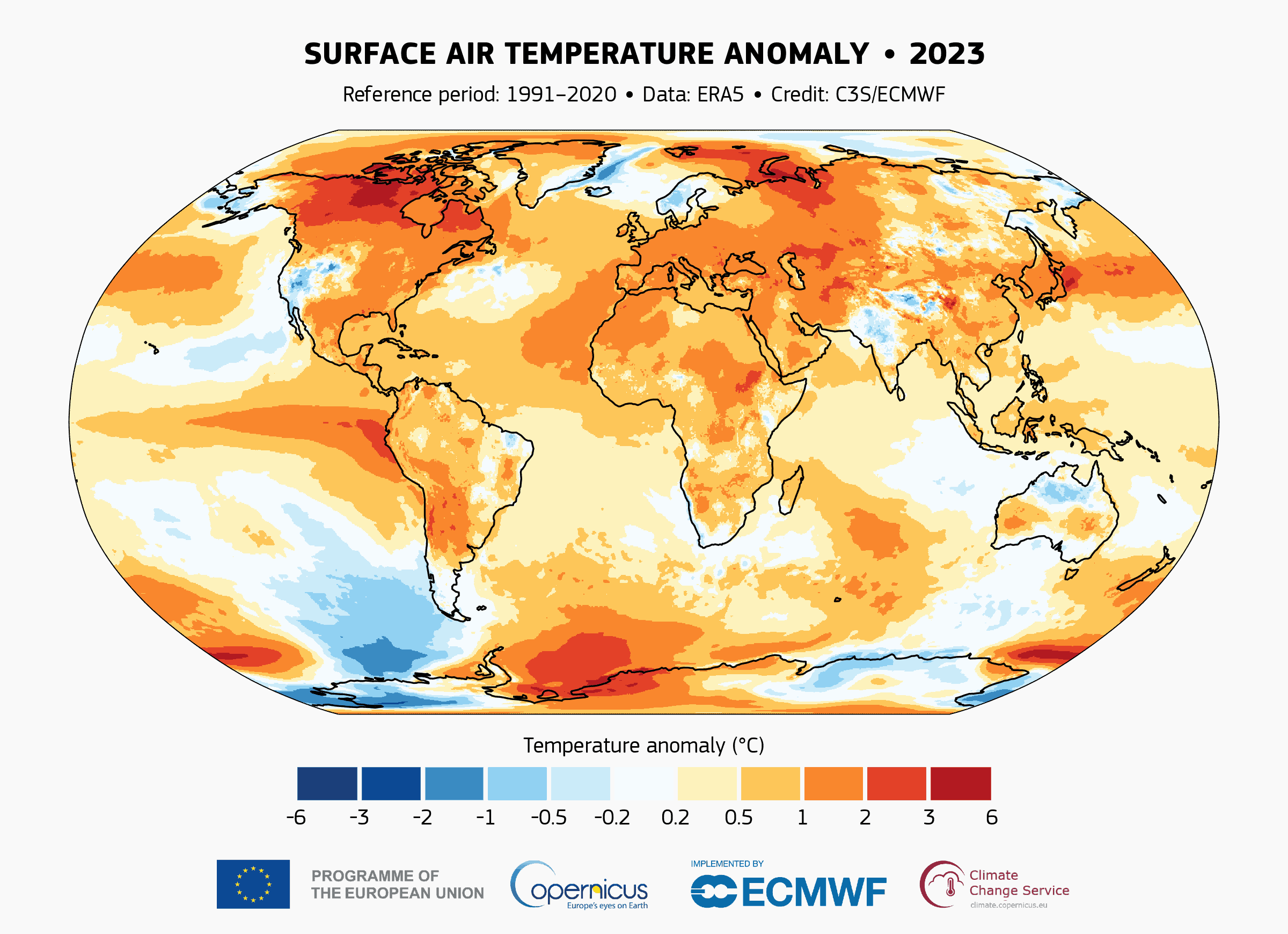
climate crisis
Surface air temperature anomaly for 2023 relative to the average for the 1991-2020 reference period. Data source: ERA5. Image credits: C3S/ECMWF.

While the figure is very close to the 1.5 °C temperature target set up in the Paris Agreement, it doesn’t mean we have already surpassed it. The global temperature would need to be above 1.5 °C for a period of at least 20 years for this to happen. Still, it’s a worrying sign that we are far from doing enough to tackle the climate crisis.

Scientists were expecting the record to be broken in 2023 after many months of extreme weather events and high temperatures. In fact, since June, every month was the world’s hottest on record when compared with the same month in any previous year. Also, close to 50% of days were 1.5 °C warmer than the 1850-1900 period.

“The extremes we have observed over the last few months provide a dramatic testimony of how far we now are from the climate in which our civilisation developed,” Carlo Buontempo, the director of the Copernicus Climate Change Service, said in a recent news release. “This has profound consequences for the Paris Agreement.”

Last year saw a growing number of extreme weather events around the world, from drought and then flooding in East Africa to wildfires and heatwaves in North America. Many of these events would have been very rare or impossible without the climate crisis. They happened at unusual times of the year and on scales never seen before.

The average temperature last year was 0.17 °C higher than the previous highest annual value in 2016 — a significant increase in climate terms. Scientists link this to greenhouse gas emissions that continue to rise, boosted by the El Niño climate phenomenon. Last year saw a transition to El Niño, which comes with unusual warming of surface waters.
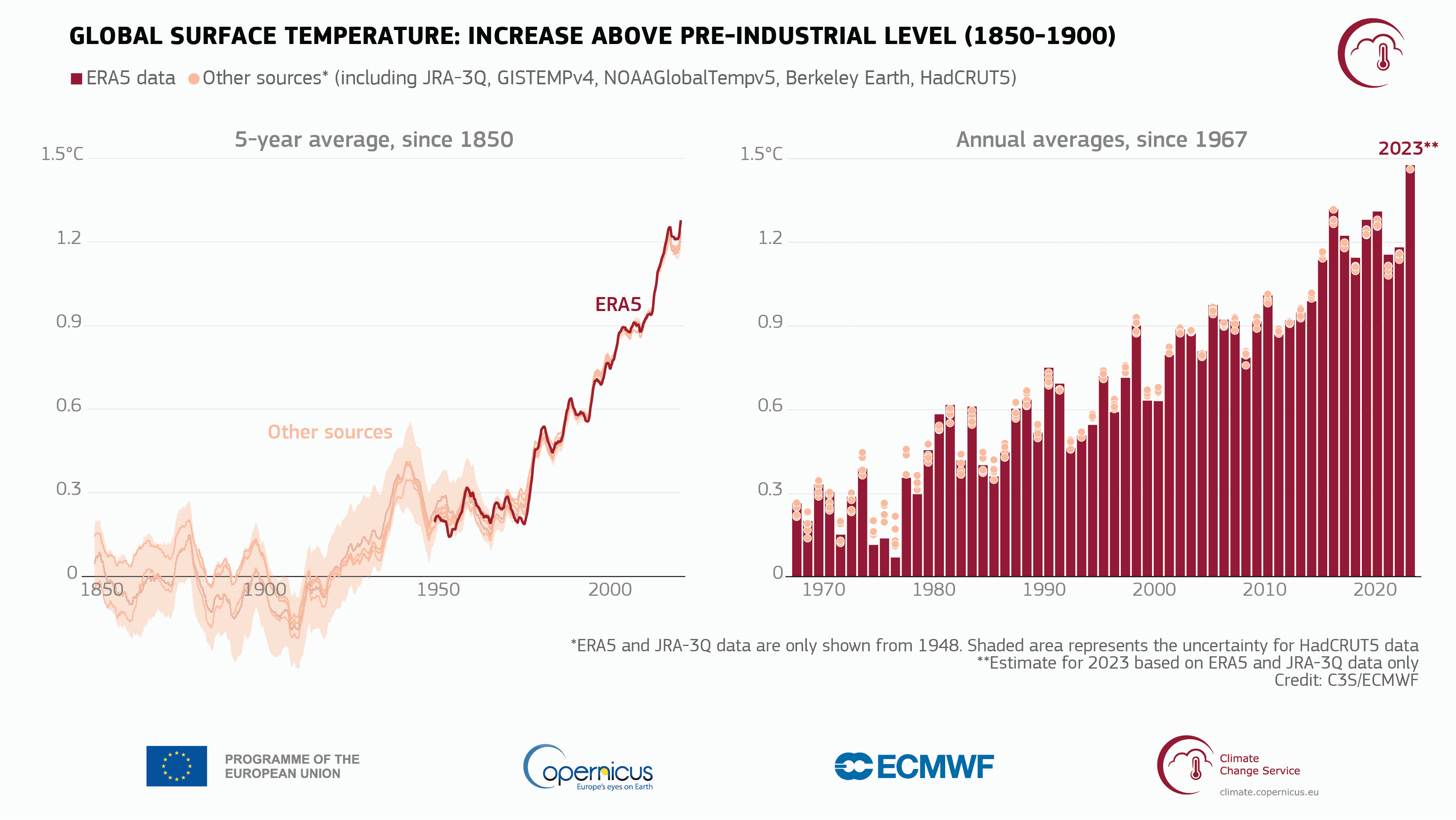
Image credits: C3S/ECMWF.

Global carbon emissions last year are likely to have reached 36.8 billion metric tons, a 1.1% increase from 2022, according to the Global Carbon Budget report. The UN panel of climate scientists, the IPCC, has said emissions need to go down by 43% by 2030 in order to deliver on the Paris Agreement target — something difficult to achieve.

“The record warm global temperatures and devastating extreme weather events of 2023 are a warning that such events will continue to get worse until we transition away from fossil fuels and reach net-zero emissions,” Ed Hawkins, professor of climate science at the University of Reading in the UK, said in a news release this week.

Climate scientists believe that 2024 could be another record-breaking year, with the possibility of exceeding 1.5 °C across the entire calendar year for the first time. And, while countries agreed at the UN climate change conference COP28 to transition away from fossil fuels, time is running out to take further action on the climate crisis.

RelatedPosts

The last ten months were the hottest on record and July was the most blazing ever
Global Warming responsible for more extreme weather, yet another research concludes
Paris climate agreement enters into force
John Kerry: “Above all, consult the scientists”
Tags: climage changeglobal warmingparis agreement

ShareTweetShare
Fermin Koop

Fermin Koop

Fermin Koop is a reporter from Buenos Aires, Argentina. He holds an MSc from Reading University (UK) on Environment and Development and is specialized in environment and climate change news.

Related Posts

Science

Trump is ordering a sweeping censorship of science, starting with climate and health

byMihai Andrei
6 months ago
Science

With our current path, the planet is set to warm by 3 degrees Celsius. Here’s what that means

byMihai Andrei
7 months ago
Climate

Climate heating is killing the young, not the oldest

byMihai Andrei
7 months ago
Climate

First Ice-Free Day in the Arctic Could Happen by 2027, Study Warns

byMihai Andrei
9 months ago

Recent news

The UK Government Says You Should Delete Emails to Save Water. That’s Dumb — and Hypocritical

August 16, 2025

In Denmark, a Vaccine Is Eliminating a Type of Cervical Cancer

August 16, 2025
This Picture of the Week shows a stunning spiral galaxy known as NGC 4945. This little corner of space, near the constellation of Centaurus and over 12 million light-years away, may seem peaceful at first — but NGC 4945 is locked in a violent struggle. At the very centre of nearly every galaxy is a supermassive black hole. Some, like the one at the centre of our own Milky Way, aren’t particularly hungry. But NGC 4945’s supermassive black hole is ravenous, consuming huge amounts of matter — and the MUSE instrument at ESO’s Very Large Telescope (VLT) has caught it playing with its food. This messy eater, contrary to a black hole’s typical all-consuming reputation, is blowing out powerful winds of material. This cone-shaped wind is shown in red in the inset, overlaid on a wider image captured with the MPG/ESO telescope at La Silla. In fact, this wind is moving so fast that it will end up escaping the galaxy altogether, lost to the void of intergalactic space. This is part of a new study that measured how winds move in several nearby galaxies. The MUSE observations show that these incredibly fast winds demonstrate a strange behaviour: they actually speed up far away from the central black hole, accelerating even more on their journey to the galactic outskirts. This process ejects potential star-forming material from a galaxy, suggesting that black holes control the fates of their host galaxies by dampening the stellar birth rate. It also shows that the more powerful black holes impede their own growth by removing the gas and dust they feed on, driving the whole system closer towards a sort of galactic equilibrium. Now, with these new results, we are one step closer to understanding the acceleration mechanism of the winds responsible for shaping the evolution of galaxies, and the history of the universe. Links  Research paper in Nature Astronomy by Marconcini et al. Close-up view of NGC 4945’s nucleus

Astronomers Find ‘Punctum,’ a Bizarre Space Object That Might be Unlike Anything in the Universe

August 15, 2025
  • About
  • Advertise
  • Editorial Policy
  • Privacy Policy and Terms of Use
  • How we review products
  • Contact

© 2007-2025 ZME Science - Not exactly rocket science. All Rights Reserved.

No Result
View All Result
  • Science News
  • Environment
  • Health
  • Space
  • Future
  • Features
    • Natural Sciences
    • Physics
      • Matter and Energy
      • Quantum Mechanics
      • Thermodynamics
    • Chemistry
      • Periodic Table
      • Applied Chemistry
      • Materials
      • Physical Chemistry
    • Biology
      • Anatomy
      • Biochemistry
      • Ecology
      • Genetics
      • Microbiology
      • Plants and Fungi
    • Geology and Paleontology
      • Planet Earth
      • Earth Dynamics
      • Rocks and Minerals
      • Volcanoes
      • Dinosaurs
      • Fossils
    • Animals
      • Mammals
      • Birds
      • Fish
      • Amphibians
      • Reptiles
      • Invertebrates
      • Pets
      • Conservation
      • Animal facts
    • Climate and Weather
      • Climate change
      • Weather and atmosphere
    • Health
      • Drugs
      • Diseases and Conditions
      • Human Body
      • Mind and Brain
      • Food and Nutrition
      • Wellness
    • History and Humanities
      • Anthropology
      • Archaeology
      • History
      • Economics
      • People
      • Sociology
    • Space & Astronomy
      • The Solar System
      • Sun
      • The Moon
      • Planets
      • Asteroids, meteors & comets
      • Astronomy
      • Astrophysics
      • Cosmology
      • Exoplanets & Alien Life
      • Spaceflight and Exploration
    • Technology
      • Computer Science & IT
      • Engineering
      • Inventions
      • Sustainability
      • Renewable Energy
      • Green Living
    • Culture
    • Resources
  • Videos
  • Reviews
  • About Us
    • About
    • The Team
    • Advertise
    • Contribute
    • Editorial policy
    • Privacy Policy
    • Contact

© 2007-2025 ZME Science - Not exactly rocket science. All Rights Reserved.