

ZME Science
No Result
View All Result
ZME Science
No Result
View All Result
ZME Science

Home → Science → News

This small quartz disc can store 360TB of data forever

This quartz disk could revolutionize storage.

Tibi PuiubyTibi Puiu
February 16, 2016 - Updated on July 29, 2023
in News, Technology
A A
Share on FacebookShare on TwitterSubmit to Reddit

A quartz disc, unassuming in appearance, carries within it a revolutionary potential that could transform our understanding and application of data storage. The crystal disc has incredible stability, being able to store data for as long as 13.8 billion years at temperatures up to 190 degrees Celsius.
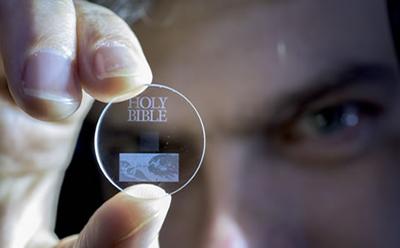
quartz disk for Eternal 5D data storage
Eternal 5D data storage. Image: Southampton University

Storing data for a long time

Digital storage is incredibly easy and practical, but it has the downside of being prone to data loss. A book stored on your hard drive might last less than a hardcover. After four years, 11% of hard drives will fail. Solid state drives last a tad longer, but after a number of read-write cycles these too will inevitably fail. Cloud storage is your safest bet at the moment, but you’re at the whim of a third party.

To make matters even worse, all the storage types we commonly use are subjected to data rot or data degradation — a type of gradual corruption of data.

There’s no real need to panic. Now, for most practical purposes this can be fine, but if you need to store important data for, say, hundreds of years? This might seem absurd, but national archives are very serious about it and invest a lot in networks that backup data over and over. Important contracts, laws, documents, iconic photos and videos, how do we make sure they’re available in the future as well?

Long-term digital data storage has proven remarkably difficult to ensure, but there might now be an elegant and reliable solution.

A team of researchers reported that they managed to cram 360TB worth of five-dimensional (5D) digital data onto a small quartz disk that is reliable for billions of years.

A 5D quartz disk

Southampton University researchers fired femtosecond laser pulses onto a structure of quartz at the nanoscale to write data, essentially creating a crystal hard drive. They made three layers of nano dots, each layer separate by only five microns (20 times thinner than a strand of human hair). Another laser pulse fired on the structure measures the polarisation of the light. Changes in polarization then can be used to read data.

RelatedPosts

Harvest moon this Saturday night – don’t miss it!
New hominid species that lived alongside the famous Lucy was mostly a climber, not a walker
Artificial intelligence for fraud detection is bound to save billions
Researchers develop new tool to help regrow burned-down forests

The quartz disc makes use of some properties of light. A light wave that is vibrating in more than one plane is referred to as unpolarized light. The light emitted by the sun, by a lamp in the classroom, or by a candle flame is unpolarized light. You can create such light waves with electric charges that vibrate in a variety of directions. This creates an electromagnetic wave that vibrates in a variety of directions — which in turn creates the changes that are measured for data storage.
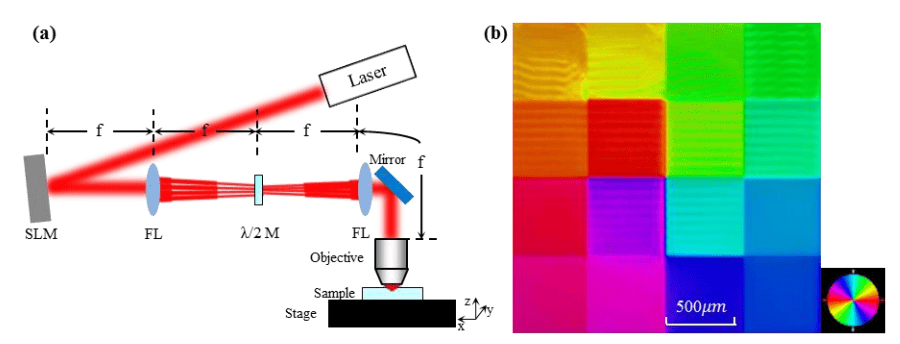
laser mechanism hard disc
The very complex mechanism behind the technology. The 5D optical storage writing setup includes a femtosecond laser, spatial light modulator (SLM), Fourier lens (FL), half-wave plates matrix (λ/2 M), dichroic mirror, water immersion objective, silica glass sample, translation stage. Color-coded slow axis orientation of the half wave-plates matrix imprinted in silica glass. Image credits: University of Southampton.

“Coined as the ‘Superman memory crystal’, as the glass memory has been compared to the “memory crystals” used in the Superman films, the data is recorded via self-assembled nanostructures created in fused quartz. The information encoding is realised in five dimensions: the size and orientation in addition to the three dimensional position of these nanostructures,” a press release explains the technology.

The “5-dimensional” descriptor is a bit misleading. The crystal hard drive has has 3 physical dimensions and no exotic higher dimensional properties. But that doesn’t make it any less fascinating.

How the crystal hard drive is used

The technology was first demonstrated in 2010 by Kazuyuki Hirao’s laboratory at the Kyoto University. Then, Professor Peter Kazansky‘s lab developed it further. Now, it’s already been put to some use.

So far, the researchers wrote the Universal Declaration of Human Rights, Newton’s Opticks, the Magna Carta and the Kings James Bible on such a quartz disk. That’s not a lot, but judging from the density of data, they could fit in 360 terabytes or million-times more.

In 2018, the technology was used to store a copy of Isaac Asimov’s Foundation trilogy. This which was launched into space aboard Elon Musk’s Tesla Roadster.

“It is thrilling to think that we have created the technology to preserve documents and information and store it in space for future generations. This technology can secure the last evidence of our civilisation: all we’ve learnt will not be forgotten,” said Kazansky, one of the researchers behind the technology.

ShareTweetShare
Tibi Puiu

Tibi Puiu

Tibi is a science journalist and co-founder of ZME Science. He writes mainly about emerging tech, physics, climate, and space. In his spare time, Tibi likes to make weird music on his computer and groom felines. He has a B.Sc in mechanical engineering and an M.Sc in renewable energy systems.

Related Posts

Chemistry

New Hydrogel Is So Sticky It Can Hold a Rubber Duck to a Rock Through Crashing Ocean Waves

byTibi Puiu
7 hours ago
Environment

The UK Government Says You Should Delete Emails to Save Water. That’s Dumb — and Hypocritical

byMihai Andrei
2 days ago
Health

In Denmark, a Vaccine Is Eliminating a Type of Cervical Cancer

byMihai Andrei
2 days ago
This Picture of the Week shows a stunning spiral galaxy known as NGC 4945. This little corner of space, near the constellation of Centaurus and over 12 million light-years away, may seem peaceful at first — but NGC 4945 is locked in a violent struggle. At the very centre of nearly every galaxy is a supermassive black hole. Some, like the one at the centre of our own Milky Way, aren’t particularly hungry. But NGC 4945’s supermassive black hole is ravenous, consuming huge amounts of matter — and the MUSE instrument at ESO’s Very Large Telescope (VLT) has caught it playing with its food. This messy eater, contrary to a black hole’s typical all-consuming reputation, is blowing out powerful winds of material. This cone-shaped wind is shown in red in the inset, overlaid on a wider image captured with the MPG/ESO telescope at La Silla. In fact, this wind is moving so fast that it will end up escaping the galaxy altogether, lost to the void of intergalactic space. This is part of a new study that measured how winds move in several nearby galaxies. The MUSE observations show that these incredibly fast winds demonstrate a strange behaviour: they actually speed up far away from the central black hole, accelerating even more on their journey to the galactic outskirts. This process ejects potential star-forming material from a galaxy, suggesting that black holes control the fates of their host galaxies by dampening the stellar birth rate. It also shows that the more powerful black holes impede their own growth by removing the gas and dust they feed on, driving the whole system closer towards a sort of galactic equilibrium. Now, with these new results, we are one step closer to understanding the acceleration mechanism of the winds responsible for shaping the evolution of galaxies, and the history of the universe. Links  Research paper in Nature Astronomy by Marconcini et al. Close-up view of NGC 4945’s nucleus
News

Astronomers Find ‘Punctum,’ a Bizarre Space Object That Might be Unlike Anything in the Universe

byTibi Puiu
2 days ago

Recent news

New Hydrogel Is So Sticky It Can Hold a Rubber Duck to a Rock Through Crashing Ocean Waves

August 17, 2025

The UK Government Says You Should Delete Emails to Save Water. That’s Dumb — and Hypocritical

August 16, 2025

In Denmark, a Vaccine Is Eliminating a Type of Cervical Cancer

August 16, 2025
  • About
  • Advertise
  • Editorial Policy
  • Privacy Policy and Terms of Use
  • How we review products
  • Contact

© 2007-2025 ZME Science - Not exactly rocket science. All Rights Reserved.

No Result
View All Result
  • Science News
  • Environment
  • Health
  • Space
  • Future
  • Features
    • Natural Sciences
    • Physics
      • Matter and Energy
      • Quantum Mechanics
      • Thermodynamics
    • Chemistry
      • Periodic Table
      • Applied Chemistry
      • Materials
      • Physical Chemistry
    • Biology
      • Anatomy
      • Biochemistry
      • Ecology
      • Genetics
      • Microbiology
      • Plants and Fungi
    • Geology and Paleontology
      • Planet Earth
      • Earth Dynamics
      • Rocks and Minerals
      • Volcanoes
      • Dinosaurs
      • Fossils
    • Animals
      • Mammals
      • Birds
      • Fish
      • Amphibians
      • Reptiles
      • Invertebrates
      • Pets
      • Conservation
      • Animal facts
    • Climate and Weather
      • Climate change
      • Weather and atmosphere
    • Health
      • Drugs
      • Diseases and Conditions
      • Human Body
      • Mind and Brain
      • Food and Nutrition
      • Wellness
    • History and Humanities
      • Anthropology
      • Archaeology
      • History
      • Economics
      • People
      • Sociology
    • Space & Astronomy
      • The Solar System
      • Sun
      • The Moon
      • Planets
      • Asteroids, meteors & comets
      • Astronomy
      • Astrophysics
      • Cosmology
      • Exoplanets & Alien Life
      • Spaceflight and Exploration
    • Technology
      • Computer Science & IT
      • Engineering
      • Inventions
      • Sustainability
      • Renewable Energy
      • Green Living
    • Culture
    • Resources
  • Videos
  • Reviews
  • About Us
    • About
    • The Team
    • Advertise
    • Contribute
    • Editorial policy
    • Privacy Policy
    • Contact

© 2007-2025 ZME Science - Not exactly rocket science. All Rights Reserved.