
ZME Science
No Result
View All Result
ZME Science
No Result
View All Result
ZME Science

Home → Health

Cosmetic eye surgery turns brown eyes into blue

Tibi PuiubyTibi Puiu
March 6, 2015
in Health, News
A A
Share on FacebookShare on TwitterSubmit to Reddit

We live in a society which puts a lot of pressure on looks. Women especially, are always looking for new ways to make themselves look more attractive either by dyeing their hair, wearing make-up or, in some particular extreme cases, plastic surgery. Now there’s another type of aesthetic procedure – a novel laser treatment which can change your eyes’ color. The procedure is permanent and only works for brown to blue eyes.

Behind blue eyes
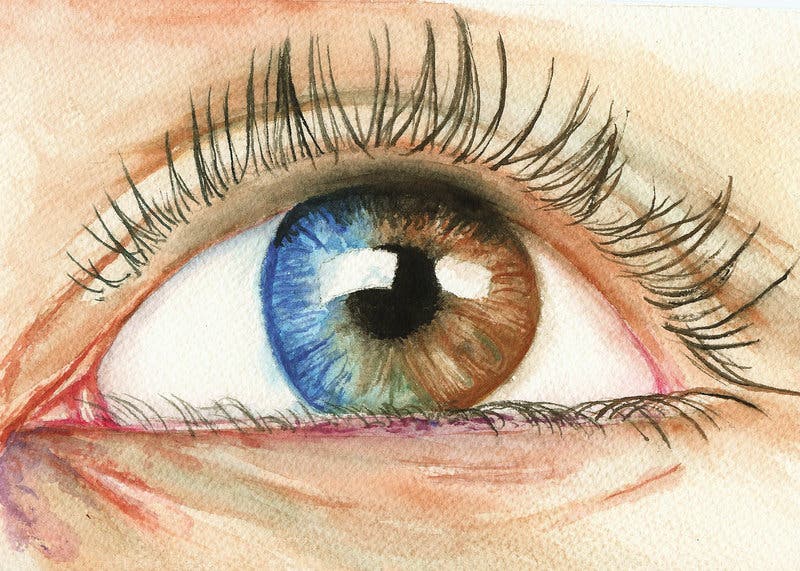
Artwork by OKERR, DEVIANT ART

For the past ten years, Dr. Gregg Homer has been working on his procedure which he claims can change one’s eye color from brown to blue in as little as 20 seconds. The whole process is irreversible and once you decide to go through it, you can’t go back to your original eye color.

The treatment employs a laser which targets melanin, the pigment in the eye responsible for brown color. Before the laser is set, a mask of the iris is projected to make the blue eyes print, after which a specific frequency of electromagnetic radiation is applied to the iris. After the first week of treatment, the eye color turns lighter as the tissue changes its characteristics. In around one to three weeks the blueness appears, until it finally defines itself. Melanin doesn’t regenerate, which is why the procedure in irreversible.

Dr. Homer first began testing the procedure in 2004 on animals, before later on moving to cadavers, and just recently to live patients. His most recent clinical trial included 17 patients who had very short-sided vision, and agreed to take part in exchange for a lens transplant. So far, each procedure was a success, without any kind of problems appearing during or post the operation.

Other eye experts, however, warn that this type of procedure is not without risks. Side effects can include double vision and glare, although these haven’t been reported by Dr. Homer’s patients. From what I’ve gathered, he’s only treated patients in Costa Rica and Mexico, and has  yet to get the green light from regulatory bodies in the United States.

“The pigment is there for a reason. If the pigment is lost you can get problems such as glare or double vision,” said Larry Benjamin, a consultant eye surgeon at Stoke Mandeville Hospital, in the UK.

“Having no eye pigment would be like having a camera aperture with a transparent blade. You wouldn’t be able to control the light getting in.”

The blue eye cosmetic laser surgery will probably arrive in the US in the next three years, due to the lengthy approval necessary for medical treatments. Stroma Medical believes the treatment will be popular, after its survey of 2,500 people suggested 17% of Americans would do it if they knew it was completely safe. A further 35% would seriously consider it.

Only 17% of all people have blue eyes. Paul Newman’s piercing eyes or the steely gaze of Daniel Craig, have arguably helped them a great deal in becoming famous – of course, their acting playing an important role as well. What’s certain is that most people are eerily fascinated by blue eyes. Some evolutionary psychologists say blue-eyed humans living in the Paleolithic had a better chance of standing out and thus had more mating opportunities. Others posit that being lighter, pupil dilation – an attraction enhancer – is easier to notice.

RelatedPosts

New molecular technique could reinvent plastic surgery — no cuts, scars or pain
Surgeons perform most extensive full face transplant, including jaws, teeth, tongue and facial muscles
Plastic surgery of the future will rely on gene therapy
The US alone spends $16 billion on plastic surgery — we’re dealing with 300,000 breast implants a year

Undoubtedly, like plastic surgery, Dr. Homer’s treatment will become a popular cosmetic trend, if it proves to be safe enough. I, for one, intend on keeping my brown eyes until they’re wide shut.

Tags: plastic surgery

ShareTweetShare
Tibi Puiu

Tibi Puiu

Tibi is a science journalist and co-founder of ZME Science. He writes mainly about emerging tech, physics, climate, and space. In his spare time, Tibi likes to make weird music on his computer and groom felines. He has a B.Sc in mechanical engineering and an M.Sc in renewable energy systems.

Related Posts

A new noninvasive process can alter the curve of a cornea from that seen in blue in a) to the new position seen in red in b) to fix vision problems. Credit: Rachel Qu, Anna Stokolosa, Charlotte Cullip.
Health

New molecular technique could reinvent plastic surgery — no cuts, scars or pain

byTibi Puiu
6 years ago
Image via Vimeo.
Health

The US alone spends $16 billion on plastic surgery — we’re dealing with 300,000 breast implants a year

byMihai Andrei
8 years ago
Reconstructive surgery (credit: U.S. Army/Nashaunda Tilghman/Wikimedia Commons)
Genetics

Plastic surgery of the future will rely on gene therapy

byTibi Puiu
12 years ago
Transplant recipient 37-year-old Richard Lee Norris of Hillsville, Virginia seen in three different stages of his live. Left: pre-accident; middle: before transplant; right: after. (c) University of Maryland Medical Center
Health

Surgeons perform most extensive full face transplant, including jaws, teeth, tongue and facial muscles

byTibi Puiu
13 years ago

Recent news

The UK Government Says You Should Delete Emails to Save Water. That’s Dumb — and Hypocritical

August 16, 2025

In Denmark, a Vaccine Is Eliminating a Type of Cervical Cancer

August 16, 2025
This Picture of the Week shows a stunning spiral galaxy known as NGC 4945. This little corner of space, near the constellation of Centaurus and over 12 million light-years away, may seem peaceful at first — but NGC 4945 is locked in a violent struggle. At the very centre of nearly every galaxy is a supermassive black hole. Some, like the one at the centre of our own Milky Way, aren’t particularly hungry. But NGC 4945’s supermassive black hole is ravenous, consuming huge amounts of matter — and the MUSE instrument at ESO’s Very Large Telescope (VLT) has caught it playing with its food. This messy eater, contrary to a black hole’s typical all-consuming reputation, is blowing out powerful winds of material. This cone-shaped wind is shown in red in the inset, overlaid on a wider image captured with the MPG/ESO telescope at La Silla. In fact, this wind is moving so fast that it will end up escaping the galaxy altogether, lost to the void of intergalactic space. This is part of a new study that measured how winds move in several nearby galaxies. The MUSE observations show that these incredibly fast winds demonstrate a strange behaviour: they actually speed up far away from the central black hole, accelerating even more on their journey to the galactic outskirts. This process ejects potential star-forming material from a galaxy, suggesting that black holes control the fates of their host galaxies by dampening the stellar birth rate. It also shows that the more powerful black holes impede their own growth by removing the gas and dust they feed on, driving the whole system closer towards a sort of galactic equilibrium. Now, with these new results, we are one step closer to understanding the acceleration mechanism of the winds responsible for shaping the evolution of galaxies, and the history of the universe. Links  Research paper in Nature Astronomy by Marconcini et al. Close-up view of NGC 4945’s nucleus

Astronomers Find ‘Punctum,’ a Bizarre Space Object That Might be Unlike Anything in the Universe

August 15, 2025
  • About
  • Advertise
  • Editorial Policy
  • Privacy Policy and Terms of Use
  • How we review products
  • Contact

© 2007-2025 ZME Science - Not exactly rocket science. All Rights Reserved.

No Result
View All Result
  • Science News
  • Environment
  • Health
  • Space
  • Future
  • Features
    • Natural Sciences
    • Physics
      • Matter and Energy
      • Quantum Mechanics
      • Thermodynamics
    • Chemistry
      • Periodic Table
      • Applied Chemistry
      • Materials
      • Physical Chemistry
    • Biology
      • Anatomy
      • Biochemistry
      • Ecology
      • Genetics
      • Microbiology
      • Plants and Fungi
    • Geology and Paleontology
      • Planet Earth
      • Earth Dynamics
      • Rocks and Minerals
      • Volcanoes
      • Dinosaurs
      • Fossils
    • Animals
      • Mammals
      • Birds
      • Fish
      • Amphibians
      • Reptiles
      • Invertebrates
      • Pets
      • Conservation
      • Animal facts
    • Climate and Weather
      • Climate change
      • Weather and atmosphere
    • Health
      • Drugs
      • Diseases and Conditions
      • Human Body
      • Mind and Brain
      • Food and Nutrition
      • Wellness
    • History and Humanities
      • Anthropology
      • Archaeology
      • History
      • Economics
      • People
      • Sociology
    • Space & Astronomy
      • The Solar System
      • Sun
      • The Moon
      • Planets
      • Asteroids, meteors & comets
      • Astronomy
      • Astrophysics
      • Cosmology
      • Exoplanets & Alien Life
      • Spaceflight and Exploration
    • Technology
      • Computer Science & IT
      • Engineering
      • Inventions
      • Sustainability
      • Renewable Energy
      • Green Living
    • Culture
    • Resources
  • Videos
  • Reviews
  • About Us
    • About
    • The Team
    • Advertise
    • Contribute
    • Editorial policy
    • Privacy Policy
    • Contact

© 2007-2025 ZME Science - Not exactly rocket science. All Rights Reserved.