

ZME Science
No Result
View All Result
ZME Science
No Result
View All Result
ZME Science

Home → Environment → Climate

All London buses will be green by 2018

This is the end for London's dirty buses.

Mihai AndreibyMihai Andrei
December 5, 2016
in Climate, News, Pollution
A A
Share on FacebookShare on TwitterSubmit to Reddit

RelatedPosts

The 0.1% Are Using Private Jets Like Ubers and It’s Costing the Planet
Existing Biotechnology Could Save Energy And Cut Carbon Dioxide By 100 Percent
Thousands take the streets of London in climate strike
These twenty companies are behind a third of mankind’s greenhouse gas emissions

This is the end for London’s dirty buses.
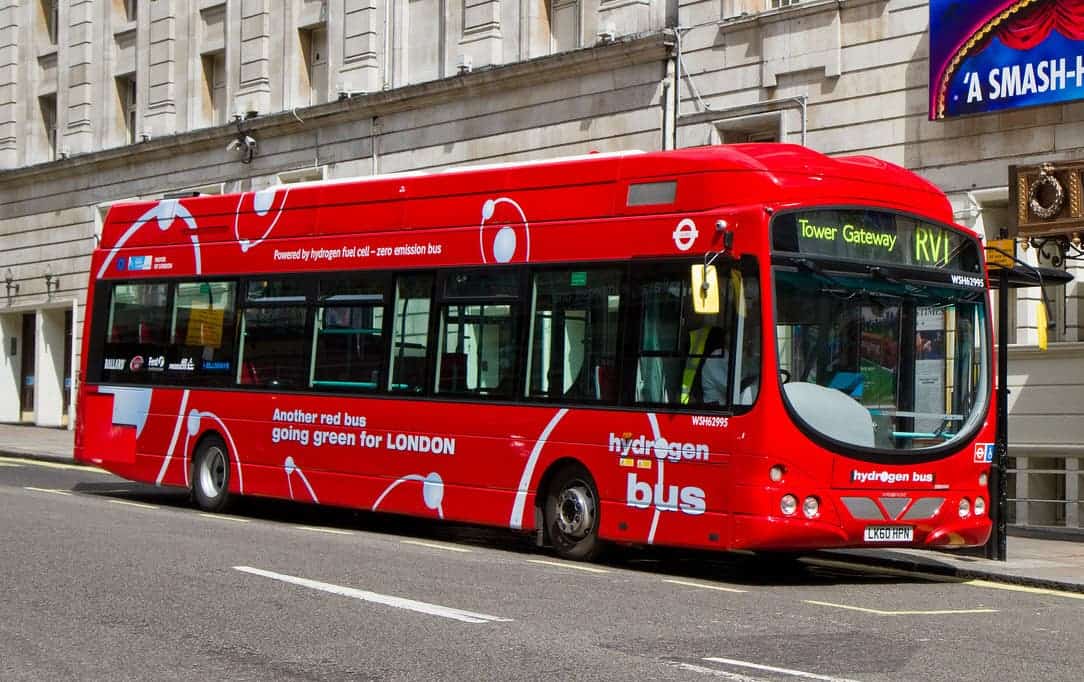
A single decker hydrogen bus in London. Image credits: Martin Addison.

Don’t fret, London’s emblematic red buses will remain red – but they’ll be green on the inside. The city’s mayor, Sadiq Khan has announced that diesel double-decker buses will be phased out from the fleet in two years, to be replaced by electric or hydrogen buses.

“I want London to become a world leader in hydrogen and electric bus technology,” he said. “Transforming London’s bus fleet by accelerating the introduction of zero-emission buses is important and I plan to work with bus manufacturers, other cities, the European Commission and the C40 Climate Change Leadership Group of Cities to move this agenda forward.”

In many ways, cities and not countries are leading the way against climate change. Earlier this year, 7,100 cities from 119 countries signed world’s largest alliance to curb climate change and in the developed world at least, city climate targets are much more ambitious than national ones. Eleven other major cities of the world have also pledged to phase out diesel buses by the end of 2020, including New York, Los Angeles, San Francisco, Amsterdam, Copenhagen and Cape Town. Also, Paris, Madrid, and Mexico City have committed to do the same thing by 2025.

For London especially, reducing pollution is crucial. The world’s first industrialized city is also one of the most polluted in Europe. London has reached its yearly NO2 pollution limit in just 8 days and it’s already being sued by its citizens. London’s smog problem is recently getting out of control and parents have been warned to ‘take care‘ when they’re going outside with babies, because of pollution. It’s estimated that almost 10,000 Londoners are killed each year by air pollution and reducing emissions from diesel cars can have a big positive impact.

Tags: busemissionslondon

ShareTweetShare
Mihai Andrei

Mihai Andrei

Dr. Andrei Mihai is a geophysicist and founder of ZME Science. He has a Ph.D. in geophysics and archaeology and has completed courses from prestigious universities (with programs ranging from climate and astronomy to chemistry and geology). He is passionate about making research more accessible to everyone and communicating news and features to a broad audience.

Related Posts

Art

This New Museum Lets You Order and Handle Unique, Ancient Exhibits

byMihai Andrei
3 weeks ago
Environment

Trump-Appointed EPA Plans to Let Most Polluters Stop Reporting CO2 Emissions

byTibi Puiu
4 months ago
Climate

The 0.1% Are Using Private Jets Like Ubers and It’s Costing the Planet

byTibi Puiu
9 months ago
Future

Finally, green concrete? New mixture sequesters CO2 while producing strong, durable concrete

byMihai Andrei
1 year ago

Recent news

The UK Government Says You Should Delete Emails to Save Water. That’s Dumb — and Hypocritical

August 16, 2025

In Denmark, a Vaccine Is Eliminating a Type of Cervical Cancer

August 16, 2025
This Picture of the Week shows a stunning spiral galaxy known as NGC 4945. This little corner of space, near the constellation of Centaurus and over 12 million light-years away, may seem peaceful at first — but NGC 4945 is locked in a violent struggle. At the very centre of nearly every galaxy is a supermassive black hole. Some, like the one at the centre of our own Milky Way, aren’t particularly hungry. But NGC 4945’s supermassive black hole is ravenous, consuming huge amounts of matter — and the MUSE instrument at ESO’s Very Large Telescope (VLT) has caught it playing with its food. This messy eater, contrary to a black hole’s typical all-consuming reputation, is blowing out powerful winds of material. This cone-shaped wind is shown in red in the inset, overlaid on a wider image captured with the MPG/ESO telescope at La Silla. In fact, this wind is moving so fast that it will end up escaping the galaxy altogether, lost to the void of intergalactic space. This is part of a new study that measured how winds move in several nearby galaxies. The MUSE observations show that these incredibly fast winds demonstrate a strange behaviour: they actually speed up far away from the central black hole, accelerating even more on their journey to the galactic outskirts. This process ejects potential star-forming material from a galaxy, suggesting that black holes control the fates of their host galaxies by dampening the stellar birth rate. It also shows that the more powerful black holes impede their own growth by removing the gas and dust they feed on, driving the whole system closer towards a sort of galactic equilibrium. Now, with these new results, we are one step closer to understanding the acceleration mechanism of the winds responsible for shaping the evolution of galaxies, and the history of the universe. Links  Research paper in Nature Astronomy by Marconcini et al. Close-up view of NGC 4945’s nucleus

Astronomers Find ‘Punctum,’ a Bizarre Space Object That Might be Unlike Anything in the Universe

August 15, 2025
  • About
  • Advertise
  • Editorial Policy
  • Privacy Policy and Terms of Use
  • How we review products
  • Contact

© 2007-2025 ZME Science - Not exactly rocket science. All Rights Reserved.

No Result
View All Result
  • Science News
  • Environment
  • Health
  • Space
  • Future
  • Features
    • Natural Sciences
    • Physics
      • Matter and Energy
      • Quantum Mechanics
      • Thermodynamics
    • Chemistry
      • Periodic Table
      • Applied Chemistry
      • Materials
      • Physical Chemistry
    • Biology
      • Anatomy
      • Biochemistry
      • Ecology
      • Genetics
      • Microbiology
      • Plants and Fungi
    • Geology and Paleontology
      • Planet Earth
      • Earth Dynamics
      • Rocks and Minerals
      • Volcanoes
      • Dinosaurs
      • Fossils
    • Animals
      • Mammals
      • Birds
      • Fish
      • Amphibians
      • Reptiles
      • Invertebrates
      • Pets
      • Conservation
      • Animal facts
    • Climate and Weather
      • Climate change
      • Weather and atmosphere
    • Health
      • Drugs
      • Diseases and Conditions
      • Human Body
      • Mind and Brain
      • Food and Nutrition
      • Wellness
    • History and Humanities
      • Anthropology
      • Archaeology
      • History
      • Economics
      • People
      • Sociology
    • Space & Astronomy
      • The Solar System
      • Sun
      • The Moon
      • Planets
      • Asteroids, meteors & comets
      • Astronomy
      • Astrophysics
      • Cosmology
      • Exoplanets & Alien Life
      • Spaceflight and Exploration
    • Technology
      • Computer Science & IT
      • Engineering
      • Inventions
      • Sustainability
      • Renewable Energy
      • Green Living
    • Culture
    • Resources
  • Videos
  • Reviews
  • About Us
    • About
    • The Team
    • Advertise
    • Contribute
    • Editorial policy
    • Privacy Policy
    • Contact

© 2007-2025 ZME Science - Not exactly rocket science. All Rights Reserved.