

ZME Science
No Result
View All Result
ZME Science
No Result
View All Result
ZME Science

Home → Health → Mind & Brain

Cooking food helped early humans grow bigger brains

Tibi PuiubyTibi Puiu
October 23, 2012
in Mind & Brain, Neurology, Studies
A A
Share on FacebookShare on TwitterSubmit to Reddit

The pyramids, art, all of the world’s great inventions, literary works, just about any valuable intellectual work can be traced back to food – cooked food. If you care to go as far back as our very roots, that is. Previous research showed that cooked food made it easier and more efficient for our guts to absorb calories more rapidly, which helped increase the brains of our early ancestors. A new research by neuroscientists at  the Federal University of Rio de Janeiro in Brazil found that humans nowadays would need to eat 9 hours non-stop to get enough energy from unprocessed raw food alone to support our large brains.

“If you eat only raw food, there are not enough hours in the day to get enough calories to build such a large brain,” says Suzana Herculano-Houzel, a neuroscientist at the Federal University of Rio de Janeiro in Brazil who is co-author of the report. “We can afford more neurons, thanks to cooking.”

Humans have roughly three times as many neurons (86 billion) than our close primate cousins, like gorillas (33 billion) or chimpanzees (28 billion). The Brazilian scientists found that the number of neurons is directly linked to brain size, as well as to the amount of energy needed to feed the brain. Thus, humans need brains consume 20% of our body’s energy when resting, compared with 9% in other primates – a hefty cost. This begged the question, however: from where did our ancestors get all this extra energy to grow such a large brain in a relatively short evolutionary time frame?
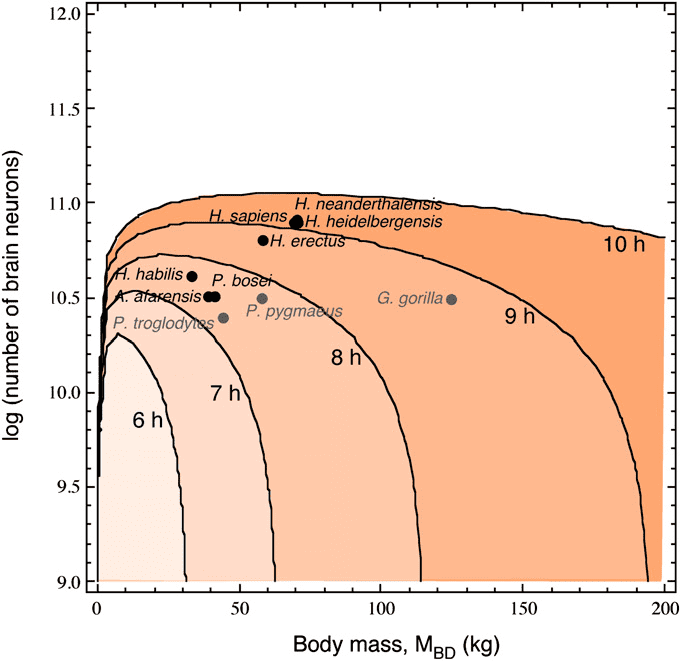
Required daily feeding time for hominin and great ape species to afford combinations of MBD and total number of brain neurons. Notice that H. heidelbergensis, H. neanderthalensis, and H. sapiens fall well over the viability curve for 8 h/d of feeding if they had a raw foods diet similar to extant nonhuman primates. (c) Fonseca-Azevedo and Herculano-Houzel
Required daily feeding time for hominin and great ape species to
afford combinations of MBD and total number of brain neurons. Notice that
H. heidelbergensis, H. neanderthalensis, and H. sapiens fall well over the
viability curve for 8 h/d of feeding if they had a raw foods diet similar to
extant nonhuman primates. (c) Fonseca-Azevedo and Herculano-Houzel

The answer is cooked food, according to the researchers. Back in the 1990s, Harvard University primatologist Richard Wrangham asserted, in a now famous thesis, that the human lineage embarked on an explosive growth of the brain some 1.6 to 1.8 million years ago when Homo Erectus started cooking food. Wrangham claimed that processed food is more efficiently absorbed in the body, significantly increasing the relative energy intake compared to digesting raw food. Follow-up studies at the time demonstrated that rodents or pythons grow faster and bigger when they eat cooked meat instead of raw meat, and that it takes less energy to digest cooked meat than raw meat.

You’d need to eat raw food for 9 hours without rest in order to get the same energy kick

 A comparison of the frontal lobes (colored) in human and several non-human primate species. The evolutionary relationships among the species are indicated by the connecting lines. Semendeferi and colleagues5 found that human frontal lobes are not disproportionately larger than predicted for a primate brain of its size. (Figure courtesy of K. Semendeferi and H. Damasio from a different  research - Nature Neuroscience  5, 190 - 192 (2002)  doi:10.1038/nn0302-190).
A comparison of the frontal lobes (colored) in human and several non-human primate species. The evolutionary relationships among the species are indicated by the connecting lines. Semendeferi and colleagues5 found that human frontal lobes are not disproportionately larger than predicted for a primate brain of its size. (Figure courtesy of K. Semendeferi and H. Damasio from a different research – Nature Neuroscience 5, 190 – 192 (2002) doi:10.1038/nn0302-190).

For the present research, the neuroscientists calculated how many hours per day humans and other primates need to eat raw food in order to support their current brains and body size. They found that it would take 8.8 hours for gorillas; 7.8 hours for orangutans; 7.3 hours for chimps; and 9.3 hours for our species, H. sapiens. Worth noting is the fact that raw food in this case, refers to that found in the wild, not processed raw food that humans typically prepare with blenders and add protein and other nutrients to.

 “The reason we have more neurons than any other animal alive is that cooking allowed this qualitative change—this step increase in brain size,” she says. “By cooking, we managed to circumvent the limitation of how much we can eat in a day.”

This study shows “that an ape could not achieve a brain as big as in recent humans while maintaining a typical ape diet,” Wrangham says.

Not all researchers are convinced however that cooking food sparked the brain growth explosion of our ancestors. That may very well be so, believes Paleoanthropologist Robert Martin of The Field Museum in Chicago, Illinois, who agrees that the present paper is the first to provide tangible evidence of metabolic limitations, but who goes on to say that whether our ancestors began cooking over a fire later, when the brain went through a second major growth spurt about 600,000 years ago or during H. Erectus is still unclear. The earliest evidence of hominid fire control found thus far has been dated from 800,000 years ago, and  regular use of fire for cooking doesn’t become widespread until more recently.

“Gorillas are stuck with this limitation of how much they can eat in a day; orangutans are stuck there; H. erectuswould be stuck there if they had not invented cooking,” Herculano-Houzel said. “The more I think about it, the more I bow to my kitchen. It’s the reason we are here.”

Findings were published in the journal Proceedings of the National Academy of Sciences. 

source: ScienceMag

RelatedPosts

Well-done meat may raise your blood pressure
When otters play with rocks, it’s because they’re excited about food
The Neuroscience Behind Vermeer’s Girl and Its Hypnotic Power
Ever-growing population and climate instability will lead to severe food shortages by 2050
Tags: foodHomo Erectusneuroscienceprimates

ShareTweetShare
Tibi Puiu

Tibi Puiu

Tibi is a science journalist and co-founder of ZME Science. He writes mainly about emerging tech, physics, climate, and space. In his spare time, Tibi likes to make weird music on his computer and groom felines. He has a B.Sc in mechanical engineering and an M.Sc in renewable energy systems.

Related Posts

News

Scientists Gave People a Fatty Milkshake. It Turned Out To Be a “Brain Bomb”

byChris Marley
1 week ago
Animals

The new fashion trend among chimpanzees: sticking grass in your ear (and butt)

byMihai Andrei
1 month ago
Future

This Ancient Grain Could Power the Future of 3D-Printed Food

byMihai Andrei
1 month ago
Mathematics

This study suggests zapping people’s brains could make them better at math

byMihai Andrei
1 month ago

Recent news

The UK Government Says You Should Delete Emails to Save Water. That’s Dumb — and Hypocritical

August 16, 2025

In Denmark, a Vaccine Is Eliminating a Type of Cervical Cancer

August 16, 2025
This Picture of the Week shows a stunning spiral galaxy known as NGC 4945. This little corner of space, near the constellation of Centaurus and over 12 million light-years away, may seem peaceful at first — but NGC 4945 is locked in a violent struggle. At the very centre of nearly every galaxy is a supermassive black hole. Some, like the one at the centre of our own Milky Way, aren’t particularly hungry. But NGC 4945’s supermassive black hole is ravenous, consuming huge amounts of matter — and the MUSE instrument at ESO’s Very Large Telescope (VLT) has caught it playing with its food. This messy eater, contrary to a black hole’s typical all-consuming reputation, is blowing out powerful winds of material. This cone-shaped wind is shown in red in the inset, overlaid on a wider image captured with the MPG/ESO telescope at La Silla. In fact, this wind is moving so fast that it will end up escaping the galaxy altogether, lost to the void of intergalactic space. This is part of a new study that measured how winds move in several nearby galaxies. The MUSE observations show that these incredibly fast winds demonstrate a strange behaviour: they actually speed up far away from the central black hole, accelerating even more on their journey to the galactic outskirts. This process ejects potential star-forming material from a galaxy, suggesting that black holes control the fates of their host galaxies by dampening the stellar birth rate. It also shows that the more powerful black holes impede their own growth by removing the gas and dust they feed on, driving the whole system closer towards a sort of galactic equilibrium. Now, with these new results, we are one step closer to understanding the acceleration mechanism of the winds responsible for shaping the evolution of galaxies, and the history of the universe. Links  Research paper in Nature Astronomy by Marconcini et al. Close-up view of NGC 4945’s nucleus

Astronomers Find ‘Punctum,’ a Bizarre Space Object That Might be Unlike Anything in the Universe

August 15, 2025
  • About
  • Advertise
  • Editorial Policy
  • Privacy Policy and Terms of Use
  • How we review products
  • Contact

© 2007-2025 ZME Science - Not exactly rocket science. All Rights Reserved.

No Result
View All Result
  • Science News
  • Environment
  • Health
  • Space
  • Future
  • Features
    • Natural Sciences
    • Physics
      • Matter and Energy
      • Quantum Mechanics
      • Thermodynamics
    • Chemistry
      • Periodic Table
      • Applied Chemistry
      • Materials
      • Physical Chemistry
    • Biology
      • Anatomy
      • Biochemistry
      • Ecology
      • Genetics
      • Microbiology
      • Plants and Fungi
    • Geology and Paleontology
      • Planet Earth
      • Earth Dynamics
      • Rocks and Minerals
      • Volcanoes
      • Dinosaurs
      • Fossils
    • Animals
      • Mammals
      • Birds
      • Fish
      • Amphibians
      • Reptiles
      • Invertebrates
      • Pets
      • Conservation
      • Animal facts
    • Climate and Weather
      • Climate change
      • Weather and atmosphere
    • Health
      • Drugs
      • Diseases and Conditions
      • Human Body
      • Mind and Brain
      • Food and Nutrition
      • Wellness
    • History and Humanities
      • Anthropology
      • Archaeology
      • History
      • Economics
      • People
      • Sociology
    • Space & Astronomy
      • The Solar System
      • Sun
      • The Moon
      • Planets
      • Asteroids, meteors & comets
      • Astronomy
      • Astrophysics
      • Cosmology
      • Exoplanets & Alien Life
      • Spaceflight and Exploration
    • Technology
      • Computer Science & IT
      • Engineering
      • Inventions
      • Sustainability
      • Renewable Energy
      • Green Living
    • Culture
    • Resources
  • Videos
  • Reviews
  • About Us
    • About
    • The Team
    • Advertise
    • Contribute
    • Editorial policy
    • Privacy Policy
    • Contact

© 2007-2025 ZME Science - Not exactly rocket science. All Rights Reserved.