
ZME Science
No Result
View All Result
ZME Science
No Result
View All Result
ZME Science

Home → Science → News

Terrorists could be identified by their ‘V’ signs

Familiar terrorist footage includes masked murders proudly posing with two 'V' shaped fingers over the corpse of their victims. Many times, this is the only thing investigators have at their disposal to identify the terrorist.
Tibi PuiubyTibi Puiu
March 11, 2016
in News
A A
Share on FacebookShare on TwitterSubmit to Reddit

Familiar terrorist footage includes masked murders proudly posing with two ‘V’ shaped fingers over the corpse of their victims. Many times, this is the only thing investigators have at their disposal to identify the terrorist.

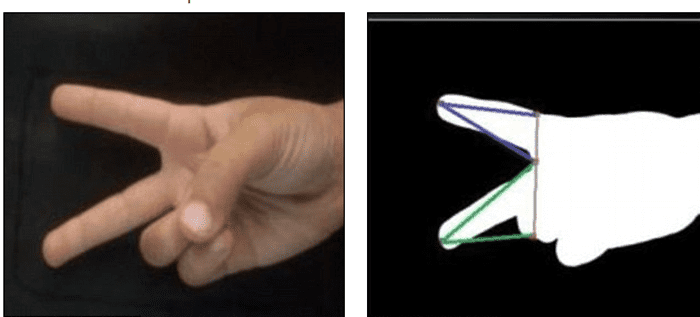
v shape identification
Credit: Mu’tah University

Researchers at Mu’tah University in Jordan claim they can now identify people with no other information available other than the ‘victory’ sign.

It’s already established that the each person’s hands are unique, so a person can be identified based on the shape, structure and gestures. For this to work though, investigators need to study the hands in great detail. Terrorist footage, however, is often of very poor resolution and no terrorist seems to want to lay their hands bare in front of the camera. Most, however, gladly show off a self-gratifying V sign.

Ahmad Hassanat and colleagues showed how it all works. First, 50 men and women were asked to pose with their fingers in the V-shape while they were photographed with a typical eight-megapixel phone camera. A database of 500 images was created.


Two thirds of these images were fed in a machine learning algorithm which was pre-programmed to look for certain cues. These include the end points of the two fingers, the lowest point in the valley in between them, and two points in the palm of the hand. These points can then be used to make triangles which can be used in identification analysis. In total 16 different features were used for the identification.

The other third of the images were used by the researchers in a blind test to see how reliably the machine could use only those V sign photos to identify a person. Hassanat says it was right 90 percent of the time. “There is a great potential for this approach to be used for the purpose of identifying terrorists, if the victory sign were the only identifying evidence,” he adds. Of course, you still need to know who the hands belongs to.

RelatedPosts

Stuxnet virus that crippled Iranian nuclear facility infects International Space Station
Somalian Jihadist movement bans plastic bags to protect the environment
What stochastic terrorism is and why the US may see more of it
Two bloody wars and 13 years later, the War on Terror has helped increase Terrorist Attacks Seven Fold

There are several limitations to this study. For one, the small sample size doesn’t make it very credible. This method needs to be tested with scrutiny if the police or secret services can use it reliably. Also, tests that might assess the degree of false positives or negatives haven’t been made it. As a proof of concept, it doesn’t sound bad at all though.

Reference: arxiv.org/abs/1602.08325 : Victory Sign Biometric for Terrorists Identification

Tags: terrorism

ShareTweetShare
Tibi Puiu

Tibi Puiu

Tibi is a science journalist and co-founder of ZME Science. He writes mainly about emerging tech, physics, climate, and space. In his spare time, Tibi likes to make weird music on his computer and groom felines. He has a B.Sc in mechanical engineering and an M.Sc in renewable energy systems.

Related Posts

Sociology

What stochastic terrorism is and why the US may see more of it

byMihai Andrei
4 years ago
A Group of Somali refugees gathers behind barbed wire fence to get water from a well. The well was drilled by the Indian Army to provide the refugees on Baidoa, Somalia with fresh water. This mission is in direct support of Operation Restore Hope. Image credits: US Forces.
Environment

Somalian Jihadist movement bans plastic bags to protect the environment

byMihai Andrei
7 years ago
Image: Global Terrorism Index 2014
News

Two bloody wars and 13 years later, the War on Terror has helped increase Terrorist Attacks Seven Fold

byTibi Puiu
11 years ago
stuxnet
Discoveries

Stuxnet virus that crippled Iranian nuclear facility infects International Space Station

byTibi Puiu
12 years ago

Recent news

The UK Government Says You Should Delete Emails to Save Water. That’s Dumb — and Hypocritical

August 16, 2025

In Denmark, a Vaccine Is Eliminating a Type of Cervical Cancer

August 16, 2025
This Picture of the Week shows a stunning spiral galaxy known as NGC 4945. This little corner of space, near the constellation of Centaurus and over 12 million light-years away, may seem peaceful at first — but NGC 4945 is locked in a violent struggle. At the very centre of nearly every galaxy is a supermassive black hole. Some, like the one at the centre of our own Milky Way, aren’t particularly hungry. But NGC 4945’s supermassive black hole is ravenous, consuming huge amounts of matter — and the MUSE instrument at ESO’s Very Large Telescope (VLT) has caught it playing with its food. This messy eater, contrary to a black hole’s typical all-consuming reputation, is blowing out powerful winds of material. This cone-shaped wind is shown in red in the inset, overlaid on a wider image captured with the MPG/ESO telescope at La Silla. In fact, this wind is moving so fast that it will end up escaping the galaxy altogether, lost to the void of intergalactic space. This is part of a new study that measured how winds move in several nearby galaxies. The MUSE observations show that these incredibly fast winds demonstrate a strange behaviour: they actually speed up far away from the central black hole, accelerating even more on their journey to the galactic outskirts. This process ejects potential star-forming material from a galaxy, suggesting that black holes control the fates of their host galaxies by dampening the stellar birth rate. It also shows that the more powerful black holes impede their own growth by removing the gas and dust they feed on, driving the whole system closer towards a sort of galactic equilibrium. Now, with these new results, we are one step closer to understanding the acceleration mechanism of the winds responsible for shaping the evolution of galaxies, and the history of the universe. Links  Research paper in Nature Astronomy by Marconcini et al. Close-up view of NGC 4945’s nucleus

Astronomers Find ‘Punctum,’ a Bizarre Space Object That Might be Unlike Anything in the Universe

August 15, 2025
  • About
  • Advertise
  • Editorial Policy
  • Privacy Policy and Terms of Use
  • How we review products
  • Contact

© 2007-2025 ZME Science - Not exactly rocket science. All Rights Reserved.

No Result
View All Result
  • Science News
  • Environment
  • Health
  • Space
  • Future
  • Features
    • Natural Sciences
    • Physics
      • Matter and Energy
      • Quantum Mechanics
      • Thermodynamics
    • Chemistry
      • Periodic Table
      • Applied Chemistry
      • Materials
      • Physical Chemistry
    • Biology
      • Anatomy
      • Biochemistry
      • Ecology
      • Genetics
      • Microbiology
      • Plants and Fungi
    • Geology and Paleontology
      • Planet Earth
      • Earth Dynamics
      • Rocks and Minerals
      • Volcanoes
      • Dinosaurs
      • Fossils
    • Animals
      • Mammals
      • Birds
      • Fish
      • Amphibians
      • Reptiles
      • Invertebrates
      • Pets
      • Conservation
      • Animal facts
    • Climate and Weather
      • Climate change
      • Weather and atmosphere
    • Health
      • Drugs
      • Diseases and Conditions
      • Human Body
      • Mind and Brain
      • Food and Nutrition
      • Wellness
    • History and Humanities
      • Anthropology
      • Archaeology
      • History
      • Economics
      • People
      • Sociology
    • Space & Astronomy
      • The Solar System
      • Sun
      • The Moon
      • Planets
      • Asteroids, meteors & comets
      • Astronomy
      • Astrophysics
      • Cosmology
      • Exoplanets & Alien Life
      • Spaceflight and Exploration
    • Technology
      • Computer Science & IT
      • Engineering
      • Inventions
      • Sustainability
      • Renewable Energy
      • Green Living
    • Culture
    • Resources
  • Videos
  • Reviews
  • About Us
    • About
    • The Team
    • Advertise
    • Contribute
    • Editorial policy
    • Privacy Policy
    • Contact

© 2007-2025 ZME Science - Not exactly rocket science. All Rights Reserved.