ZME Science
No Result
View All Result
ZME Science
No Result
View All Result
ZME Science

Home → Science → News

Celebrating Ada Lovelace: the first computer programmer (XIXth century)

In 1847, at the tender age of 27, Ada Lovelace became the world's first programmer, more than a hundred years before the first computer was actually introduced.

Tibi PuiubyTibi Puiu
October 13, 2015 - Updated on April 6, 2021
in News, Science
A A
Share on FacebookShare on TwitterSubmit to Reddit

RelatedPosts

Here’s why there was no Twitter on Friday — it’s way scarier than you think
Hard to crack and easy to remember password? Try a poem
This Strange Material Flips Between Conductor and Insulator and This Could Supercharge Computers by 1,000 Times
First computer made out of carbon nanotubes spells silicon demise in electronics
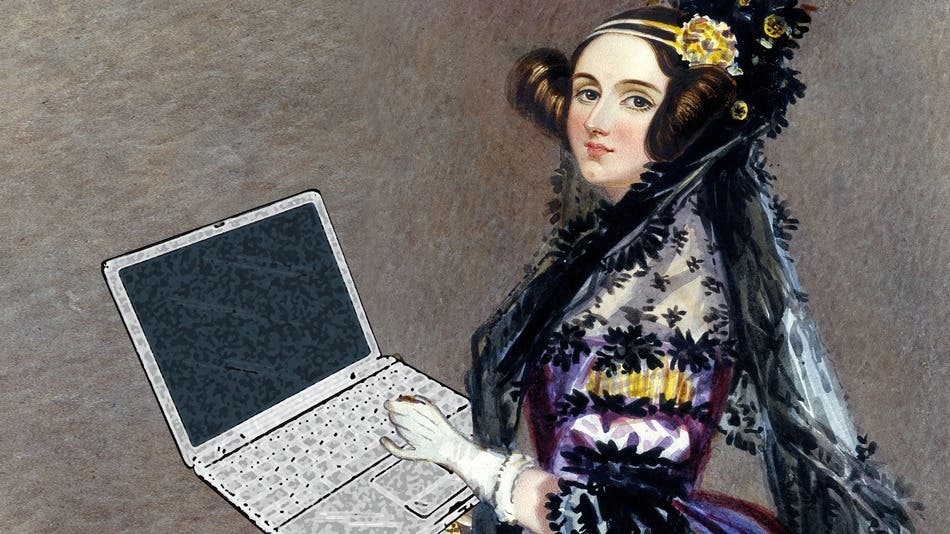
Image: MASHABLE COMPOSITE ALFRED EDWARD CHALON/SCIENCE & SOCIETY PICTURE LIBRARY

In 1847, at the tender age of 27, Ada Lovelace became the world’s first programmer, more than a hundred years before the first computer was actually introduced. Ahead of her time is likely an understatement, and of course there’s much to learn from Lovelace’s story. Today, scientists all over the world celebrate her legacy by holding special events that seek to encourage women to pursue careers in STEM (science, technology, engineering and mathematics). While gender discrepancy in STEM has somewhat leveled out, far too few women embark on this sort of career path. One can only imagine how society must have looked upon the likes of Lovelace, a full blown mathematical genius in the XIXth century, who was prolific decades before Marie Curie – perhaps the most cited science female role model – was even born. Alas, she was ‘but’ a woman.

A genius ahead of her time

The daughter of none other than Lord Byron, the famous poet, Lovelace become acquainted while she was only 18 to inventor Charles Babbage, then 42. The two strung a close friendship that would change Ada’s life forever. Babbage was working on a very early, calculator-like computer called The Difference Engine, which eventually went to grow into the Analytical Engine, a forerunner to the modern computer. In 1842, Ada translated a description of it by Italian mathematician Luigi Menabrea. “As she understood [it] so well”, Babbage asked Ada to expand the article, which eventually grew into a 20,000-word work that included the first computer program: An algorithm that would teach the machine how to calculate a series of Bernoulli Numbers.

“By understanding what the Analytical Engine could do — that it was far more than just a calculator — there’s no doubt whatsoever that Ada glimpsed the future of information technology,” said James Essinger, whose biography of Lovelace titled Ada’s Algorithm is published this week. According to Essinger, Ada expanded on Babbage’s ideas and envisioned the modern day computer. “What computers do, with literally billions of applications by billions of people, is exactly what Ada foresaw. In some ways, it is almost miraculously prophetic.”

Unfortunately, Babbage never created the machine and Ada was unable to test her theory before she died at the age of 36 of cancer.

Ada herself was an inspiration to many including Michael Faraday. On the 10 June 1840, Ada Lovelace sent a copy of her portrait to Michael Faraday with a note saying:

‘Dear Mr. Faraday,

Mr Babbage tells me that you have expressed a wish to possess one of the engravings of me, by which I feel exceedingly flattered, & hope you will accept one that we still happen to have by us.

I am sorry that there is no proof left, to which I might have put my signature.

Believe me, yours very truly

Augusta Ada Lovelace

St James’ Square’

Faraday liked to collect images of people he met or were acquainted with so this etching was gratefully received into his collection.

We can only imagine how Ada might have felt had she traveled to the future and saw what computers are capable of in our present day and how ubiquitous they’ve become . Most people in the developed world nowadays carry a tiny computer in their pockets whose computing power is greater than the combined power of all the Apollo -era computers used to help man land on the moon. Actually, almost anyone today owns or at least knows how to power up a computer – more than four billion PCs, tablets and smartphones are currently in use. It’s crazy, but while most people have yet to realize how fortunate they are to live in such exciting times, we can only hope they will eventually become inspired. There’s so much we can learn, both men and women, from the brave and brilliant Ada Lovelace.

Tags: Ada Lovelacecomputers

Share72TweetShare
Tibi Puiu

Tibi Puiu

Tibi is a science journalist and co-founder of ZME Science. He writes mainly about emerging tech, physics, climate, and space. In his spare time, Tibi likes to make weird music on his computer and groom felines. He has a B.Sc in mechanical engineering and an M.Sc in renewable energy systems.

Related Posts

News

This Strange Material Flips Between Conductor and Insulator and This Could Supercharge Computers by 1,000 Times

byTudor Tarita
1 month ago
Credit: Harvard University.
News

Squishy computers now enable the first fully soft robots

byTibi Puiu
6 years ago
Image credits Mahmoud Elzouka & Sidy Ndao, (2017), Scientific Reports.
Electronics

Thermal diode could allow computers to one day function on heat alone

byAlexandru Micu
8 years ago
Image credits kuloser / Pixabay.
Mind & Brain

Emotional computers really freak people out — a new take on the uncanny valley

byAlexandru Micu
8 years ago

Recent news

The UK Government Says You Should Delete Emails to Save Water. That’s Dumb — and Hypocritical

August 16, 2025

In Denmark, a Vaccine Is Eliminating a Type of Cervical Cancer

August 16, 2025
This Picture of the Week shows a stunning spiral galaxy known as NGC 4945. This little corner of space, near the constellation of Centaurus and over 12 million light-years away, may seem peaceful at first — but NGC 4945 is locked in a violent struggle. At the very centre of nearly every galaxy is a supermassive black hole. Some, like the one at the centre of our own Milky Way, aren’t particularly hungry. But NGC 4945’s supermassive black hole is ravenous, consuming huge amounts of matter — and the MUSE instrument at ESO’s Very Large Telescope (VLT) has caught it playing with its food. This messy eater, contrary to a black hole’s typical all-consuming reputation, is blowing out powerful winds of material. This cone-shaped wind is shown in red in the inset, overlaid on a wider image captured with the MPG/ESO telescope at La Silla. In fact, this wind is moving so fast that it will end up escaping the galaxy altogether, lost to the void of intergalactic space. This is part of a new study that measured how winds move in several nearby galaxies. The MUSE observations show that these incredibly fast winds demonstrate a strange behaviour: they actually speed up far away from the central black hole, accelerating even more on their journey to the galactic outskirts. This process ejects potential star-forming material from a galaxy, suggesting that black holes control the fates of their host galaxies by dampening the stellar birth rate. It also shows that the more powerful black holes impede their own growth by removing the gas and dust they feed on, driving the whole system closer towards a sort of galactic equilibrium. Now, with these new results, we are one step closer to understanding the acceleration mechanism of the winds responsible for shaping the evolution of galaxies, and the history of the universe. Links  Research paper in Nature Astronomy by Marconcini et al. Close-up view of NGC 4945’s nucleus

Astronomers Find ‘Punctum,’ a Bizarre Space Object That Might be Unlike Anything in the Universe

August 15, 2025
  • About
  • Advertise
  • Editorial Policy
  • Privacy Policy and Terms of Use
  • How we review products
  • Contact

© 2007-2025 ZME Science - Not exactly rocket science. All Rights Reserved.

No Result
View All Result
  • Science News
  • Environment
  • Health
  • Space
  • Future
  • Features
    • Natural Sciences
    • Physics
      • Matter and Energy
      • Quantum Mechanics
      • Thermodynamics
    • Chemistry
      • Periodic Table
      • Applied Chemistry
      • Materials
      • Physical Chemistry
    • Biology
      • Anatomy
      • Biochemistry
      • Ecology
      • Genetics
      • Microbiology
      • Plants and Fungi
    • Geology and Paleontology
      • Planet Earth
      • Earth Dynamics
      • Rocks and Minerals
      • Volcanoes
      • Dinosaurs
      • Fossils
    • Animals
      • Mammals
      • Birds
      • Fish
      • Amphibians
      • Reptiles
      • Invertebrates
      • Pets
      • Conservation
      • Animal facts
    • Climate and Weather
      • Climate change
      • Weather and atmosphere
    • Health
      • Drugs
      • Diseases and Conditions
      • Human Body
      • Mind and Brain
      • Food and Nutrition
      • Wellness
    • History and Humanities
      • Anthropology
      • Archaeology
      • History
      • Economics
      • People
      • Sociology
    • Space & Astronomy
      • The Solar System
      • Sun
      • The Moon
      • Planets
      • Asteroids, meteors & comets
      • Astronomy
      • Astrophysics
      • Cosmology
      • Exoplanets & Alien Life
      • Spaceflight and Exploration
    • Technology
      • Computer Science & IT
      • Engineering
      • Inventions
      • Sustainability
      • Renewable Energy
      • Green Living
    • Culture
    • Resources
  • Videos
  • Reviews
  • About Us
    • About
    • The Team
    • Advertise
    • Contribute
    • Editorial policy
    • Privacy Policy
    • Contact

© 2007-2025 ZME Science - Not exactly rocket science. All Rights Reserved.