ZME Science
No Result
View All Result
ZME Science
No Result
View All Result
ZME Science

Home → Features → Technology → Sustainability → Green Living

Wooden alternatives to green up your Christmas Tree

Mihai AndreibyMihai Andrei
December 23, 2015 - Updated on December 21, 2023
in Green Living
A A
Share on FacebookShare on TwitterSubmit to Reddit

I’ve already written an article about the best ways to green up your Christmas tree, so I really recommend you start from there. But if you want some more creative, out of the box eco-friendly alternatives, this is the place for you! Just in case you’re wondering why I’m against ‘traditional’ artificial trees: they’re made from PVC, which is polluting and non-recyclable, and they often contain lead which keeps the PVC together – you don’t want to breathe next to them.

possibiliTree
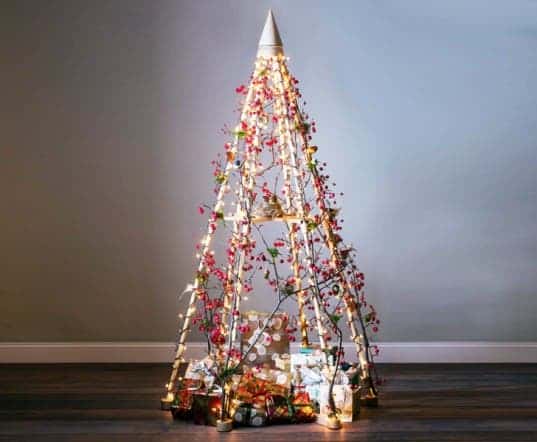
PossibiliTree wooden trees are a natural alternative to live and artificial Christmas trees. They’re light, compact, portable, and they also have an awesome name. They come in three sizes: 2ft ($190), 3ft ($230) and 6ft ($460). The price tag is certainly no joke, but it provides an eco-friendly, light alternative – and you get to save money on the decorations.

Oh, and they look awesome – Christmas or not. The suspended tree is a real show-stopper, but the others work just as fine; and they can be used throughout the year for various occasions – birthdays, anniversaries, and other celebrations.

The FestiveTree(s)

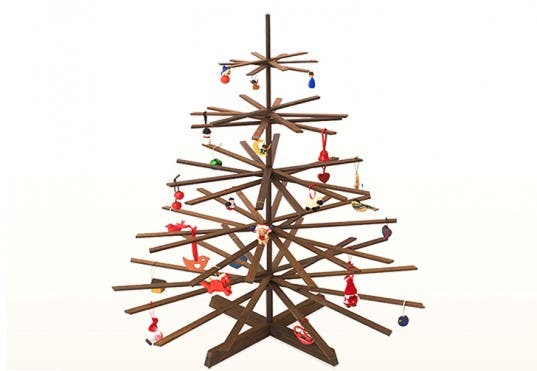
This small, innovative company from New Hampshire provides several lovely alternatives. Their mission is to cut down on the holiday-related consumerism, and offer a simple, sustainable option. Therefore, they’ve created environmentally friendly, reusable, and versatile trees. They provide four different options:
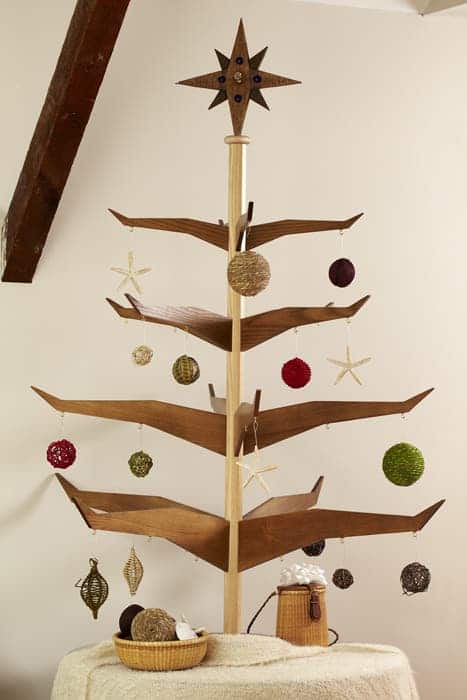
The People’s tree. $350.

Scandinavian style melds old-world charm with modern lines to transpose the warm, genuine artistic design of these trees.
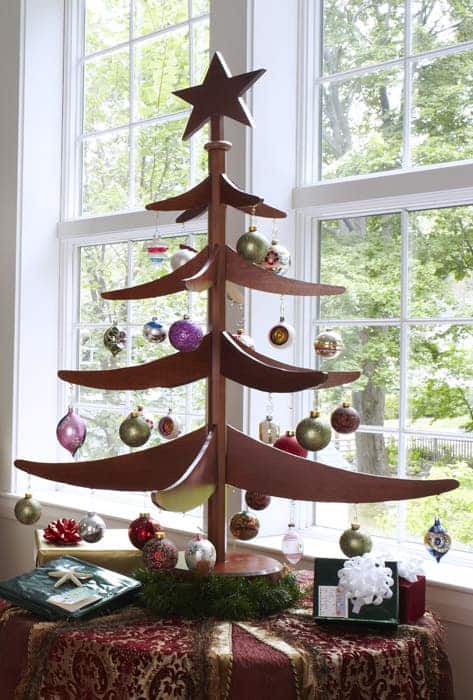
The Norwegian. $350.

Again, the price is no joke, but just like with the possibiliTree, the trees are pretty sturdy and you can use them with every occasion. But they offer some cheaper options as well:

RelatedPosts

Science Santa History: The origins of Christmas Customs
Yule Foods From Around The World
Saturnalia and Christmas — how a Pagan Roman festival paved the way for modern Christmas
The neuroscience of the Christmas cheer ‘emotion’
The Puzzle Tree. $195.
The Little Swede. $75.


Jubiltree Wooden Tree

Jubiltree. Price: $475.

The Jubiltree brings a surprising mix of traditional and modern that you can easily customize to adapt to your home’s decor. Personally, I find the price a little too high for my preference (at least compared to some of the other things I’ve found), but I do feel that this could be the perfect fit for a modern office or meeting room.

Cardboard trees

Buying a cardboard Christmas tree is a much the best route you can take, when it comes to cheap, eco-friendly alternatives.

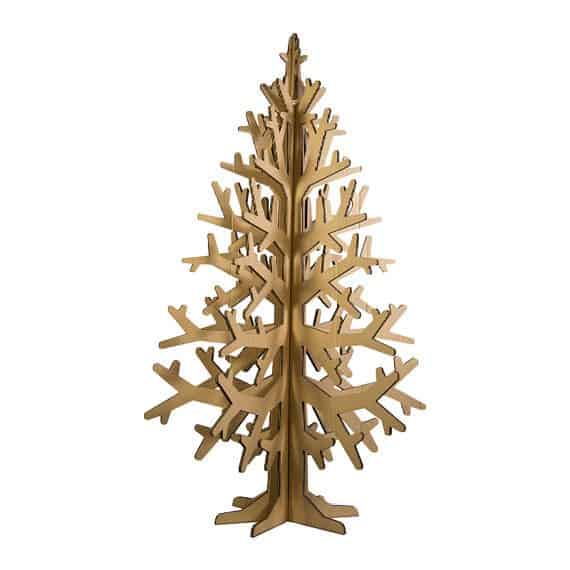
Three Piece Cardboard Christmas Tree. $99.
Recycled cardboard christmas tree holiday decoration. $139.

Norfolk Island Pine

Most Christmas Trees don’t do that well indoors, and you have to plant them or at least put them somewhere outside so they can survive, as I explained here. However, if that’s not an option, you should know that there are a few species who thrive indoors – among then, the Norfolk Island Pine, which you can currently get for only $4.99 at Amazon. Decorate it for the holidays, admire its beauty the rest of the year.

Bonus!

Don’t limit yourself to just pine trees – who says the Christmas tree has to be a pine or a fir? For the more exotic, the Christmas tree can be something else, like for example… a rosemary tree! Not only is it really nice to look at, but it also smells nice, and it gives you tasty, healthy herbs for the entire year. What’s not to like? You can get them at any local supermarket or specialized shop.

Yes, that’s a rosemary tree. Via Inhabitat.

Another small tree that really works well with this idea is the bonsai – exotic looking, the bonsay is a pleasure to look at throughout the entire year. Just like with the rosemary, you can find them on Amazon or at any local market.

Tags: Christmaschristmas tree

ShareTweetShare
Mihai Andrei

Mihai Andrei

Dr. Andrei Mihai is a geophysicist and founder of ZME Science. He has a Ph.D. in geophysics and archaeology and has completed courses from prestigious universities (with programs ranging from climate and astronomy to chemistry and geology). He is passionate about making research more accessible to everyone and communicating news and features to a broad audience.

Related Posts

Animals

What do reindeer do for Christmas? Actually, they just chill through it

byMihai Andrei
8 months ago
Science

America’s Favorite Christmas Cookies in 2024: A State-by-State Map

byMihai Andrei
8 months ago
Culture & Society

Christmas myths: The Krampus, Santa’s evil twin

byMihai Andrei
8 months ago
Image via Christmas Wallpapers.
Green Living

Real Vs Artificial Christmas Tree: What the science says

byMihai Andrei
8 months ago

Recent news

The UK Government Says You Should Delete Emails to Save Water. That’s Dumb — and Hypocritical

August 16, 2025

In Denmark, a Vaccine Is Eliminating a Type of Cervical Cancer

August 16, 2025
This Picture of the Week shows a stunning spiral galaxy known as NGC 4945. This little corner of space, near the constellation of Centaurus and over 12 million light-years away, may seem peaceful at first — but NGC 4945 is locked in a violent struggle. At the very centre of nearly every galaxy is a supermassive black hole. Some, like the one at the centre of our own Milky Way, aren’t particularly hungry. But NGC 4945’s supermassive black hole is ravenous, consuming huge amounts of matter — and the MUSE instrument at ESO’s Very Large Telescope (VLT) has caught it playing with its food. This messy eater, contrary to a black hole’s typical all-consuming reputation, is blowing out powerful winds of material. This cone-shaped wind is shown in red in the inset, overlaid on a wider image captured with the MPG/ESO telescope at La Silla. In fact, this wind is moving so fast that it will end up escaping the galaxy altogether, lost to the void of intergalactic space. This is part of a new study that measured how winds move in several nearby galaxies. The MUSE observations show that these incredibly fast winds demonstrate a strange behaviour: they actually speed up far away from the central black hole, accelerating even more on their journey to the galactic outskirts. This process ejects potential star-forming material from a galaxy, suggesting that black holes control the fates of their host galaxies by dampening the stellar birth rate. It also shows that the more powerful black holes impede their own growth by removing the gas and dust they feed on, driving the whole system closer towards a sort of galactic equilibrium. Now, with these new results, we are one step closer to understanding the acceleration mechanism of the winds responsible for shaping the evolution of galaxies, and the history of the universe. Links  Research paper in Nature Astronomy by Marconcini et al. Close-up view of NGC 4945’s nucleus

Astronomers Find ‘Punctum,’ a Bizarre Space Object That Might be Unlike Anything in the Universe

August 15, 2025
  • About
  • Advertise
  • Editorial Policy
  • Privacy Policy and Terms of Use
  • How we review products
  • Contact

© 2007-2025 ZME Science - Not exactly rocket science. All Rights Reserved.

No Result
View All Result
  • Science News
  • Environment
  • Health
  • Space
  • Future
  • Features
    • Natural Sciences
    • Physics
      • Matter and Energy
      • Quantum Mechanics
      • Thermodynamics
    • Chemistry
      • Periodic Table
      • Applied Chemistry
      • Materials
      • Physical Chemistry
    • Biology
      • Anatomy
      • Biochemistry
      • Ecology
      • Genetics
      • Microbiology
      • Plants and Fungi
    • Geology and Paleontology
      • Planet Earth
      • Earth Dynamics
      • Rocks and Minerals
      • Volcanoes
      • Dinosaurs
      • Fossils
    • Animals
      • Mammals
      • Birds
      • Fish
      • Amphibians
      • Reptiles
      • Invertebrates
      • Pets
      • Conservation
      • Animal facts
    • Climate and Weather
      • Climate change
      • Weather and atmosphere
    • Health
      • Drugs
      • Diseases and Conditions
      • Human Body
      • Mind and Brain
      • Food and Nutrition
      • Wellness
    • History and Humanities
      • Anthropology
      • Archaeology
      • History
      • Economics
      • People
      • Sociology
    • Space & Astronomy
      • The Solar System
      • Sun
      • The Moon
      • Planets
      • Asteroids, meteors & comets
      • Astronomy
      • Astrophysics
      • Cosmology
      • Exoplanets & Alien Life
      • Spaceflight and Exploration
    • Technology
      • Computer Science & IT
      • Engineering
      • Inventions
      • Sustainability
      • Renewable Energy
      • Green Living
    • Culture
    • Resources
  • Videos
  • Reviews
  • About Us
    • About
    • The Team
    • Advertise
    • Contribute
    • Editorial policy
    • Privacy Policy
    • Contact

© 2007-2025 ZME Science - Not exactly rocket science. All Rights Reserved.