

ZME Science
No Result
View All Result
ZME Science
No Result
View All Result
ZME Science

Home → Environment → Animals

Baleen whales use unique vocal boxes to produce their mysterious songs. This also makes them vulnerable

Scientists make a breakthrough in understanding how whales sing.

Tibi PuiubyTibi Puiu
February 21, 2024
in Animals, News
A A
Edited and reviewed by Zoe Gordon
Share on FacebookShare on TwitterSubmit to Reddit
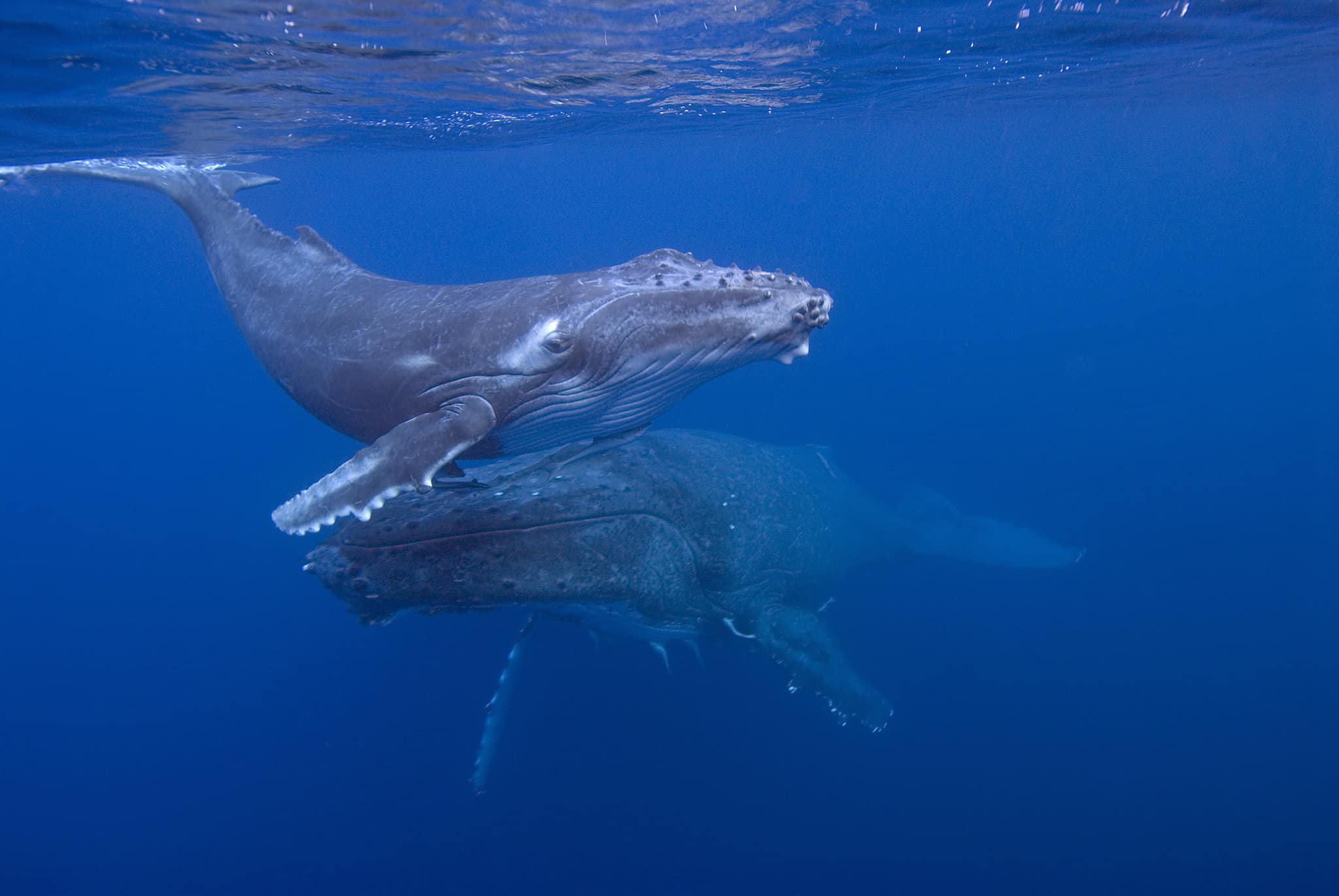
Humpback whale mother and calf, Ha'apai Islands, Tonga
Humpback whale mother and calf, Ha’apai Islands, Tonga. Credit: Flickr, GRID-Arendal.

Baleen whales, the ocean’s largest and most majestic creatures, have long captivated us with their haunting underwater melodies. Yet the exact mechanisms that produce these sounds echoing through the ocean depths remained a puzzle — until now. A new study has unveiled a novel aspect of whale vocalization, showing these gentle giants use a specialized larynx, or voice box, in their underwater communication.

A New Whale Sound Pathway

For years, we believed that whales produced sounds similarly to humans, by passing air through vocal cords. However, recent research published by a team of researchers led by Professor Coen Elemans of the University of Southern Denmark has revealed a unique mechanism in baleen whales. Unlike any other known method, these marine giants generate sound by pushing air between a tissue fold and a fatty cushion in their larynx, causing vibrations that produce their iconic songs.

Early sailors attributed the sounds of whales to ghosts or mythical creatures. We now know better, partly thanks to the advent of hydrophones. These are underwater microphones that can capture these sounds, revealing their true origin. These devices, initially developed for iceberg detection and military purposes, inadvertently provided marine biologists with a treasure trove of whale songs, unlocking a world of underwater acoustics previously shrouded in mystery.

Elemans and his colleagues studied the larynges of three stranded baleen whales. Through advanced scanning and modeling, they found baleen whales use a U-shaped structure in their larynx, akin to vocal cords, which has been modified over millions of years of evolution.

Like all whales, baleen whales evolved from an ancestor who journeyed from land back to the sea (where the ancestors of terrestrial animals first evolved). When these whale ancestors migrated back to the sea, their vocal folds prevented the very fast breathing that a whale needs to perform when taking oxygen at the water’s surface.

While toothed whales developed a nasal vocal organ to produce their signature songs, baleen whales — including species like the sei, common minke, and humpback — rely on their uniquely configured larynx. These specialized structures enable them to make sounds, recycle air, and prevent water inhalation simultaneously.

“This changes our perspective on how sounds are made in these whales, and it perhaps shows us a mechanism which the whales might use to make more than one sound at the same time,” Joy S. Reidenberg, a professor of anatomy at the Icahn School of Medicine at Mount Sinai who was not involved in the study told the NY Times.

RelatedPosts

Mice With a Human Gene Started Squeaking Differently. Could This Tiny Genetic Mutation Explain the Origin of Speech?
Young bats learn different dialects from their nest mates
AI Can Hear Cancer in the Voice Before Doctors Can Detect It
Oldest avian voice box suggests quacking sounds filled the air during the age of dinosaurs

The significance of this discovery extends beyond the mere mechanics of sound. It appears that baleen whales are equipped to communicate over impressive distances. However, they are limited within a specific frequency range of up to 300 Hz. This range is crucial for their low-frequency calls to permeate the ocean’s opaque waters, reaching depths of 100 meters.

Here’s the problem though: the frequency range of baleen whale songs overlaps significantly with the noise generated by shipping vessels, which also falls within the 30–300 Hz range. This unfortunate coincidence suggests that the increasing cacophony of human activity at sea could severely disrupt the whales’ ability to communicate, potentially impacting their social and reproductive behaviors.

The delicate balance of the ocean’s soundscape is being upended, posing yet another challenge for these majestic creatures as they navigate the perils of an ocean brimming with noise.

Tags: baleen whalelarynxvocalization

ShareTweetShare
Tibi Puiu

Tibi Puiu

Tibi is a science journalist and co-founder of ZME Science. He writes mainly about emerging tech, physics, climate, and space. In his spare time, Tibi likes to make weird music on his computer and groom felines. He has a B.Sc in mechanical engineering and an M.Sc in renewable energy systems.

Related Posts

Health

AI Can Hear Cancer in the Voice Before Doctors Can Detect It

byMihai Andrei
4 days ago
Geology

Scientists Analyzed a Dinosaur’s Voice Box. They Found a Chirp, Not a Roar

byTudor Tarita
3 weeks ago
Biology

Mice With a Human Gene Started Squeaking Differently. Could This Tiny Genetic Mutation Explain the Origin of Speech?

byTibi Puiu
6 months ago
Animals

This Australian duck says ‘You bloody fool’ and imitates other wacky sounds — and we couldn’t be more fascinated

byTibi Puiu
2 years ago

Recent news

The UK Government Says You Should Delete Emails to Save Water. That’s Dumb — and Hypocritical

August 16, 2025

In Denmark, a Vaccine Is Eliminating a Type of Cervical Cancer

August 16, 2025
This Picture of the Week shows a stunning spiral galaxy known as NGC 4945. This little corner of space, near the constellation of Centaurus and over 12 million light-years away, may seem peaceful at first — but NGC 4945 is locked in a violent struggle. At the very centre of nearly every galaxy is a supermassive black hole. Some, like the one at the centre of our own Milky Way, aren’t particularly hungry. But NGC 4945’s supermassive black hole is ravenous, consuming huge amounts of matter — and the MUSE instrument at ESO’s Very Large Telescope (VLT) has caught it playing with its food. This messy eater, contrary to a black hole’s typical all-consuming reputation, is blowing out powerful winds of material. This cone-shaped wind is shown in red in the inset, overlaid on a wider image captured with the MPG/ESO telescope at La Silla. In fact, this wind is moving so fast that it will end up escaping the galaxy altogether, lost to the void of intergalactic space. This is part of a new study that measured how winds move in several nearby galaxies. The MUSE observations show that these incredibly fast winds demonstrate a strange behaviour: they actually speed up far away from the central black hole, accelerating even more on their journey to the galactic outskirts. This process ejects potential star-forming material from a galaxy, suggesting that black holes control the fates of their host galaxies by dampening the stellar birth rate. It also shows that the more powerful black holes impede their own growth by removing the gas and dust they feed on, driving the whole system closer towards a sort of galactic equilibrium. Now, with these new results, we are one step closer to understanding the acceleration mechanism of the winds responsible for shaping the evolution of galaxies, and the history of the universe. Links  Research paper in Nature Astronomy by Marconcini et al. Close-up view of NGC 4945’s nucleus

Astronomers Find ‘Punctum,’ a Bizarre Space Object That Might be Unlike Anything in the Universe

August 15, 2025
  • About
  • Advertise
  • Editorial Policy
  • Privacy Policy and Terms of Use
  • How we review products
  • Contact

© 2007-2025 ZME Science - Not exactly rocket science. All Rights Reserved.

No Result
View All Result
  • Science News
  • Environment
  • Health
  • Space
  • Future
  • Features
    • Natural Sciences
    • Physics
      • Matter and Energy
      • Quantum Mechanics
      • Thermodynamics
    • Chemistry
      • Periodic Table
      • Applied Chemistry
      • Materials
      • Physical Chemistry
    • Biology
      • Anatomy
      • Biochemistry
      • Ecology
      • Genetics
      • Microbiology
      • Plants and Fungi
    • Geology and Paleontology
      • Planet Earth
      • Earth Dynamics
      • Rocks and Minerals
      • Volcanoes
      • Dinosaurs
      • Fossils
    • Animals
      • Mammals
      • Birds
      • Fish
      • Amphibians
      • Reptiles
      • Invertebrates
      • Pets
      • Conservation
      • Animal facts
    • Climate and Weather
      • Climate change
      • Weather and atmosphere
    • Health
      • Drugs
      • Diseases and Conditions
      • Human Body
      • Mind and Brain
      • Food and Nutrition
      • Wellness
    • History and Humanities
      • Anthropology
      • Archaeology
      • History
      • Economics
      • People
      • Sociology
    • Space & Astronomy
      • The Solar System
      • Sun
      • The Moon
      • Planets
      • Asteroids, meteors & comets
      • Astronomy
      • Astrophysics
      • Cosmology
      • Exoplanets & Alien Life
      • Spaceflight and Exploration
    • Technology
      • Computer Science & IT
      • Engineering
      • Inventions
      • Sustainability
      • Renewable Energy
      • Green Living
    • Culture
    • Resources
  • Videos
  • Reviews
  • About Us
    • About
    • The Team
    • Advertise
    • Contribute
    • Editorial policy
    • Privacy Policy
    • Contact

© 2007-2025 ZME Science - Not exactly rocket science. All Rights Reserved.