

ZME Science
No Result
View All Result
ZME Science
No Result
View All Result
ZME Science

Home → Science → News

UK successfully transmits data via the national electricity grid, in a global premiere

Smart grids, smart cities.

Mihai AndreibyMihai Andrei
October 11, 2016
in News, Renewable Energy, Technology
A A
Share on FacebookShare on TwitterSubmit to Reddit

RelatedPosts

Some people can really tell if you look sick, new study reports
Hidden features in old colonial money reveal how Ben Franklin outwitted counterfeiters and shaped America’s first currency
European rivers are fragmented by over one million barriers
This researcher says there’s a massive ozone hole over the tropics – but not everyone is convinced

For the first time in history, information has been transmitted through a national electricity grid, opening massive opportunities for smart grids and smart cities.
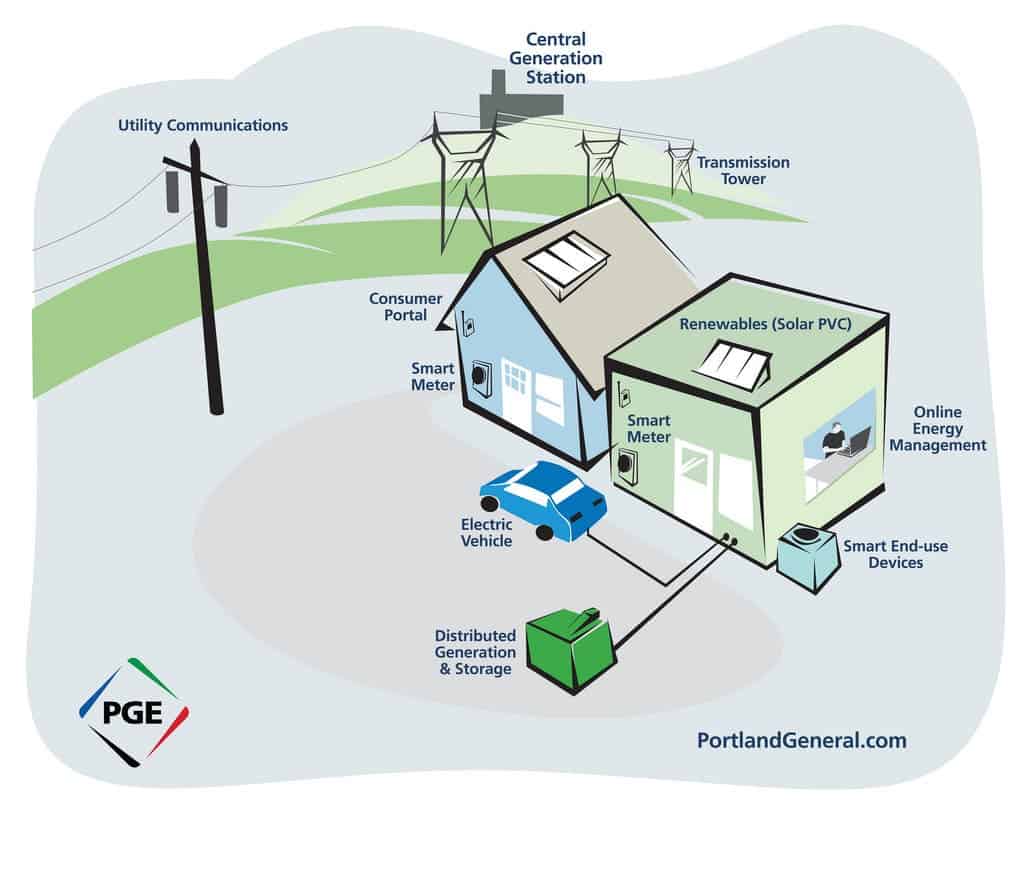
Building smart cities is a key aspect of a sustainable future. For the first time in history, more people are living in urban than rural areas, and people living in cities generally consume much more resources and emit much more carbon dioxide than their rural counterparts (really big cities are actually more eco-friendly than smaller cities, but this is another discussion).

Basically, at the core of every smart city there is a smart grid. Smart grids include a variety of operational and energy measures designed to increase energy efficiency and reduce overall consumption and emissions.

The problem is that smart grids are hard to implement, for a number of reasons. For starters, designing anything that’s connected to millions of people is going to be difficult – especially when you’re working with something as crucial as electricity when failures are simply not an option. Furthermore, the infrastructure is old and vulnerable in many parts of the world and smart technologies are hard to incorporate. But British engineers may have found a way around that: by sending raw information through the grid itself.

The new data system, created using telecoms technology by Reactive Technologies, has been successfully tested already on the British grid. It sends messages to any appliances in any house connected through a smart plug, asking it to adjust its energy usage. In your home, it could ask your freezer to increase its temperature by a degree when there is high energy demand and then lower it back after the peak has passed. Also, it could instruct appliances to use renewable energy when readily available. The main idea is to make the consumption smarter and much more efficient, as opposed to generating more energy.

“The old mindset would be, we need to build more power stations,” Jens Madrian, at RT and former CFO at “big six” utility RWE npower told the Guardian “We disagree with that. There are other ways of managing electricity, one of which is carrying knowledge from the telecommunications and software engineering side into the energy sector.”

RT believes that we should change more than our infrastructure – we should change our mindset as well.
“What is better? Building a Hinkley, which if it goes down you have lost 7% of the national electricity generation, or building up capacity from many hundreds of thousands of smaller devices around the UK? It needs quite a cultural shift: smaller is better, distributed is better.”
As for the grid managers, naturally, they love anything that can make their system more efficient. Cordi O’Hara, at National Grid, said:
“We are keen to support innovative products like this one that can bring a real benefit for customers. It represents another step forward in the development of the smart grid technologies that are going to play an increasingly important role in the energy systems of the future.”
All in all, it’s a win-win for everybody.

ShareTweetShare
Mihai Andrei

Mihai Andrei

Dr. Andrei Mihai is a geophysicist and founder of ZME Science. He has a Ph.D. in geophysics and archaeology and has completed courses from prestigious universities (with programs ranging from climate and astronomy to chemistry and geology). He is passionate about making research more accessible to everyone and communicating news and features to a broad audience.

Related Posts

Chemistry

New Hydrogel Is So Sticky It Can Hold a Rubber Duck to a Rock Through Crashing Ocean Waves

byTibi Puiu
4 hours ago
Environment

The UK Government Says You Should Delete Emails to Save Water. That’s Dumb — and Hypocritical

byMihai Andrei
2 days ago
Health

In Denmark, a Vaccine Is Eliminating a Type of Cervical Cancer

byMihai Andrei
2 days ago
This Picture of the Week shows a stunning spiral galaxy known as NGC 4945. This little corner of space, near the constellation of Centaurus and over 12 million light-years away, may seem peaceful at first — but NGC 4945 is locked in a violent struggle. At the very centre of nearly every galaxy is a supermassive black hole. Some, like the one at the centre of our own Milky Way, aren’t particularly hungry. But NGC 4945’s supermassive black hole is ravenous, consuming huge amounts of matter — and the MUSE instrument at ESO’s Very Large Telescope (VLT) has caught it playing with its food. This messy eater, contrary to a black hole’s typical all-consuming reputation, is blowing out powerful winds of material. This cone-shaped wind is shown in red in the inset, overlaid on a wider image captured with the MPG/ESO telescope at La Silla. In fact, this wind is moving so fast that it will end up escaping the galaxy altogether, lost to the void of intergalactic space. This is part of a new study that measured how winds move in several nearby galaxies. The MUSE observations show that these incredibly fast winds demonstrate a strange behaviour: they actually speed up far away from the central black hole, accelerating even more on their journey to the galactic outskirts. This process ejects potential star-forming material from a galaxy, suggesting that black holes control the fates of their host galaxies by dampening the stellar birth rate. It also shows that the more powerful black holes impede their own growth by removing the gas and dust they feed on, driving the whole system closer towards a sort of galactic equilibrium. Now, with these new results, we are one step closer to understanding the acceleration mechanism of the winds responsible for shaping the evolution of galaxies, and the history of the universe. Links  Research paper in Nature Astronomy by Marconcini et al. Close-up view of NGC 4945’s nucleus
News

Astronomers Find ‘Punctum,’ a Bizarre Space Object That Might be Unlike Anything in the Universe

byTibi Puiu
2 days ago

Recent news

New Hydrogel Is So Sticky It Can Hold a Rubber Duck to a Rock Through Crashing Ocean Waves

August 17, 2025

The UK Government Says You Should Delete Emails to Save Water. That’s Dumb — and Hypocritical

August 16, 2025

In Denmark, a Vaccine Is Eliminating a Type of Cervical Cancer

August 16, 2025
  • About
  • Advertise
  • Editorial Policy
  • Privacy Policy and Terms of Use
  • How we review products
  • Contact

© 2007-2025 ZME Science - Not exactly rocket science. All Rights Reserved.

No Result
View All Result
  • Science News
  • Environment
  • Health
  • Space
  • Future
  • Features
    • Natural Sciences
    • Physics
      • Matter and Energy
      • Quantum Mechanics
      • Thermodynamics
    • Chemistry
      • Periodic Table
      • Applied Chemistry
      • Materials
      • Physical Chemistry
    • Biology
      • Anatomy
      • Biochemistry
      • Ecology
      • Genetics
      • Microbiology
      • Plants and Fungi
    • Geology and Paleontology
      • Planet Earth
      • Earth Dynamics
      • Rocks and Minerals
      • Volcanoes
      • Dinosaurs
      • Fossils
    • Animals
      • Mammals
      • Birds
      • Fish
      • Amphibians
      • Reptiles
      • Invertebrates
      • Pets
      • Conservation
      • Animal facts
    • Climate and Weather
      • Climate change
      • Weather and atmosphere
    • Health
      • Drugs
      • Diseases and Conditions
      • Human Body
      • Mind and Brain
      • Food and Nutrition
      • Wellness
    • History and Humanities
      • Anthropology
      • Archaeology
      • History
      • Economics
      • People
      • Sociology
    • Space & Astronomy
      • The Solar System
      • Sun
      • The Moon
      • Planets
      • Asteroids, meteors & comets
      • Astronomy
      • Astrophysics
      • Cosmology
      • Exoplanets & Alien Life
      • Spaceflight and Exploration
    • Technology
      • Computer Science & IT
      • Engineering
      • Inventions
      • Sustainability
      • Renewable Energy
      • Green Living
    • Culture
    • Resources
  • Videos
  • Reviews
  • About Us
    • About
    • The Team
    • Advertise
    • Contribute
    • Editorial policy
    • Privacy Policy
    • Contact

© 2007-2025 ZME Science - Not exactly rocket science. All Rights Reserved.