
ZME Science
No Result
View All Result
ZME Science
No Result
View All Result
ZME Science

Home → Science → News

How to fight noise pollution (and why your headphones might be making you deaf)

More and more people are blasting loud music in their headphones to cancel out noise pollution -- and that's turning into a major problem.

Tibi PuiubyTibi Puiu
March 19, 2019 - Updated on March 21, 2019
in Health, News, Science
A A
Share on FacebookShare on TwitterSubmit to Reddit
Credit: Pixabay.
Credit: Pixabay.

Our environment is such that it has become difficult to escape unnatural noise. Even electrical appliances at home put out a constant hum or beeping sound. According to a 2014 study, tens of millions of Americans suffer from a range of adverse health outcomes due to noise exposure, including heart disease, hearing loss, and even dementia. Noise pollution also has important consequences for wildlife. Bats and owls, for instance, are particularly sensitive to noise pollution. These animals rely on their keen sense of hearing — which can be 20 decibels more sensitive than our own — to hunt low humming insects and rodents. If disrupted by background noise, they’d be unable to hunt, feed, and survive.

By definition, noise pollution takes place when there is either an excessive amount of noise or an unpleasant sound that causes a temporary disruption in the natural balance. This definition is usually applicable to sounds or noises that are unnatural in either their volume or their production.

The World Health Organization calls noise pollution “an underestimated threat” that can cause “sleep disturbance, cardiovascular effects, poorer work and school performance, hearing impairment.” The agency recommends less than 30 A-weighted decibels (background noise of a quiet rural area) in the bedroom for a good night’s sleep.

In order to escape the infernal racket of urban life, many choose to go about their day wearing headphones. However, this may end up hurting our hearing more than the noise itself in the long run because so many people use the headphone at high volume to compensate for the background acoustic interference. People also wear headphones for longer periods of time now than ever before. The World Health Organization estimated that by 2050 some 900 million people around the world will have disabling hearing loss — 93 percent more than those who do today — in part because of damaging levels of sound from personal audio devices.

According to a 2018 study in Denmark, 14% of more than 3,000 9-to-11-year-old had signs of hearing loss. The main culprit was found to be damage incurred by overexposure to personal music players.

So, on one hand, people blast loud music in their headphones to cancel noise pollution, but on the hand, they’re incurring more hearing damage than they would from noise pollution alone.
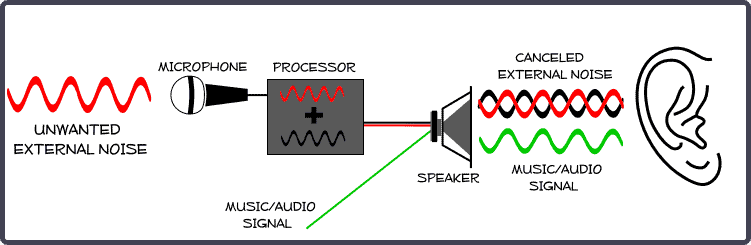
How noise-canceling technology works.

An elegant solution might be using noise blocking headphones and other similar technology. To cancel noise, these headphones emit an anti-noise signal to contrast the external sounds.

RelatedPosts

Common air pollutants (and traffic noise) linked to infertility — both for men and for women
Oil and gas noise pollution hinders bird reproduction
Animals all over the world against noise pollution
These AI headphones let you listen to a single person in a crowd or noisy area

“Noise-canceling headphones can minimize problems because you don’t have to play the headphones as loud to drown out noises,” says Maria Rerecich, director of electronics testing at Consumer Reports. “You can hear the music at a moderate level without having to blast it.”

Noise canceling headphones are especially recommended in very noisy environments which require you to raise your voice in order for someone to understand you. In the future, noise canceling technologies might even be embedded inside offices and homes. For instance, researchers at the University of Illinois’ Coordinated Science Laboratory have combined wireless Internet of Things (IoT) networks with noise cancellation. A microphone is placed in the environment that sense sounds and sends them over wireless signals to an earpiece. Since wireless signals travel a million times faster than sound, the earphone can receive the sound information much faster than the actual sound itself.

“This is similar to lightning and thunder — the lightning arrives much before the thunder, allowing people to prepare for the loud rumble,” said Shen’s advisor, Romit Roy Choudhury, an ECE Professor. “Similarly, our ear device gets the sound information in advance, and has much more time to produce a better anti-noise signal.”

However, that being said, people should still be mindful of how loud and how long they listen to music on their portable music players. Even if noise-canceling headphones allow you to listen to music at a more moderate level, experts still recommend people follow the 80-90 rule: that is, if you listen at 80 percent of the maximum volume, do so for no more than 90 minutes per day.

Finally, skip any type of headphones when engaging in activities that require your undivided attention and hearing, such as driving a vehicle, bicycling, or jogging in through the city. Your safety is more important than any nuisance incurred by noise pollution.

Tags: headphonesnoise pollution

Share20TweetShare
Tibi Puiu

Tibi Puiu

Tibi is a science journalist and co-founder of ZME Science. He writes mainly about emerging tech, physics, climate, and space. In his spare time, Tibi likes to make weird music on his computer and groom felines. He has a B.Sc in mechanical engineering and an M.Sc in renewable energy systems.

Related Posts

Environment

Common air pollutants (and traffic noise) linked to infertility — both for men and for women

byMihai Andrei
8 months ago
Future

These AI headphones let you listen to a single person in a crowd or noisy area

byMihai Andrei
1 year ago
Western Bluebirds lay fewer eggs and hatch chicks with smaller bodies around noisy anthropogenic areas. Credit: Wikimedia Commons.
Animals

Oil and gas noise pollution hinders bird reproduction

byTibi Puiu
8 years ago
Environment

Animals all over the world against noise pollution

byMihai Andrei
15 years ago

Recent news

The UK Government Says You Should Delete Emails to Save Water. That’s Dumb — and Hypocritical

August 16, 2025

In Denmark, a Vaccine Is Eliminating a Type of Cervical Cancer

August 16, 2025
This Picture of the Week shows a stunning spiral galaxy known as NGC 4945. This little corner of space, near the constellation of Centaurus and over 12 million light-years away, may seem peaceful at first — but NGC 4945 is locked in a violent struggle. At the very centre of nearly every galaxy is a supermassive black hole. Some, like the one at the centre of our own Milky Way, aren’t particularly hungry. But NGC 4945’s supermassive black hole is ravenous, consuming huge amounts of matter — and the MUSE instrument at ESO’s Very Large Telescope (VLT) has caught it playing with its food. This messy eater, contrary to a black hole’s typical all-consuming reputation, is blowing out powerful winds of material. This cone-shaped wind is shown in red in the inset, overlaid on a wider image captured with the MPG/ESO telescope at La Silla. In fact, this wind is moving so fast that it will end up escaping the galaxy altogether, lost to the void of intergalactic space. This is part of a new study that measured how winds move in several nearby galaxies. The MUSE observations show that these incredibly fast winds demonstrate a strange behaviour: they actually speed up far away from the central black hole, accelerating even more on their journey to the galactic outskirts. This process ejects potential star-forming material from a galaxy, suggesting that black holes control the fates of their host galaxies by dampening the stellar birth rate. It also shows that the more powerful black holes impede their own growth by removing the gas and dust they feed on, driving the whole system closer towards a sort of galactic equilibrium. Now, with these new results, we are one step closer to understanding the acceleration mechanism of the winds responsible for shaping the evolution of galaxies, and the history of the universe. Links  Research paper in Nature Astronomy by Marconcini et al. Close-up view of NGC 4945’s nucleus

Astronomers Find ‘Punctum,’ a Bizarre Space Object That Might be Unlike Anything in the Universe

August 15, 2025
  • About
  • Advertise
  • Editorial Policy
  • Privacy Policy and Terms of Use
  • How we review products
  • Contact

© 2007-2025 ZME Science - Not exactly rocket science. All Rights Reserved.

No Result
View All Result
  • Science News
  • Environment
  • Health
  • Space
  • Future
  • Features
    • Natural Sciences
    • Physics
      • Matter and Energy
      • Quantum Mechanics
      • Thermodynamics
    • Chemistry
      • Periodic Table
      • Applied Chemistry
      • Materials
      • Physical Chemistry
    • Biology
      • Anatomy
      • Biochemistry
      • Ecology
      • Genetics
      • Microbiology
      • Plants and Fungi
    • Geology and Paleontology
      • Planet Earth
      • Earth Dynamics
      • Rocks and Minerals
      • Volcanoes
      • Dinosaurs
      • Fossils
    • Animals
      • Mammals
      • Birds
      • Fish
      • Amphibians
      • Reptiles
      • Invertebrates
      • Pets
      • Conservation
      • Animal facts
    • Climate and Weather
      • Climate change
      • Weather and atmosphere
    • Health
      • Drugs
      • Diseases and Conditions
      • Human Body
      • Mind and Brain
      • Food and Nutrition
      • Wellness
    • History and Humanities
      • Anthropology
      • Archaeology
      • History
      • Economics
      • People
      • Sociology
    • Space & Astronomy
      • The Solar System
      • Sun
      • The Moon
      • Planets
      • Asteroids, meteors & comets
      • Astronomy
      • Astrophysics
      • Cosmology
      • Exoplanets & Alien Life
      • Spaceflight and Exploration
    • Technology
      • Computer Science & IT
      • Engineering
      • Inventions
      • Sustainability
      • Renewable Energy
      • Green Living
    • Culture
    • Resources
  • Videos
  • Reviews
  • About Us
    • About
    • The Team
    • Advertise
    • Contribute
    • Editorial policy
    • Privacy Policy
    • Contact

© 2007-2025 ZME Science - Not exactly rocket science. All Rights Reserved.