

ZME Science
No Result
View All Result
ZME Science
No Result
View All Result
ZME Science

Home → Environment → Animals

Humpback whales bounce back from the brink of extinction

Humpback whales have made an epic return.

Mihai AndreibyMihai Andrei
September 7, 2016
in Animals, Biology, News
A A
Share on FacebookShare on TwitterSubmit to Reddit

Humpback whales have made an epic return. Nine out of 14 distinct populations have now been crossed off the federal endangered species list. Four populations retain their endangered status, while one is listed as threatened.
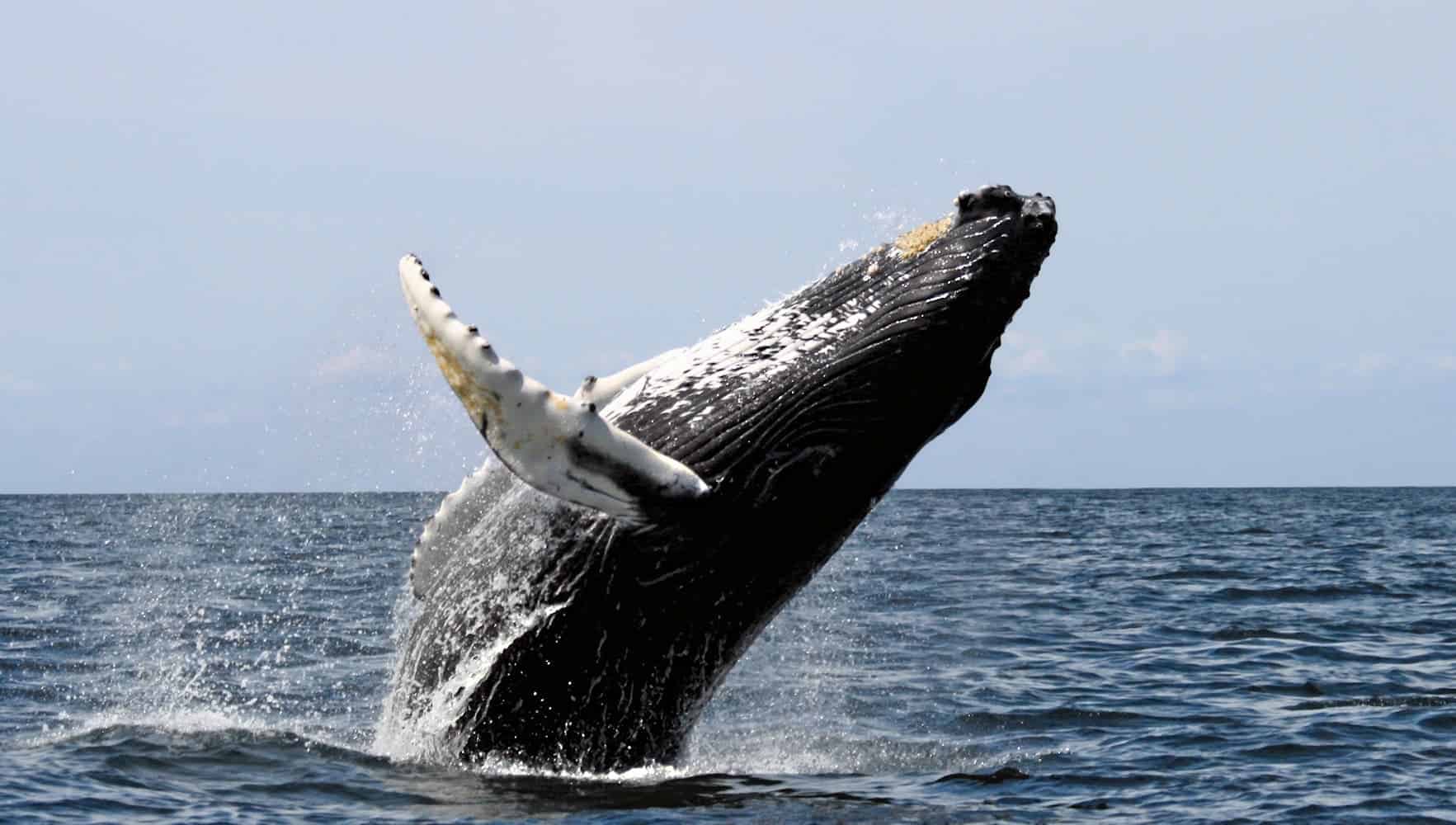
Humpbacks frequently breach, throwing two-thirds or more of their bodies out of the water and splashing down on their backs. Photo by Wwelles14.

Conservation efforts do work, at least when they’re done properly. It took 50 years, but international efforts to protect humpback whales have been met with success as the numbers increased steadily decade after decade.

Humpback whales were almost hunted to extinction in the 19th and 20th century, mostly for their meat and fat, which was used much like oil. But a moratorium was passed in 1966, effectively banning whaling – and this was the key turning point for the whales. Now, after almost half a century, they’re finally off the endangered list.

“Today’s news is a true ecological success story,” Eileen Sobeck, assistant administrator for fisheries at the National Oceanic and Atmospheric Administration, said in a statement.

The feeling was echoed by many groups who reported seeing plenty of whales and wanted this change to underline a healthy recovery.

“We just saw a lot of whales. So we thought this is a success in ocean management and we wanted to point that out to the world – that things are good with whales in Hawaii,” said Phil Fernandez, president of the Hawaii Fishermen’s Alliance for Conservation and Tradition.
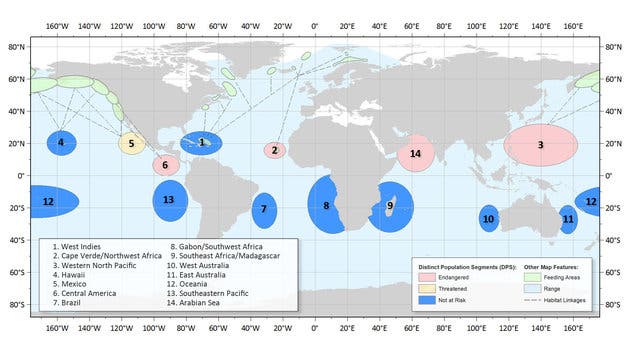
The image above, provided by NOAA, shows the 14 newly-identified humpback whale population segments and their migratory patterns.

Angela Somma, chief of NOAA Fisheries’ endangered species division, said “very little will actually change” in efforts to protect whales. According to her, humpbacks will still receive protection and the International Whaling Commission’s moratorium on commercial whaling will also remain in place.

“Many of the day-to-day protections and activities will continue to occur,” Somma said in a call to reporters Tuesday. “We will continue to work and maintain their conservation.”

However, not everyone agrees with this. Several biologists and conservationists have asked for continued protection on the endangered list.

According to the Miami Herald, Center for Biological Diversity attorney Kristen Monsell said that humpback whales face significant and growing threats, including getting entangled in fishing gear. She says the protections should stay in place for the whales.

RelatedPosts

Only a few tiger subspecies remain in the wild — here they are
Early baleen whales were fearsome predators with wicked teeth, but lost them entirely
Exploding stars may have wiped off large ocean life 2.5 million years ago
Navy admits training exercises will likely kill dolphins and whales in large numbers

It is true that even without whaling, humpbacks face growing challenges. They are vulnerable to collisions with ships, entanglement in fishing gear and noise pollution.

“These whales face several significant and growing threats, including entanglement in fishing gear, so ending protections now is a step in the wrong direction,” Kristen Monsell, an attorney with the Center for Biological Diversity, said in a statement.

Hopefully, the recovery won’t backfire and humpback whales will enjoy their recovery as time passes on.

Four populations are still considered endangered, including those that frequent waters in the Pacific Northwest, Central America, the Arabian Sea and northwest Africa.

Tags: extinctionhumpbackwhales

ShareTweetShare
Mihai Andrei

Mihai Andrei

Dr. Andrei Mihai is a geophysicist and founder of ZME Science. He has a Ph.D. in geophysics and archaeology and has completed courses from prestigious universities (with programs ranging from climate and astronomy to chemistry and geology). He is passionate about making research more accessible to everyone and communicating news and features to a broad audience.

Related Posts

Animals

The tragic story of the warrah wolf, a species too friendly to survive

byMihai Andrei
2 weeks ago
News

Killer Whales Have Skincare Routines — It Involves Kelp, Massages, and Tool-Making

byMihai Andrei
2 months ago
Animals

Scientists Map the DNA of a Mysterious Creature Called the Asian Unicorn That No One’s Seen in Years

byTudor Tarita
3 months ago
Animals

There’s a Great Whale Urine Highway That Moves Nutrients Across Oceans

byMihai Andrei
5 months ago

Recent news

The disturbing reason why Japan’s Olympic athletes wear outfits designed to block infrared

August 19, 2025
Erin Kunz holds a microelectrode array in the Clark Center, Stanford University, on Thursday, August 8, 2025, in Stanford, Calif. The array is implanted in the brain to collect data. (Photo by Jim Gensheimer)

Brain Implant Translates Silent Inner Speech into Words, But Critics Raise Fears of Mind Reading Without Consent

August 19, 2025

‘Skin in a Syringe’ Might be the Future of Scar Free Healing For Burn Victims

August 18, 2025
  • About
  • Advertise
  • Editorial Policy
  • Privacy Policy and Terms of Use
  • How we review products
  • Contact

© 2007-2025 ZME Science - Not exactly rocket science. All Rights Reserved.

No Result
View All Result
  • Science News
  • Environment
  • Health
  • Space
  • Future
  • Features
    • Natural Sciences
    • Physics
      • Matter and Energy
      • Quantum Mechanics
      • Thermodynamics
    • Chemistry
      • Periodic Table
      • Applied Chemistry
      • Materials
      • Physical Chemistry
    • Biology
      • Anatomy
      • Biochemistry
      • Ecology
      • Genetics
      • Microbiology
      • Plants and Fungi
    • Geology and Paleontology
      • Planet Earth
      • Earth Dynamics
      • Rocks and Minerals
      • Volcanoes
      • Dinosaurs
      • Fossils
    • Animals
      • Mammals
      • Birds
      • Fish
      • Amphibians
      • Reptiles
      • Invertebrates
      • Pets
      • Conservation
      • Animal facts
    • Climate and Weather
      • Climate change
      • Weather and atmosphere
    • Health
      • Drugs
      • Diseases and Conditions
      • Human Body
      • Mind and Brain
      • Food and Nutrition
      • Wellness
    • History and Humanities
      • Anthropology
      • Archaeology
      • History
      • Economics
      • People
      • Sociology
    • Space & Astronomy
      • The Solar System
      • Sun
      • The Moon
      • Planets
      • Asteroids, meteors & comets
      • Astronomy
      • Astrophysics
      • Cosmology
      • Exoplanets & Alien Life
      • Spaceflight and Exploration
    • Technology
      • Computer Science & IT
      • Engineering
      • Inventions
      • Sustainability
      • Renewable Energy
      • Green Living
    • Culture
    • Resources
  • Videos
  • Reviews
  • About Us
    • About
    • The Team
    • Advertise
    • Contribute
    • Editorial policy
    • Privacy Policy
    • Contact

© 2007-2025 ZME Science - Not exactly rocket science. All Rights Reserved.