homehome Home chatchat Notifications


US Space Plane is in orbit

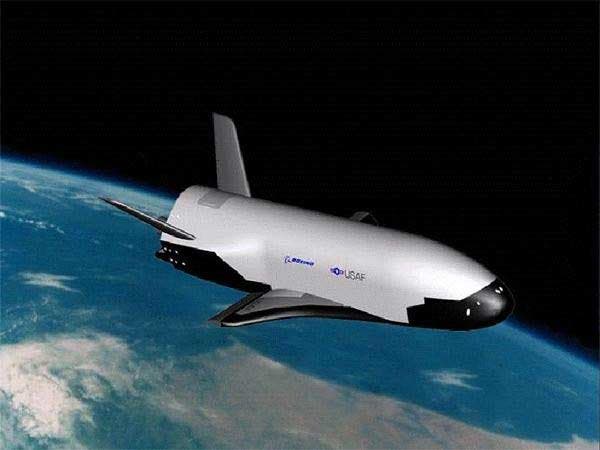
Whenever Boeing and NASA team up, you can bet your sweet lasers something wicked is going to happen; actually, the first logical thing that would come to mind is a space plane – and this is what they did. The US X-37B is now in orbit, after a successful launch that took place without any […]

Mihai Andrei
March 6, 2011 @ 3:28 pm

share Share

Whenever Boeing and NASA team up, you can bet your sweet lasers something wicked is going to happen; actually, the first logical thing that would come to mind is a space plane – and this is what they did. The US X-37B is now in orbit, after a successful launch that took place without any incidents whatsoever.

The orbital test vehicle took off from Cape Canaveral, Fla. this Sunday, after the Friday launch was called off due to bad weather. The mission and purpose of the space plane was mostly classified and information has been pretty scarce around it, but it is certain that it is designed to operate as an unmanned test platform for space research that can land itself at Edwards Air Force Base in California.

Boeing Vice President Craig Cooning shed some light on the matter in a written statement in which he explained that the space plane was being monitored by the Air Force Rapid Capabilities Office; which in layman terms means that the military is involved and that its purpose is at least partially military.

“We took another important step with the successful launch of the second (orbital test vehicle), enabling the RCO to further experiment with the vehicle and its ability to operate in low-Earth orbit,” Cooning said.

share Share

NASA Found Signs That Dwarf Planet Ceres May Have Once Supported Life

In its youth, the dwarf planet Ceres may have brewed a chemical banquet beneath its icy crust.

Nudists Are Furious Over Elon Musk's Plan to Expand SpaceX Launches in Florida -- And They're Fighting Back

A legal nude beach in Florida may become the latest casualty of the space race

New Liquid Uranium Rocket Could Halve Trip to Mars

Liquid uranium rockets could make the Red Planet a six-month commute.

Scientists think they found evidence of a hidden planet beyond Neptune and they are calling it Planet Y

A planet more massive than Mercury could be lurking beyond the orbit of Pluto.

A Long Skinny Rectangular Telescope Could Succeed Where the James Webb Fails and Uncover Habitable Worlds Nearby

A long, narrow mirror could help astronomers detect life on nearby exoplanets

Astronomers May Have Discovered The First Rocky Earth-Like World With An Atmosphere, Just 41 Light Years Out

Astronomers may have discovered the first rocky planet with 'air' where life could exist.

Mars Seems to Have a Hot, Solid Core and That's Surprisingly Earth-Like

Using a unique approach to observing marsquakes, researchers propose a structure for Mars' core.

Giant solar panels in space could deliver power to Earth around the clock by 2050

A new study shows space solar panels could slash Europe’s energy costs by 2050.

Frozen Wonder: Ceres May Have Cooked Up the Right Recipe for Life Billions of Years Ago

If this dwarf planet supported life, it means there were many Earths in our solar system.

Astronomers See Inside The Core of a Dying Star For the First Time, Confirm How Heavy Atoms Are Made

An ‘extremely stripped supernova’ confirms the existence of a key feature of physicists’ models of how stars produce the elements that make up the Universe.