homehome Home chatchat Notifications


Iranian president wants to be the first Iranian man in space

After the successful test in which the Iranians sent a monkey into outer space and back safely, their goal of sending a man to the Moon by 2025 seems quite feasible. Ok, so some liked this, the US didn’t really like it but that’s a different story – but Iran’s space program is not really […]

Mihai Andrei
February 5, 2013 @ 4:58 am

share Share

After the successful test in which the Iranians sent a monkey into outer space and back safely, their goal of sending a man to the Moon by 2025 seems quite feasible.
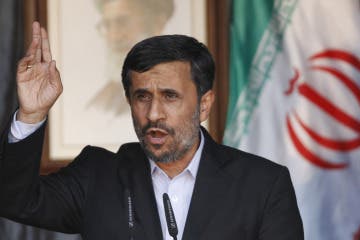
Iranian President Mahmoud Ahmadinejad waves as he speaks during in a rally organized by Lebanon's Hezbollah in Bint Jbeil Ok, so some liked this, the US didn’t really like it but that’s a different story – but Iran’s space program is not really something you can be indifferent too. Their nascent space program aims to send a man into space by 2020 and put an astronaut on the moon by 2025, and that has many people worrying.

However, things can only get more dubious as president Mahmoud Ahmadinejad says he wants to be his country’s first man in space, declaring:

”I’m ready to be the first Iranian to be sacrificed by the scientists of my country and go into space, even though I know there are a lot of candidates”, he declared,

It’s not clear if he was being serious, or if this was just a political maneuver to create an outburst support.

Iran successfully sent a monkey named “Pishgam,” or “Pioneer” in Farsi into outer space, where it traveled over 100 km before safely returning to Earth. The launch fueled concern among Western observers because the same technology used in space launches could be applied to launch a ballistic missile carrying a nuclear warhead. So what do you think? Should we fear Iran’s development, or should we embrace it is a remarkable scientific achievement?

share Share

A Comet That Exploded Over Earth 12,800 Years Ago May Have Triggered Centuries of Bitter Cold

Comet fragments may have sparked Earth’s mysterious 1,400-year cold spell.

Astronomers Find ‘Punctum,’ a Bizarre Space Object That Might be Unlike Anything in the Universe

Bright, polarized, and unseen in any other light — Punctum challenges astrophysical norms.

How Much Has Mercury Shrunk?

Mercury is still shrinking as it cools in the aftermath of its formation; new research narrows down estimates of just how much it has contracted.

First Complete Picture of Nighttime Clouds on Mars

Data captured by the Emirates Mars Mission reveal that clouds are typically thicker during Martian nighttime than daytime.

A Supermassive Black Hole 36 Billion Times the Mass of the Sun Might Be the Heaviest Ever Found

In a massive galaxy, known for its unique visual effect lies an even more massive black hole.

Scientists Have a Plan to Launch a Chip-Sized, Laser-Powered Spacecraft Toward a Nearby Black Hole and Wait 100 Years for It to Send a Signal Home

One scientist thinks we can see what's really in a black hole.

Distant Exoplanet Triggers Stellar Flares and Triggers Its Own Destruction

HIP 67522 b can’t stop blasting itself in the face with stellar flares, a type of magnetic interaction that scientists have spent decades looking for.

The Universe’s First “Little Red Dots” May Be a New Kind of Star With a Black Hole Inside

Mysterious red dots may be a peculiar cosmic hybrid between a star and a black hole.

Quakes on Mars Could Support Microbes Deep Beneath Its Surface

A new study finds that marsquakes may have doubled as grocery deliveries.

The 400-Year-Old, Million-Dollar Map That Put China at the Center of the World

In 1602, the Wanli Emperor of the Ming dynasty had a big task for his scholars: a map that would depict the entire world. The results was a monumental map that would forever change China’s understanding of its place in the world. Known as the Kunyu Wanguo Quantu (坤輿萬國全圖), or A Map of the Myriad […]