
Supermassive black hole spotted struggling with its galactic meal
Sometimes, even a black hole can choke on its meal.

Even supermassive black holes can bite off more than they can chew, it seems, based on observations of a nearby pair of colliding galaxies.
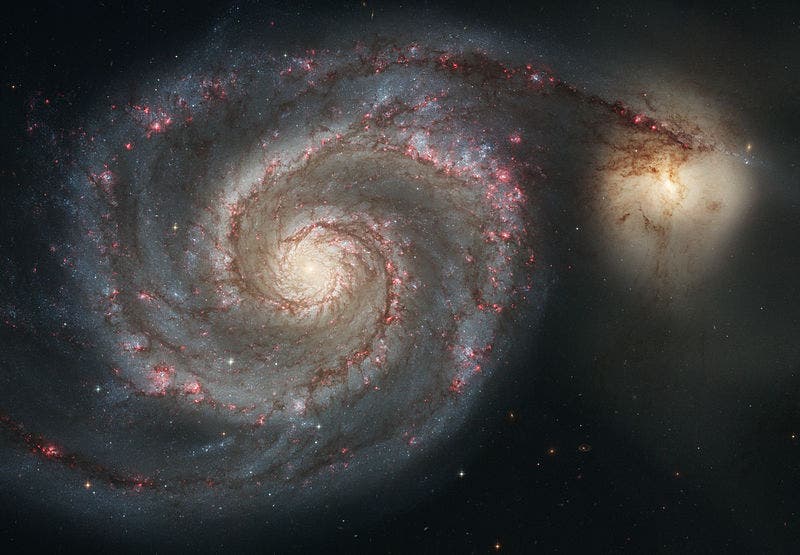
NGC 5194 & 5195.
Image credits NASA, ESA.
A study analyzing emissions throughout the electromagnetic spectrum released by a nearby supermassive black hole gobbling up matter has revealed that even they can suffer from ‘indigestion’.
The mammoth body, weighing in at some 19 million times the mass of the Sun, lies at the center of a small galaxy named NGC 5195. Once every few hundred millions of years, NGC 5195 collides with the outer arms of its larger neighbor, known as NGC 5194 or (the more palatable) ‘Whirlpool’ galaxy. This happens because the two are locked in a gravitational wooing period that — in a few billion more years — will see them merge into a single galaxy.
But in the meantime, when these two galaxies touch, the supermassive black hole at the center of NGC 5195 picks up a lot of matter from Whirlpool into an accretion disk — so much matter, in fact, that it can’t absorb it all. But it still collapses onto the black hole since it’s subjected to enormous gravity. So all that excess matter eventually gets blown out into space. Last year, NASA’s Chandra X-Ray Observatory caught a whiff of X-ray emission that appeared to result from this process, but we didn’t really understand the how it happens.
Now, using high-resolution images of NGC 5195’s core taken with the e-MERLIN radio array, and drawing from archive images of the area taken with the Very Large Array (VLA), Chandra and the Hubble Space Telescope, a team of astronomers at the University of Manchester’s Jodrell Bank Centre for Astrophysics revealed the details of how these huge blasts of matter occur, and their behavior in space.
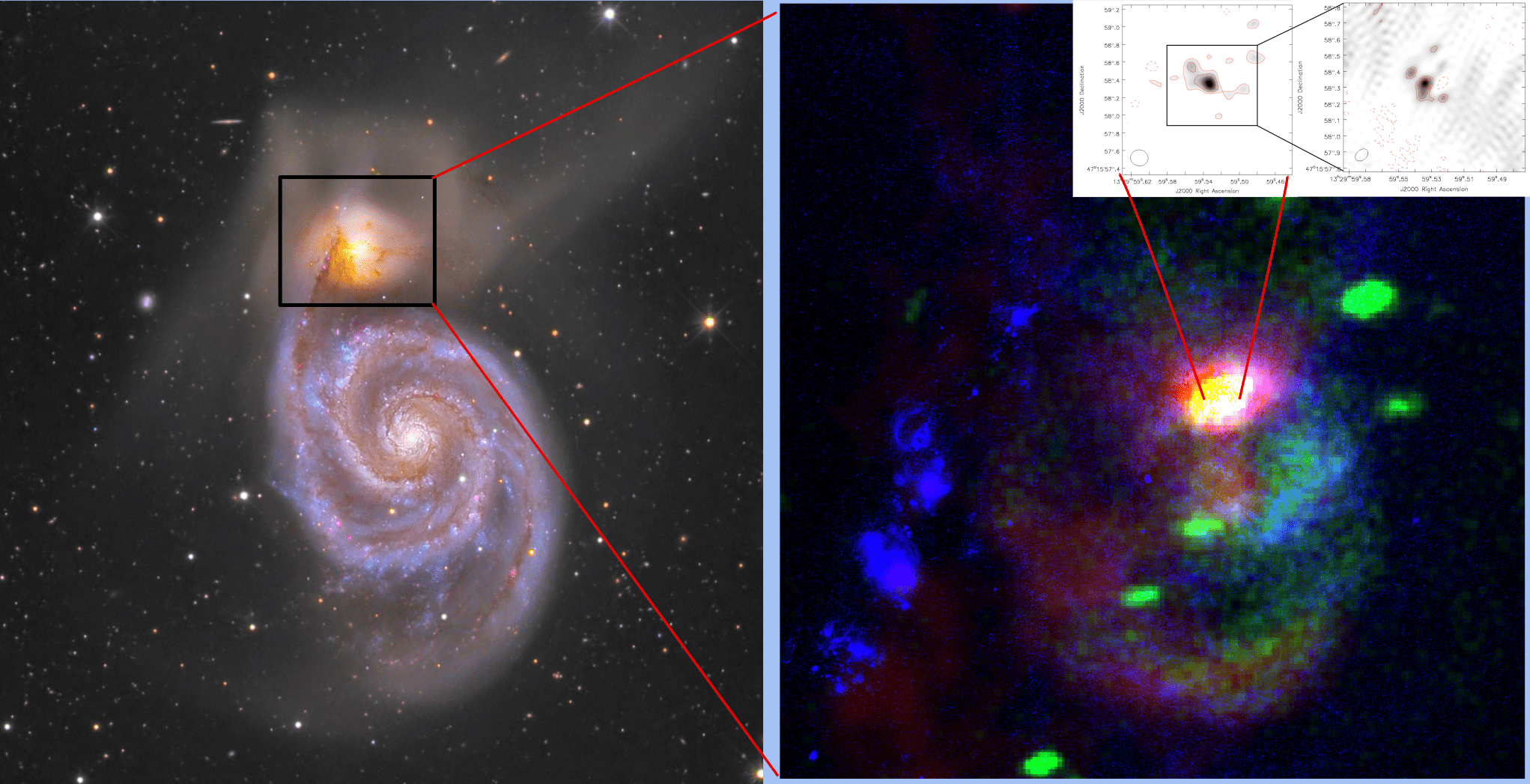
Letf: Image of the Whirlpool galaxy and NGC 5195.
Right: False colour image of NGC 5195 created by combining the VLA 20 cm radio image (red), the Chandra X-ray image (green), and the Hubble Space telescope H-alpha image (blue).
Image credits Jon Christensen.
They report that when the accretion disk surrounding NGC 5195’s supermassive black hole breaks down, the immense forces and pressures involved create a shock wave which blasts all that matter back out into space — if you’re thinking this is kinda like how supernovae form, you’re pretty much on point.
Electrons, accelerated by this event close to the speed of light, interact with magnetic fields from neighboring bodies and emit energy in the radio wavelength spectrum. The X-ray emissions e-MERLIN picked up are created when the shock wave hits the gasses in the interstellar medium, inflating and heating them up. This process strips electrons from hydrogen gas atoms and ionizes them, creating the features seen by Chandra and Hubble.
“Comparing the VLA images at radio wavelengths to Chandra’s X-ray observations and the hydrogen-emission detected by Hubble, shows that features are not only connected, but that the radio outflows are in fact the progenitors of the structures seen by Chandra and Hubble,” explains Dr Hayden Rampadarath, who will be presenting his findings at the National Astronomy Meeting at the University of Hull explains.
“This is an event of galactic proportions that we can see right across the electromagnetic spectrum.”
According to him, the arcs seen in the NGC 5195 system are 1 to 2 million years old, meaning the first bits of matter were being pushed away from the black hole at about the same time as humans were learning how to make fire.
This isn’t the first time we’ve seen a black hole struggling to eat everything on its plate, and that event also had many of the features Dr Rampadarath identified here. Knowing this, it may be easier to spot overly-greedy black holes in the future.


