
NASA finds organic building blocks of life on Mars... along with peculiar methane variability in its atmosphere
Peering closer into Mars' potentially habitable past.

During a recent press conference, NASA scientists made two major announcements that further strengthen the case for a potentially habitable Martian past.
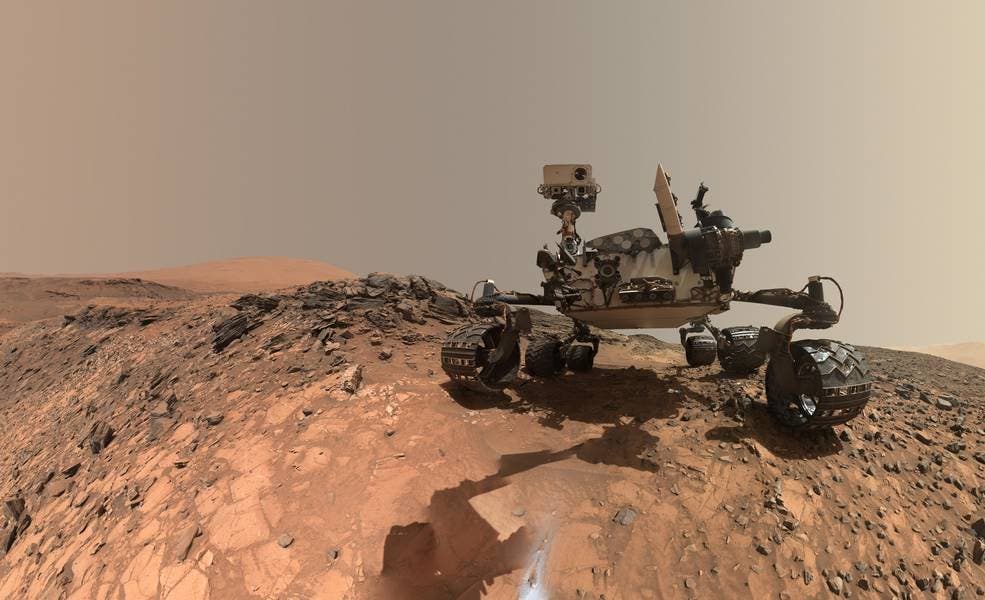
Credits: NASA/JPL-Caltech/MSSS
In the first part of the announcement, NASA researchers announced the discovery of organic compounds in 3.5-billion-year-old rocks sampled at Gale Crater. The site is poised between Mars’ flat northern lowlands and the heavily cratered southern hemisphere, and presumably used to be an ancient lake and potentially habitable environment.
https://twitter.com/JimBridenstine/status/1004788595675353089
These compounds, such as thiophene, 2- and 3-methylthiophenes, methanethiol, and dimethylsulfide, all point to an organic chemistry in Martian mudstone that is eerily similar to ours. Organic compounds are typically produced by lifeforms, although they could very well be sourced otherwise, such as from meteorites. So, this discovery doesn’t necessarily prove the lakebed was inhabited by life — it’s just another circumstantial evidence that it might have been. The novel organic compounds were identified by the rover’s Sample Analysis at Mars (SAM) instrument which sniffed dust sampled thanks to the rover’s recently repaired drill.
“Curiosity has not determined the source of the organic molecules,” said Jen Eigenbrode of NASA’s Goddard Space Flight Center in Greenbelt, Maryland, who is lead author of one of the two new Science papers. “Whether it holds a record of ancient life, was food for life, or has existed in the absence of life, organic matter in Martian materials holds chemical clues to planetary conditions and processes.”
In the second part of the announcement, researchers explained how methane levels recorded by Curiosity varied by the season. Over the last five years, the rover’s Tunable Laser Spectrometer measured the methane levels in the atmosphere around it. Methane levels average 0.41 parts per billion (ppb), but varied from 0.24 to 0.65 ppb depending on the season. Because a day on Mars is about 24hours and 37 minutes long and the Red Planet’s axial tilt is almost identical to Earth’s, the seasons there follow a remarkably similar variation to those on Earth.
The seasonal variability of Methane on Mars is indicative of some geological process. Perhaps there is more active water in the subsurface than previously thought.

Credit: NASA/JPL-Caltech.
“This is the first time we’ve seen something repeatable in the methane story, so it offers us a handle in understanding it,” said Chris Webster of NASA’s Jet Propulsion Laboratory (JPL) in Pasadena, California, lead author of the second paper. “This is all possible because of Curiosity’s longevity. The long duration has allowed us to see the patterns in this seasonal ‘breathing.'”
These recent breakthroughs raise confidence that NASA’s upcoming 2020 rover mission, as well as ESA’s Exomars rover, will be able to find even more organics in the Martian shallow subsurface.
“Are there signs of life on Mars?” said Michael Meyer, lead scientist for NASA’s Mars Exploration Program, at NASA Headquarters. “We don’t know, but these results tell us we are on the right track.”
Both studies were published in the journal Science (1 and 2).


