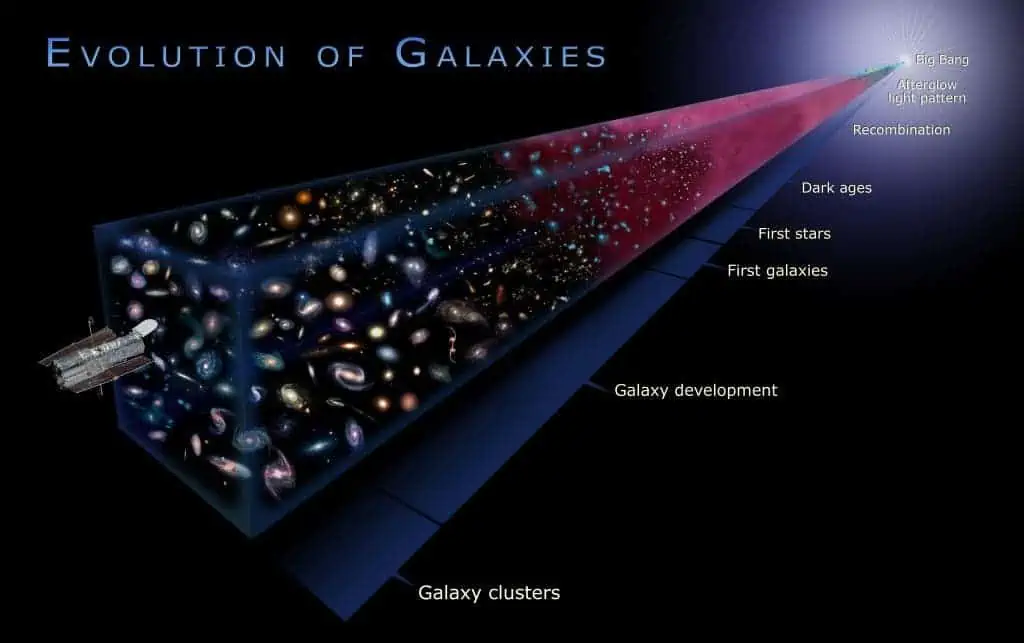
Hubble's law is the name for the theory in physical cosmology (proven by observation) that: (1) all objects observed in deep space (intergalactic space) are found to have a Doppler shift observable relative velocity to Earth, and to each other; and (2) that this Doppler-shift-measured velocity, of various galaxies receding from the Earth, is proportional to their distance from the Earth and all other interstellar bodies. In effect, the space-time volume of the observable universe is expanding and Hubble's law is the direct physical observation of this process.[1] The motion of astronomical objects due solely to this expansion is known as the Hubble flow.[2] Hubble's law is considered the first observational basis for the expanding space paradigm and today serves as one of the pieces of evidence most often cited in support of the Big Bang model.
A metal poor star located in the Milky Way galaxy, “just” 190 light years away from our Sun is 14.46+-0.80 billion years old – nearly as much as the age of the Universe! All stars follow a stellar evolutionary path; by knowing some parameters about the star (such as mass, luminosity, and surface temperature), astronomers [...]
The Universe is in constant expansion, which is why it is commonly said to be infinite, so basically one can measure all he wants and still won’t find out how big the Universe is. An accurate measurement of this rate of expansion, however, is critical for space observations, and a young Australian student has recently [...]
Mon, Feb 25, 2013
0 Comments