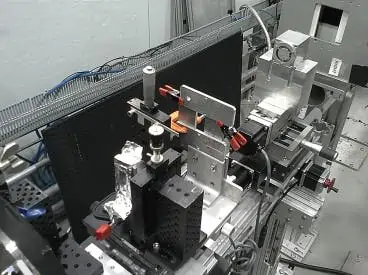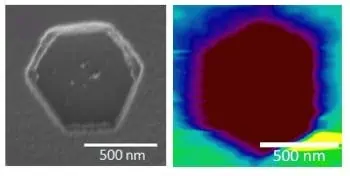
Atomic force microscopy (AFM) or scanning force microscopy (SFM) is a very high-resolution type of scanning probe microscopy, with demonstrated resolution on the order of fractions of a nanometer, more than 1000 times better than the optical diffraction limit. The precursor to the AFM, the scanning tunneling microscope, was developed by Gerd Binnig and Heinrich Rohrer in the early 1980s at IBM Research - Zurich, a development that earned them the Nobel Prize for Physics in 1986. Binnig, Quate and Gerber invented the first atomic force microscope (also abbreviated as AFM) in 1986. The first commercially available atomic force microscope was introduced in 1989. The AFM is one of the foremost tools for imaging, measuring, and manipulating matter at the nanoscale. The information is gathered by "feeling" the surface with a mechanical probe. Piezoelectric elements that facilitate tiny but accurate and precise movements on (electronic) command enable the very precise scanning. In some variations, electric potentials can also be scanned using conducting cantilevers. In more advanced versions, currents can be passed through the tip to probe the electrical conductivity or transport of the underlying surface, but this is much more challenging with few research groups reporting consistent data (as of 2004).[1]
To fully understand the processes and mechanisms that work at a cellular level, biologists should study them in their native, watery environments. But how would you go on doing this? Well, leave it to engineers to solve everyone’s problems – they have now deviced a kind of atomic force microscopy that works on samples sitting [...]
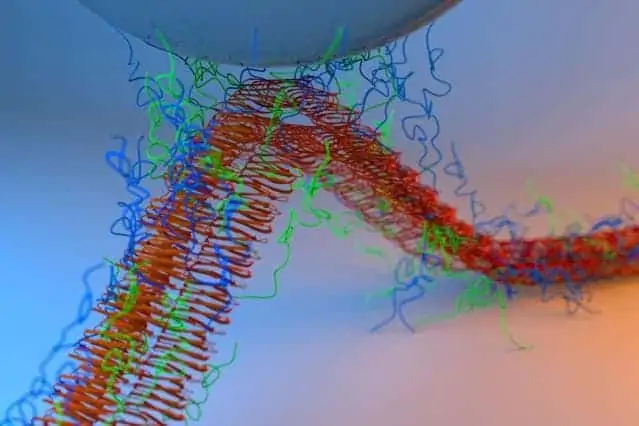
In an amazing breakthrough, scientists at Ludwig-Maximilians-Universität (LMU) have for the first time demonstrated an extremely appealing, yet still obscure concept – intelligent molecules. By definition intelligence is the ability to learn and understand or deal with new situation and the latter is exactly what the researchers’ polymer molecules can do, namely react to external stimuli and reversibly [...]
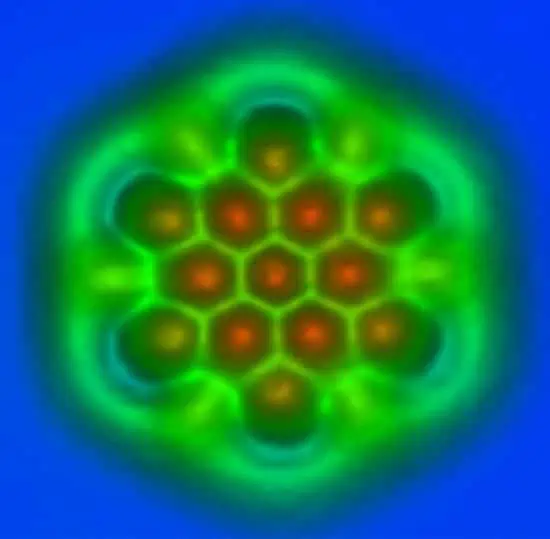
Atomic level imaging has come a long way in the past decade, and after scientists first managed to image molecular structure and even electron clouds, now a group of researchers at IBM Research Center Zurich have visually depicted how chemical bonds differentiate in individual molecules using a technique called non-contact atomic force microscopy (AFM). In the image below [...]
The 2012 London summer Olympic games are just a few weeks away, and as millions are set to flock to the city and other hundreds of millions will rejoice on the web and TV at the world’s grandest spectacle of athletic performance, it’s pretty clear this is one of the most anticipated events of the year. Every [...]
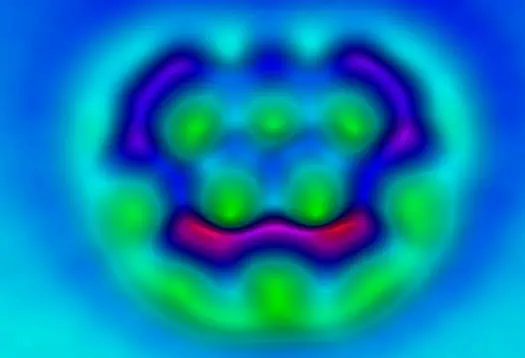
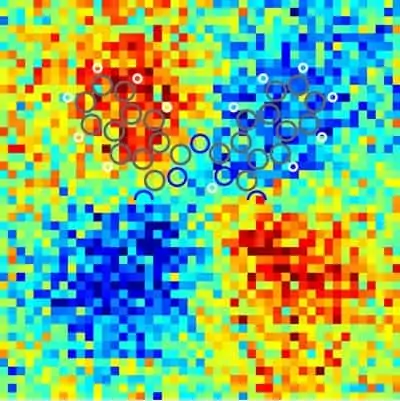
Part of a the recent slew of revolutionary technological and scientific novelties coming off IBM‘s research and development lab, the company has just announced that it has successfully managed to measure and image for the first time how charge is distributed within a single molecule. The achievement was made possible after a new technique, called Kelvin probe force microscopy [...]
Tue, Jun 4, 2013
0 Comments