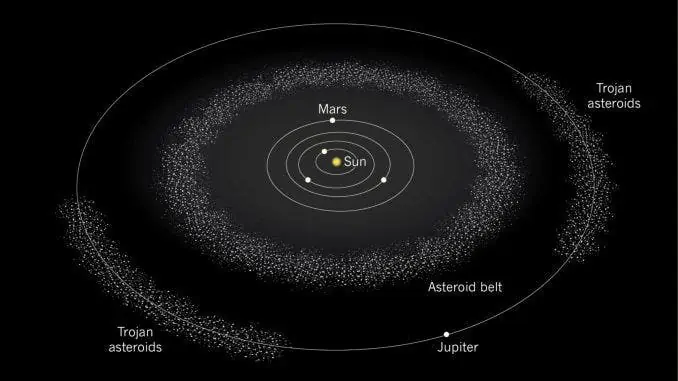
Asteroids are minor planets (small Solar System bodies and dwarf planets) that are not comets, especially those of the inner Solar System. They have also been called planetoids, especially the larger ones. These terms have historically been applied to any astronomical object orbiting the Sun that did not show the disk of a planet and was not observed to have the characteristics of an active comet, but as small objects in the outer Solar System were discovered, their volatile-based surfaces were found to more closely resemble comets, and so were often distinguished from traditional asteroids.[1] Thus the term asteroid has come increasingly to refer specifically to the small bodies of the inner Solar System out to the orbit of Jupiter. They are grouped with the outer bodiesâcentaurs, Neptune trojans, and trans-Neptunian objectsâas minor planets, which is the term preferred in astronomical circles.[2] In this article the term "asteroid" refers to the minor planets of the inner Solar System.
When you think of asteroid impacts, the last thing that might come to mind is life. Contrary to popular belief, a team of researchers have recently presented their theory that holds intelligent life on our planet spurred with the help of asteroid impacts. As cosmic cold rock hit Earth, the impacts allowed for a shift [...]
Tuesday at 6:51 a.m. EDT (1051 GMT) a small asteroid dubbed TD54 passed the Earth dangerously close, above a section of Southeast Asia by Singapore, being at its closest 28,000 miles from our blue planet. The asteroid, 2010 TD54 was first discovered on October 9th, by scientists in Arizona at a NASA-sponsored lab. A few [...]
Mon, Nov 5, 2012
0 Comments