

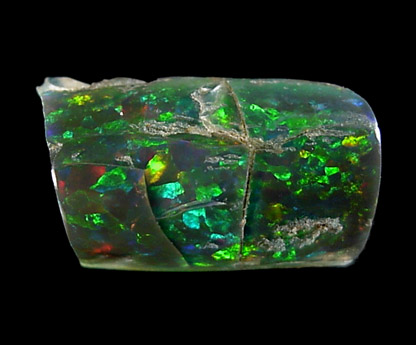
Opals on Mars hint at planet’s wet past
As a proud student in geophysics, I can tell you that opal is hydrated silicon dioxide mineral with many astounding properties, but it’s also water hydrated. Since water hydrated minerals have been found on Mars we are led to the logic conclusion that when these minerals was formed, there was water on Mars.
Opals have been long prized for their beauty, but now scientists are appreciating them from a whole new perspective. The fact that they have been located there comes after ice on Mars has been found, and it expands the habitable space by a whole lot, as this finding shows that Mars has been wet for more than a billion years longer than the previous estimates. Whether the planet was suitable for life or not takes a whole new meaning after this.
“Water may have existed as recently as two billion years ago,” said John Hopkins University’s Scott Murchie, a lead scientist with the Mars Reconnaissance Orbiter team. “It extends the time range for liquid water on Mars, and the places where it might have supported life.”
These silica-based deposits are the third and more importantly, the youngest type of water-containing mineral which has been found on Mars. Contrary to them, the oldest hydrated materials are some phyllosilicates, which were formed more than 3 and a half billion years ago.


Share on Digg
Share on reddit
Bookmark to del.icio.us
Share on StumbleUpon
Share on Mixx
Share on Twitter
Share on Facebook


September 25th, 2009 at 7:50 pm
…pa/opa(N)=tint, paint=opal. in mexico they leech through
red clay soil around the state of queretaro, and are called fire opals, when they are not translucent and don’t shimmy and shine
they are called agata/agate of opal and are jujube brick color.
an opal represents thousands and thousands and probably millions
of years of rainfail passing through the soil and form in little
hollows below the surface, a chemical soil sample cristalized=
c(r)e(s)tl(letra)=cetl(N)=ice(the oneness/ce of water).
i dealt with them in my antique store, being not far away from
the source, the bajio of guanajuato is rock hound’s paradise,
fields are full of small quartz and other minerals that seem to
have showered out of past volcanoes like rain, we’ve have meteor
showers, the last big one in ´68, not much between us and outer
space on the high plains/altoplanicie at 2k metres/6,500′.
of course opals are very fragile and if you wear one or make
jewelry out of them have them set in and protected by a collar
of silver or gold. i had a jeweler make octopi pins with mine,
set on the legs like disks, was able to use up the really small
ones and the silver backing brought out the blue in them, i called
those my water opals, then there were the chanpagne opals, a nice
bubbly yellow. i don’t recommend making rings of them as the hand
is quicker than they eye and sooner or later they’ll hit something,
but i never wear rings anyway.
sometimes opals cloud over, they miss the water that formed them perhaps or haven’t finished the process of annealing themselves
to eternity, or maybe it’s an offshoot of limestone, whatever the case they can cloud on you, my first experience with opal was
through a comic book, a western, that touted opals as bad luck,
so for the cloudy ones i keep them in water, which is probably not a bad idea for any opal as atl(N)=water is their heaven.