

Space offers incredibly fascinating experimental conditions for various scientific studies, otherwise very hard or practically impossible to replicate on Earth. Microgravity is something of great interest to scientists, and even simple experiments with fire are extremely insightful.
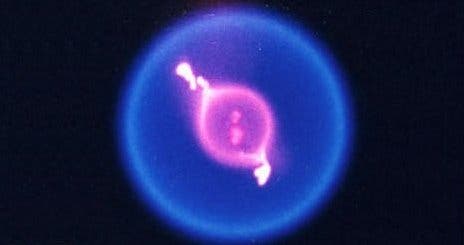
Combustion in space occurs at much lower temperatures and with a lower amount of required oxygen, and to better understand the process, scientists established the Flame Extinguishment Experiment, known as FLEX. The experiment was set-up on the International Space Station‘s Destiny module, however it was all remotely controlled from 200 miles away at NASA’s John Glenn Research Center in Cleveland, Ohio.
What scientists observed was that curiously enough the flame of an ignited droplet of fuel is completely spherical, something incredibly difficult to achieve on Earth. This spherical symmetry makes observing the droplet’s behavior and describing it mathematically much easier.
The Destiny module is filled with cameras and sensors which fed the John Glenn Research Center with every discrete piece of information they needed. In the chamber, small drops of chemicals such as heptane or methanol were ignited and allowed to burn for 20 seconds. This was repeated many hundreds of times under various atmospheric conditions by a device called Multiuser Droplet Combustion Apparatus .
“Research leads to a better understanding of fire behavior,” said study’s leader, University of California, San Diego, aerospace engineering professor Forman Williams,. “And better understanding ultimately leads to better safety designs.”
Besides developing better fire hazard safety designs for both on Earth and in space, scientists hope to somehow recreate the conditions found in the experiment inside a combustion engine. If they can manage to compensate microgravity somehow, this could be the greatest breakthrough in the field since the introduction of stratified injection.
“Findings could lead to new designs for cleaner fuels that have a smaller carbon footprint and emit fewer pollutants, among other applications,” according to a University of California, San Diego, statement.
Williams and colleagues will present their FLEX findings in an upcoming conference in Poland.
Was this helpful?