

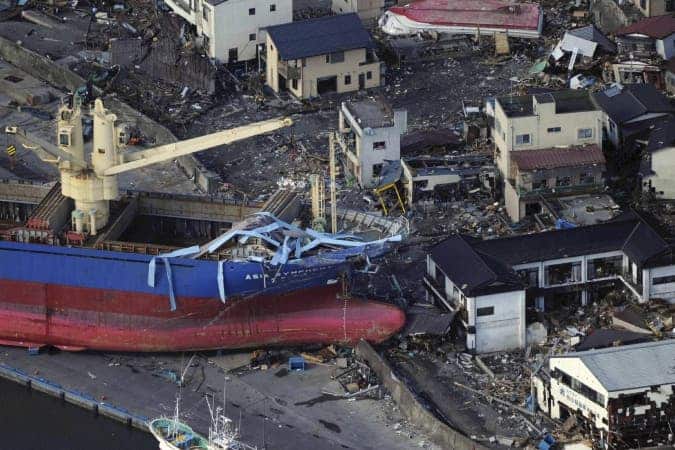
Magnitude of Japan earthquake takes scientists by surprise

It’s no mystery for anybody that the earthquake in Japan is one of the largest ever to be recorded in history, and it’s no mystery for anybody that Japan is an area with numerous seismic events, but the magnitude of this one exceeded greatly all expectations, even the most pessimistic one.

The 8.9 magnitude (or 9.0 according to other measurements) earthquake that struck the northeastern coast of Japan “is going to be among the top 10 earthquakes recorded since we have had seismographs,” said seismologist Susan Hough of the U.S. Geological Survey in Pasadena. “It’s bigger than any known historic earthquake in Japan, and bigger than expectations for that area.”

That particular portion of the Ring of Fire, as it is called, was expected to create a 8, maybe 8.5 magnitude temblor, but something as big as 8.9 is quite surprising; this may not seem like a big difference, but the Richter scale is a logarithmic one, so a 9 earthquake is 10 times more powerful than a 8 earthquake.

The thing is, temblors this big in the crust take place when a long, relatively straight fault line ruptures; a classical example for this would be Peru or Chile, but not Japan, because that tectonic plate boundary is not straight at all, but very irregular. According to USGS, an earthquake this big would require a huge rupture, of more than 300 miles. To top things off, this type of earthquake was perfect for tsunami generation, because it was very big, and at a very shallow depth.

Written by


  • Michele Kammerer

    Hi,
    I grew up in L.A. and it is my understanding that the Richter scale was designed specifically for the SoCal region and was superceded by an international scale many years ago. Thanks for producing this zine I really appreciate your writing.
    Michele
    Bellingham, WA

  • Marc

    @Michele -

    It’s true that the Richter scale has been superseded, but not because it was designed for SoCal (although Charles Richter was a CalTech alum, working in Pasadena, when he developed the scale.)

    The Richter scale is based on ground movement, which was the only aspect of earthquakes that scientists could measure in the 30s when Richter was doing his (do I dare call it ground-breaking?) work. Ground movement is a pretty good measurement for earthquakes whose epicenters are on land, but it would significantly under-report an earthquake like this one.
    So the new scale – the moment magnitude scale, or MMS – measures instead how much energy was released by the quake. It’s still a logarithmic scale, and the numbers are fairly consistent with Richter numbers (except that they tend to be a bit higher, since not all of the energy of a quake goes into shaking the surface.)

  • Pingback: Disturbing time-lapse animation shows Japan earthquakes | ZME Science

Tags: , ,

Subscribe for FREE!

Drop us a line!

Tip us on news, scientific reports and studies, scientific advances, science art, interesting phenomena or any kind of science related material. Just write to andrei@zmescience.com.

Popular This Week