

In the first ever-survey of its kind, geologists have managed to discover a chain of massive underwater volcanoes, some as tall as 2 miles, underneath the Antarctic waters near the South Sandwich Islands in the remote Atlantic Ocean.
The South Sandwich Islands have always been known for their evident volcanic activity, ever since their discovery by famous explorer Captain Cook in 1775. What happens beneath the islands however remained more or less ignored, until recently when scientists mapped in great detail the area of the seafloor around these islands.
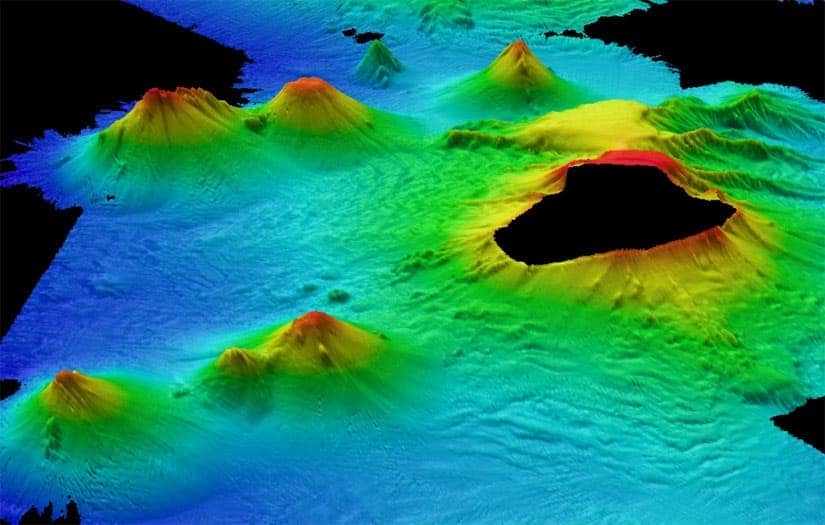
Scientists used sonar scanners to trace each shape and slope of the volcanoes, which fed them back some incredible data – 12 new undersea volcanoes, some topping even two miles. Some are still active, while others have been found collapsed in craters as large as 3 miles.
The volcanoes came as a consequences, scientists claim, of the tectonic dance between the South American continental plate sliding under the South Sandwich plate to the east. Water gets slipped beneath one of the plates and deep into the interior of the earth, from where it escapes upward, springing a molten rock eruption along the way.
Underwater volcanoes form parallel to the plane lines and as they steadily build up, they form new crust which will eventually someday after millions of year link with a continent. Scientists hope to learn more by studying the process in greater detail, and gain a greater grasp upon the formation of continents.
“We have GPS data to show that the South Sandwich Islands are moving east very fast indeed with respect to Africa,” Ian Dalziel of the University of Texas at Austin said. “It’s a very active system.”
Researchers warn however that underwater volcanoes could cause highly damaging tsunamis, since such volcanoes often have unstable slopes.
“This is quite well known,” Phil Leats of the British Antarctic Survey who led the new efforts said “Clearly this has happened in this area. We can see the scars. We can see the quite large slump deposits, which must have caused quite large tsunamis, so clearly it’s an area where this kind of hazard does exist.”
The survey was made by the British Antarctic Survey.
via
Was this helpful?