

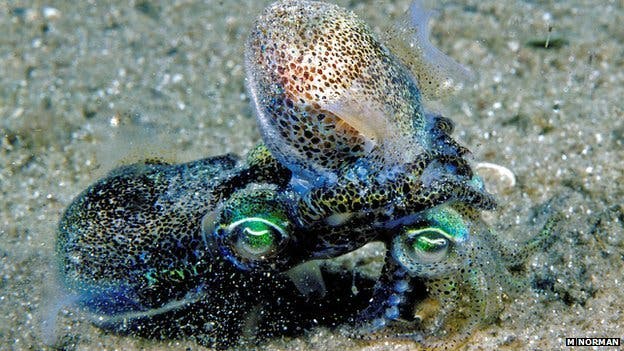
Squids and cephalopods, in general, might not be the sexiest animals out there, but their mating systems are quite interesting, to say the least. For instance, the male bioluminescent Dana Octopus Squid uses its beak and sharp claws to pierce holes in its mate before using a penis-like appendage to insert sperm into the cuts. Female giant squids bite bits off of the males during mating, turning coitus into a cannibalistic ecstasy. Add the Australian dumpling squid to the list of promiscuous cephalopods, after researchers closely studying the animal found it engages in exhausting three hours-long sexual intercourse. In the aftermath, the dumpling squid is extremely vulnerable to predators, which might explain their short lifespan.
During intercourse, the male grabs the female from underneath, and holds her in place throughout copulation; also, the male changes colour, squirts ink and pumps jets of water into the female’s mantle – pretty wild if you ask me. These guys don’t waste time, there’s no foreplay. Regardless, both male and female are completely exhausted at least thirty minutes afterward – researchers found that swimming endurance was halved after mating for both sexes.
“The squid mate for up to three hours and the male must physically restrain the female during this time,” said researcher Amanda Franklin from the University of Melbourne, Australia.
“It was exciting for us to show that this affects their physical abilities after mating because this has not been shown before.”
The dumpling squid’s ‘wild’ mating ritual comes at a great cost, as energy available for avoiding predators and feeding is consumed, making them extremely vulnerable. The squids only live for less than a year, and their last few months are spent almost exclusively mating, time in which the male mates with as many partners as possible.
Still, the squids try to compensate for their low-energy levels after mating, as both males and females change colour from sandy yellow to dark purple with green and orange highlights in order to blend into their surroundings. However, this isn’t always effective. The dumpling squid is a high card player, living life to the fullest; it doesn’t care that its lifestyle comes with a short life span.
“[The energetic cost of sex] is likely to affect how an animal behaves after mating and may also influence how often an individual will mate,” said Ms Franklin.
Findings were published in the journal Biology Letters.
Was this helpful?