

Researchers at the University of Delaware and the Canadian Ice Service recently reported that an ice island, whose surface is twice that of Manhattan, broke off from Greenland’s Petermann Glacier, one of the two largest glaciers left in Greenland connecting the great Greenland ice sheet with the ocean via a floating ice shelf.
The 46-square-mile giant iceberg broke off from the glacier on Monday, and has since started its journey towards the open ocean.The on-site discovery was confirmed with satellite imaging from the Moderate Resolution Imaging Spectroradiometer aboard NASA’s Terra and Aqua satellites.
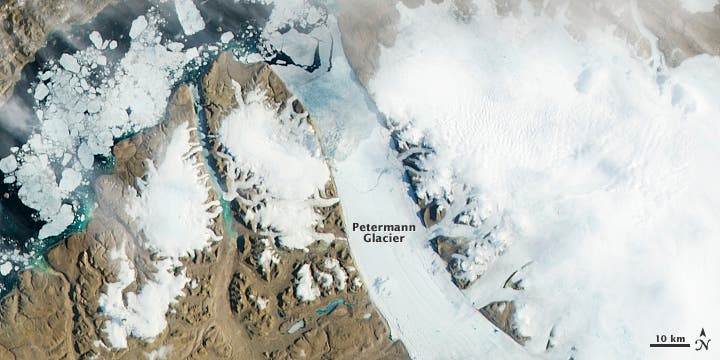
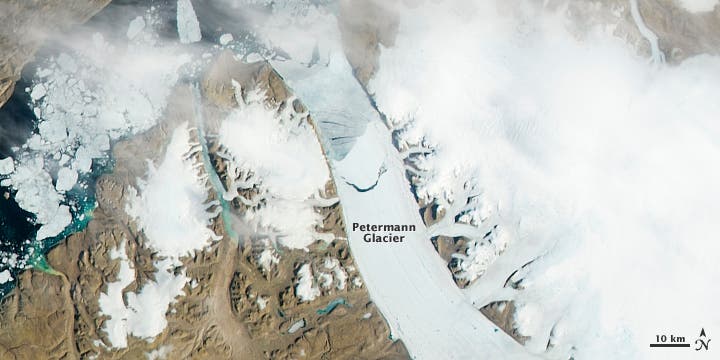
Although the new iceberg is admitedly large, it rather pales in comparison to its predecessor from 2010, when a chuck of ice 97-square-mile chunk of ice broke off from the Petermann Glacier – the largest iceberg recorded in the Arctic since 1962. Last year, on the other side of the world, an iceberg the size of New York City broke off from the Antarctic ice sheet – 340-square-miles in surface.
Greenland ice sheet is melting and shrinking
“While the size is not as spectacular as it was in 2010, the fact that it follows so closely to the 2010 event brings the glacier’s terminus to a location where it has not been for at least 150 years,” says Andreas Muenchow, associate professor of physical ocean science and engineering in UD’s College of Earth, Ocean, and Environment.
“The Greenland ice sheet as a whole is shrinking, melting and reducing in size as the result of globally changing air and ocean temperatures and associated changes in circulation patterns in both the ocean and atmosphere,” he notes.
Muenchow points out that the air around northern Greenland and Ellesmere Island has warmed by about 0.11 +/- 0.025 degrees Celsius per year since 1987. This means Northern Greenland and Canada have been warming five times faster than the average global temperature, according to the scientist.
“Northwest Greenland and northeast Canada are warming more than five times faster than the rest of the world,” Muenchow says, “but the observed warming is not proof that the diminishing ice shelf is caused by this, because air temperatures have little effect on this glacier; ocean temperatures do, and our ocean temperature time series are only five to eight years long — too short to establish a robust warming signal.”
This is not an isolated incident. Many of glaciers in southern Greenland have been melting at an unusual rapid pace. If it continues, and more of the Petermann is lost, the melting would push up sea levels – the ice lost so far was already floating, so the breaks don’t add to global sea levels.
The new iceberg is expected to follow in the footsteps of the previous 2010 giant glacier, breaking apart into smaller icebergs as it moves away north, then west, before reaching the shores of Newfoundland.
Source: University of Delaware via Our Amazing Planet
Was this helpful?